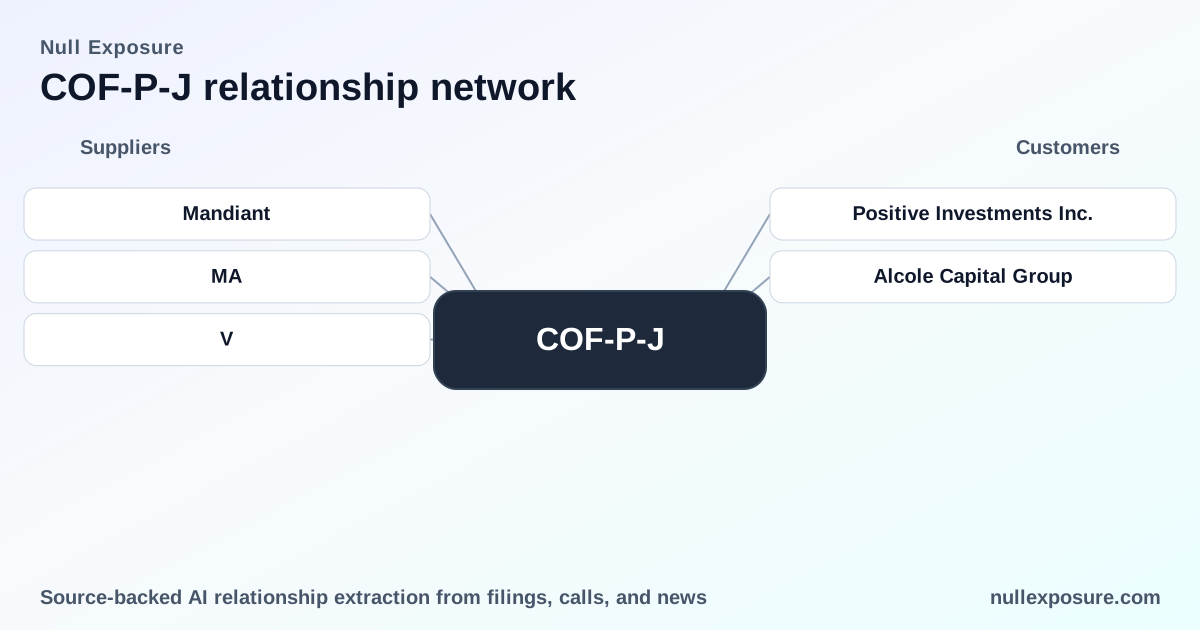
Capital One (COF-P-J) — supplier relationships and what they mean for investors
Capital One is a diversified U.S. bank holding company that monetizes through credit-card interest and fees, lending (including auto loans), deposit spread, and growing payment-technology fee capture. The company historically routed card transactions across Visa and Mastercard networks but is actively adjusting that footprint after strategic moves to build its own payments capabilities; it also engages third-party cyber forensics and incident-response vendors when needed. For investors and operators, the critical supplier exposures are payment networks (transaction routing and fee economics) and specialist cybersecurity firms (operational resiliency and legal exposure).
Explore more supplier intelligence at https://nullexposure.com/.
Executive read: what to watch in supplier risk and value capture
Capital One’s supplier posture is simple and consequential: long-term commercial dependency on major card networks drives fee and routing economics, while episodic engagement of specialist vendors supports operational continuity and legal defense. Contracting with external incident responders under non-privileged statements of work signals a pragmatic, externalized approach to acute risk events. The move toward an in-house payment network shifts the revenue mix and reduces counterparty concentration for transaction fees — a fundamental structural change to monitor.
Explore the full supplier map for COF-P-J at https://nullexposure.com/ for ongoing updates.
Counterparty map: Mandiant, Mastercard, Visa — the relationships investors need to know
Below are the supplier relationships surfaced for COF-P-J, with plain-English summaries and source references.
-
Mandiant — Capital One retained Mandiant in January 2019 under a non-privileged statement of work to perform incident response services, reflecting a reliance on external cybersecurity expertise for breach investigation and remediation efforts. This engagement surfaced in court and regulatory discussions around forensic reporting. (Source: Hunton & Williams privacy and cybersecurity blog covering the court fight over a forensic report, FY2020).
-
Mastercard — Capital One historically processed card transactions on the Mastercard network and continues to have economic and routing linkages with Mastercard; public commentary around executive compensation and business strategy reiterated that Capital One runs cards on both Mastercard and Visa networks. Recent strategic moves are reducing dependence on third-party networks for fee capture. (Source: American Banker coverage of Capital One card network usage, FY2025; CNBC analysis discussing reduced reliance after a payment-network acquisition, July 2025).
-
Visa — Visa is the other primary card network on which Capital One has historically run debit and credit transactions, representing a core commercial dependency for transaction routing and fee economics that impacts interchange flows and co-brand partner distribution. Market commentary indicates Capital One’s new payment-network capability changes the long-term routing and fee dynamics with Visa. (Source: American Banker on card network usage, FY2025; CNBC on the impact of Capital One’s payments acquisition, July 2025).
What these relationships imply for the operating model
Treat the following as company-level operating signals (no extracted constraints explicitly name a relationship entity).
-
Contracting posture: Capital One engages specialized external vendors for episodic, high-skill work (forensic incident response), and executes non-privileged statements of work when speed and operational transparency are required; this indicates a pragmatic operational stance that balances confidentiality with legal exposure management. The Mandiant SOW from January 2019 is an explicit example of that posture (Hunton, FY2020).
-
Concentration risk: Historically high — Visa and Mastercard have been central to Capital One’s card distribution and interchange economics. That concentration represents a meaningful vendor dependency risk for transaction routing and fee economics, although recent strategic moves to run a proprietary payments network reduce that dependency over time (American Banker; CNBC, FY2025 / July 2025).
-
Criticality: Payment networks are operationally critical — an outage or commercial dispute with Visa or Mastercard would materially affect transactional flows and fee revenue. Cybersecurity vendors such as Mandiant are operationally critical during breaches because they influence remediation speed, regulatory exposure, and reputational impact.
-
Maturity and tenor: Relationships with card networks are long-standing and embedded in processing infrastructure and commercial agreements; engagements with specialist vendors are typically short-term, event-driven, and focused on discrete deliverables (forensics, IR).
Risk and value considerations for investors and operators
-
Fee capture shift is the dominant thematic. If Capital One successfully migrates transaction volume onto its own network, the firm captures economic value previously retained by card networks; this improves revenue per transaction but requires scale and merchant acceptance.
-
Legal and disclosure dynamics around incident response are material. The use of non-privileged SOWs for forensic work increases the likelihood that vendor outputs enter legal/regulatory proceedings; that has both reputational and remediation-cost implications. (Hunton, FY2020).
-
Diversification reduces counterparty concentration but increases execution risk. Building and operating a payments network reduces reliance on Visa/Mastercard but requires ongoing investment, regulatory oversight, and merchant network effects to preserve or increase transaction economics.
Mid-deck action: practical next steps for supplier diligence
-
Review contractual terms and indemnities with Visa and Mastercard to understand termination, routing priority, and fee share mechanics. Companies with legacy routing dependency need explicit migration economics to justify the capex and operational shift. Learn more about supplier exposure monitoring at https://nullexposure.com/.
-
Evaluate incident-response contracting norms: non-privileged SOWs can be operationally quick but legally risky; demand clauses that protect forensic privilege where legally feasible without compromising remediation speed.
-
Model two scenarios for fee capture: continued reliance on card networks (status quo) versus accelerated migration to self-processing (capture upside but with execution and adoption risks).
Close: clear takeaways for the investor
Capital One’s supplier footprint is concentrated around two buckets: payments rails (Visa, Mastercard) that determine routing and fee economics, and specialist cybersecurity vendors (e.g., Mandiant) that determine incident resilience and legal exposure. The strategic pivot to own payments infrastructure is the largest supplier-related event for investors — it reduces concentration risk and increases revenue capture potential, but it also introduces execution and regulatory complexity. Investors should watch contractual terms, migration timelines, and continued third-party cybersecurity engagements as leading indicators of both risk and realized value.
For a deeper look at the COF-P-J supplier relationships and ongoing monitoring, visit https://nullexposure.com/.