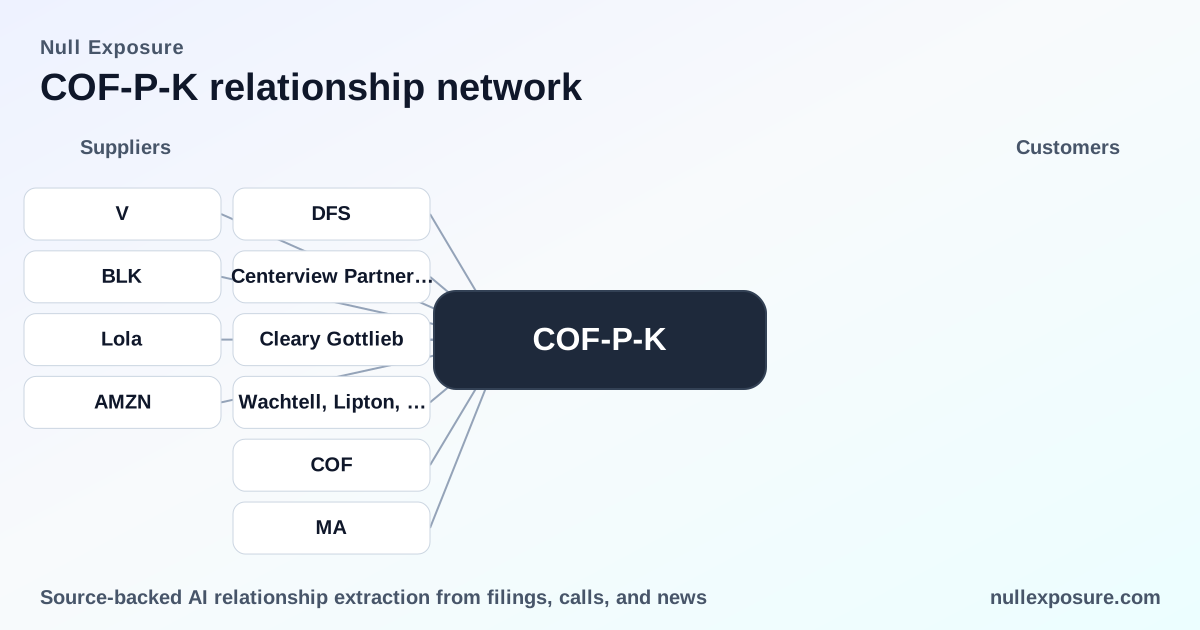
Capital One (COF‑P‑K): Supplier map and strategic implications for investors
Capital One Financial Corporation operates as a diversified U.S. bank holding company that monetizes through consumer and commercial lending, card interchange and fees, and deposit balances; the COF‑P‑K instrument is a preferred tranche that reflects capital structure exposure rather than operating cash flow. For investors and counterparties evaluating supplier relationships, the recent material in the market centers on network partnerships (Visa, Mastercard, Discover), strategic advisors on the Discover transaction, and a mix of technology and asset‑management counterparties that influence operational resilience and fiduciary outcomes. Understanding who delivers critical services—and who advised on strategic M&A—is essential to assessing operational concentration and legal/contractual risk.
Explore deeper supplier intelligence at Null Exposure.
How to read this map as an investor
Capital One’s supplier posture combines long‑dated, high‑criticality relationships (card networks and cloud providers) with episodic advisor engagements tied to M&A and litigation. Payment networks are mission‑critical to card issuance and debit routing; legal and financial advisors are episodic but material during transactions; asset managers and fintech targets indicate diversification of capabilities and investment in ecosystem growth. These dynamics translate into a contracting posture that is strategic and relationship‑driven, concentration that is meaningful in payments and cloud services, and supplier maturity that ranges from global incumbents to boutique advisors.
For direct supplier research, start with the payment rails and cloud contracts, then layer in advisor engagements and past acquisitions for talent/technology risk. For primary supplier analysis, visit Null Exposure to align counterparty diligence with portfolio exposure.
Relationship round‑up — what the public record shows
Below are every supplier/partner/advisor mentioned in the collected reports, each summarized in plain English with source attribution.
Discover (reported in The Financial Brand, FY2025)
Reporting indicates Capital One will move its debit business to the Discover debit network and shift some credit card flows to Discover as part of the post‑deal roadmap. According to The Financial Brand (March 2026), the Discover network is central to the integration plan (https://thefinancialbrand.com/news/banking-trends-strategies/the-surprising-places-capital-one-discover-deal-could-go-now-that-it-has-green-light-188817).
Centerview Partners LLC (reported in FinTech Weekly, FY2025)
Centerview served as Capital One’s financial advisor for the Discover acquisition, positioning the firm as a short‑term but material strategic advisor on valuation and deal structure. This engagement was documented by FinTech Weekly (March 2026) (https://www.fintechweekly.com/magazine/articles/capital-one-acquisition-discover-financial-services).
Cleary Gottlieb (reported in FinTech Weekly, FY2025)
Cleary Gottlieb acted as co‑antitrust legal counsel to Capital One during the Discover transaction, carrying responsibility for regulatory submissions and competition analysis. FinTech Weekly covered the firm’s role in the advisory team (March 2026) (https://www.fintechweekly.com/magazine/articles/capital-one-acquisition-discover-financial-services).
Wachtell, Lipton, Rosen & Katz (reported in FinTech Weekly, FY2025)
Wachtell, Lipton, Rosen & Katz provided primary legal advice to Capital One on the acquisition, a signal that Capitol One leaned on elite transactional counsel for deal execution. FinTech Weekly lists Wachtell as the lead advisor (March 2026) (https://www.fintechweekly.com/magazine/articles/capital-one-acquisition-discover-financial-services).
Mastercard Inc. (reported in Digital Transactions, FY2025)
Mastercard publicly addressed potential impacts from the Capital One–Discover combination, reflecting that existing Mastercard issuances form part of Capital One’s network mix and require operational planning. Digital Transactions noted Mastercard’s engagement on network implications (March 2026) (https://www.digitaltransactions.net/with-the-final-oks-the-capital-one-discover-combo-sets-a-may-18-closing/).
Discover Financial Services (reported in Digital Transactions, FY2025)
Discover’s Pulse debit network and credit card portfolio are key assets acquired by Capital One; the Pulse network handled substantial volume prior to the deal and now materially expands Capital One’s debit routing footprint. Digital Transactions quantified Pulse volume and positioned it as a strategic network gain for Capital One (March 2026) (https://www.digitaltransactions.net/with-the-final-oks-the-capital-one-discover-combo-sets-a-may-18-closing/).
Mastercard (reported in The Financial Brand, FY2025)
The Financial Brand reiterated Capital One’s status as an issuer on both Visa and Mastercard, underscoring multi‑network issuer relationships that preserve acceptance breadth for customers. The article references Mastercard alongside Visa in Capital One’s issuer mix (March 2026) (https://thefinancialbrand.com/news/banking-trends-strategies/the-surprising-places-capital-one-discover-deal-could-go-now-that-it-has-green-light-188817).
Visa (reported in The Financial Brand, FY2025)
Capital One historically issues Visa‑branded cards and will continue that relationship post‑transaction, maintaining a dual‑network issuance model that supports merchant acceptance and consumer convenience. The Financial Brand noted Visa’s role in the issuer mix (March 2026) (https://thefinancialbrand.com/news/banking-trends-strategies/the-surprising-places-capital-one-discover-deal-could-go-now-that-it-has-green-light-188817).
BlackRock (reported in PlanSponsor, FY2022)
BlackRock was involved historically as the provider of a target‑date fund series used as a qualified default investment alternative in plan litigation where Capital One was a defendant; this represents an asset‑management relationship with historic legal implications. PlanSponsor documented the dismissal of related ERISA suits (May 2022) (https://www.plansponsor.com/erisa-suits-capital-one-booz-allen-hamilton-dismissed/).
Visa (reported in Spokesman Review, FY2025)
A separate outlet also documented Capital One’s prior partnerships with Visa and Mastercard, reinforcing the company’s multi‑network strategy and the continuity of those contracts after the Discover purchase. The Spokesman‑Review covered the completion of the Discover purchase and noted Visa ties (May 2025) (https://www.spokesman.com/stories/2025/may/19/capital-one-completes-35-billion-purchase-of-disco/).
Mastercard (reported in Spokesman Review, FY2025)
The same report confirmed Mastercard’s historical partnership with Capital One, reinforcing network continuity and acceptance strategy. The Spokesman‑Review referenced Mastercard in its coverage of the transaction close (May 2025) (https://www.spokesman.com/stories/2025/may/19/capital-one-completes-35-billion-purchase-of-disco/).
Lola (reported in PYMNTS, FY2021)
Capital One acquired staff and software from travel fintech Lola to bolster its fintech capabilities in Boston, reflecting an acquisitive approach to capability building and talent capture. PYMNTS covered the Lola acquisition as part of Capital One’s fintech expansion (2021) (https://www.pymnts.com/news/partnerships-acquisitions/2021/capital-one-buys-travel-fintech-lola/).
Amazon Web Services Inc. (reported in SiliconANGLE, FY2022)
AWS appears in public records related to the 2019 data breach case because an ex‑AWS employee accessed cloud resources affecting Capital One, which highlights cloud‑provider risk and the operational dependencies on third‑party infrastructure. SiliconANGLE reported on the legal outcome surrounding the incident (October 2022) (https://siliconangle.com/2022/10/05/former-aws-employee-given-5-years-probation-capital-one-hack/).
Company‑level constraints and operating signals
No structured constraint excerpts were provided in the source collection; as a company‑level signal, investors should treat these operating characteristics as evident from the relationship profile:
- Contracting posture: strategic and advisor‑driven — long‑term network contracts combined with transaction‑specific legal/financial retainers.
- Concentration: meaningful in payments and cloud services — a handful of networks and cloud providers represent high criticality exposures.
- Criticality: high for payment rails and cloud infrastructure — these suppliers are operational lifelines for card acceptance and digital services.
- Maturity: mixed — global incumbents (Visa, Mastercard, AWS, BlackRock) coexist with boutique advisors and acquired fintechs.
These signals inform counterparty risk assessment, operational continuity planning, and legal exposure modeling.
Final takeaways and next steps
- Payment networks are the single biggest supplier risk vector for day‑to‑day business continuity and acceptance; the Discover integration reshapes that vector materially.
- Elite legal and financial advisors were deployed for the Discover deal, indicating prioritization of regulatory and valuation control during the transaction.
- Technology and asset management relationships are legacy and strategic — cloud security incidents and plan‑sponsor arrangements are governance considerations for investors.
For a structured supplier diligence workflow and to map supplier concentration into portfolio risk, see Null Exposure. For bespoke supplier‑risk briefings tied to capital structure instruments like COF‑P‑K, visit Null Exposure to commission focused research.