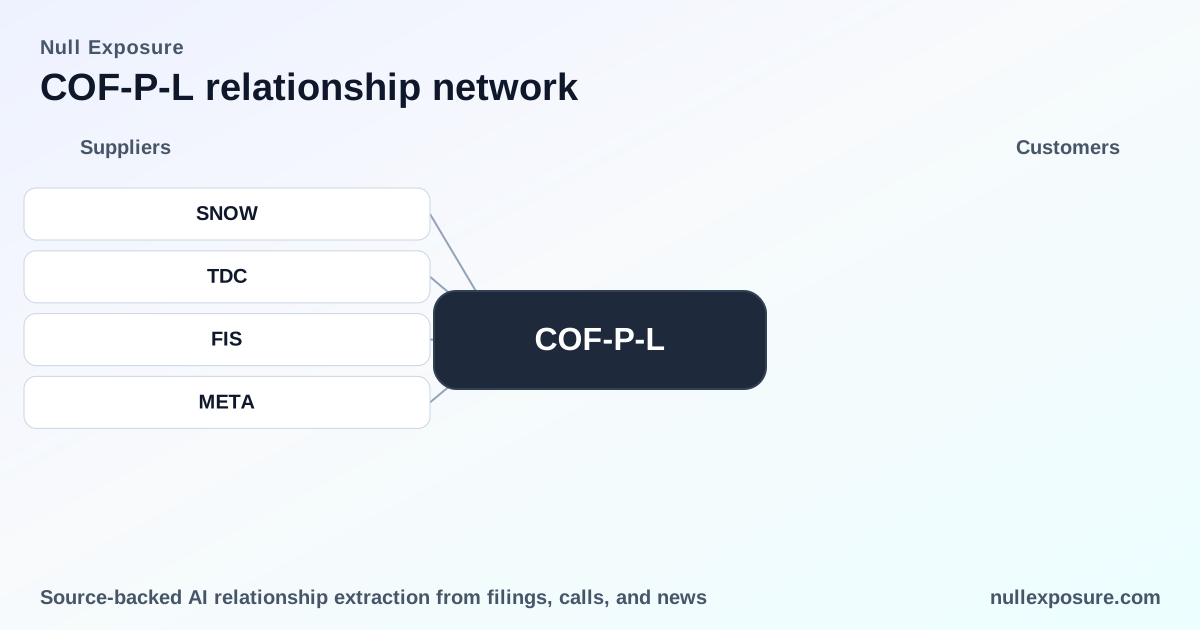
Capital One (COF-P-L): supplier map, operational constraints, and what investors should price
Capital One Financial Corporation operates as a diversified U.S. consumer bank: it originates and services credit cards, auto loans, deposit accounts and related services, and has recently begun commercializing internal engineering work as software. The company monetizes through net interest margin on lending, fee and interchange revenue, and increasingly through the sale of software and analytics capabilities built on its technology platform. For investors focused on operational resilience and third‑party exposure, supplier relationships are direct drivers of service continuity, cost of remediation and strategic optionality. Learn more at https://nullexposure.com/.
Why the supplier map matters for preferred‑equity investors
Preferred shareholders price the security not only on coupon and call mechanics but on the stability of the issuer’s cash flows. Third‑party outages, vendor concentration, and successful productization of internal capabilities all affect capital allocation, operating expense volatility and reputational capital. This analysis synthesizes public reporting on Capital One’s visible supplier footprint and draws out practical implications for investors evaluating COF‑P‑L exposure.
What the public record shows about Capital One’s supplier relationships
Snowflake Inc. (FY2022)
Capital One launched a commercial offering called Capital One Software based on work it executed during a multi‑year migration to Snowflake’s cloud data warehouse; the firm is explicitly packaging that engineering expertise into revenue‑generating software services. According to SiliconANGLE coverage of the FY2022 initiative, Capital One is turning Snowflake migration experience into a product line (https://siliconangle.com/2022/07/09/capital-one-sees-win-win-selling-software-built-snowflake-cloud/).
Takeaway: cloud data platforms have become a monetizable asset for the bank, not just an internal efficiency play.
Teradata Corp. (FY2022)
Capital One previously operated on on‑premises Teradata infrastructure for years before migrating off it, and public reporting highlights the limitations that on‑premises systems imposed on scale and user access. SiliconANGLE noted the legacy role of Teradata in the bank’s historical data stack (https://siliconangle.com/2022/07/09/capital-one-sees-win-win-selling-software-built-snowflake-cloud/).
Takeaway: legacy on‑prem dependencies were a constraint that the company explicitly addressed through multi‑year modernization.
FIS Global (FY2025)
A high‑profile availability incident was traced to a power failure at FIS Global, a vendor that provides payment processing and core services; reporting framed the outage as a third‑party failure that directly impacted Capital One customers and operations. The Financial Brand covered the event and its communication lessons in FY2025 (https://thefinancialbrand.com/news/bank-culture/communication-during-third-party-failure-what-to-learn-from-capital-ones-outage-186370).
Takeaway: incidents at critical payments and processing vendors translate immediately into customer friction and reputational risk for the bank.
Meta — Llama LLM (FY2025)
Capital One has publicized internal AI tooling that is built on Meta’s open‑source Llama family of large language models, signaling the bank’s adoption of externally developed model architectures for production use. Euromoney profiled Capital One’s AI roadmap and noted Llama as the underlying model technology in FY2025 (https://www.euromoney.com/article/2eh2s01l11023kmxtleyo/fintech/prem-natarajan-on-capital-ones-ai-stairway-to-heaven/).
Takeaway: advanced AI tooling is being integrated into the operating model and is supported by external ML ecosystems.
Operating‑model constraints and company‑level signals
No explicit contractual clauses or vendor limits are disclosed in the supplied results; however, the public relationship set signals a clear set of company‑level characteristics investors should factor into valuation and risk assessments:
- Contracting posture: Capital One demonstrates a hybrid posture — aggressive modernization plus selective productization of internal capabilities for external sale. That indicates supplier contracts are negotiated not only for cost and uptime but for strategic flexibility and IP portability.
- Concentration and substitutability: the bank relies on a small set of large, systemic vendors for core functions; this increases systemic concentration risk even as cloud migration improves substitutability over multi‑year horizons.
- Operational criticality: several suppliers occupy critical paths for customer experience and payments; any vendor outage has immediate earnings‑adjacent reputational consequences and potential remediation costs.
- Maturity of relationships: the firm has executed multi‑year migrations and now exploits external technology stacks commercially, suggesting vendor relationships are mature and evolving from integration to partnership and commercial leverage.
These company‑level signals should be treated as governance and operational risk inputs when sizing preferred security exposure.
Investment implications: what to watch and how to act
- Operational resilience is a financial factor. Outages at critical vendors translate into customer attrition, remediation spend, and higher regulatory scrutiny — all of which compress distributable cash available to preferred holders.
- Productization creates upside optionality. Selling software and analytics developed during modernization projects is a positive margin lever that reduces reliance on core banking spreads over time.
- Vendor concentration is a risk factor, not a binary failure. A small number of suppliers are systemically important; investors should monitor service‑level performance disclosures, remediation reserve levels, and vendor diversification efforts in Capital One’s public communications.
For a structured, investor‑grade supplier risk view, visit https://nullexposure.com/ to see how these relationships are tracked and stress‑tested.
A pragmatic checklist for COF‑P‑L investors
- Confirm whether Capital One’s public filings and earnings commentary quantify remediation reserves or one‑off costs associated with recent third‑party outages.
- Track product revenue disclosures tied to Capital One Software as a sign that technology commercialization is contributing to operating cash flow.
- Monitor vendor SLAs and redundancy commitments for payments and core processing to assess the realistic timeline for substitutability after an outage.
Bottom line and recommended next steps
Capital One’s supplier map shows a bank that has modernized aggressively, monetizes its engineering capability, but remains exposed to a small set of critical vendors whose failures have immediate financial and reputational consequences. Preferred investors should incorporate vendor concentration and operational resilience into yield premiums and monitor disclosures on software commercialization and remediation spend. For ongoing monitoring and a detailed supplier‑risk dashboard, go to https://nullexposure.com/.
For direct access to supplier intelligence and alerts that feed investment decisions, explore the platform at https://nullexposure.com/.