Cohen & Company (COHN): Supplier relationships that shape funding, distribution and legal execution
Cohen & Company is a publicly traded investment manager that monetizes through asset management fees, fund placement and distribution, and capital-markets activity including equity distribution programs and securities services. The firm operates a cross-border platform (U.S. and Europe) focused on alternative credit and insurance-linked strategies, generating revenue from management and performance fees while using third-party brokers, distribution partners and law firms to scale fundraising and capital markets execution. For investors evaluating counterparty exposure, the supplier roster points to concentrated clearing and meaningful reliance on external distribution channels for European vintage fundraising. Learn more about how these signals translate into investment risk and opportunity at https://nullexposure.com/.
How Cohen contracts and where vendor risk concentrates
Cohen & Company runs a lean operating model where external partners execute capital-raising, distribution and transactional work that would otherwise increase fixed costs. This produces a contracting posture that is outsourced and execution-driven: legal counsel for transactions, distribution partners for fund closings, and broker-dealers for capital markets and clearing services. Company filings and press coverage identify two structural signals:
- Clearing and financing concentration: company disclosures indicate heavy reliance on Pershing LLC for clearing services and margin financing, with a margin loan balance reported at $66.7 million as of December 31, 2024, placing annual supplier spend in the $10M–$100M band. That relationship is operationally critical to securities financing and short-term liquidity.
- Distribution criticality in Europe: fundraising for the PriDe IV vintage was driven by two distribution partners that together sourced the majority of commitments, underlining third-party sales channels as the principal route to scale in that market.
These company-level constraints make counterparties operationally significant and create concentrated counterparty risk for short-term financing and European fund flows.
Active capital-markets partners: equity programs and execution
Cohen launched an at-the-market equity program (ATM) of up to $75 million under an Equity Distribution Agreement dated February 20, 2026, using Northland Capital Markets and Cohen & Company Securities as sales agents to execute incremental equity issuance and liquidity for shareholders. TradingView reported the ATM program announcement in March 2026; this facility directly ties Cohen’s near-term capital structure flexibility to the execution capability of those sales agents. Key takeaway: the ATM amplifies funding optionality but puts execution dependence on two broker-dealer relationships.
Legal and fundraising partners behind PriDe IV
Cohen’s European vintage fundraising for PriDe IV closed at approximately €481.5 million and relied on specialist fund formation and distribution partners:
- Reed Smith LLP provided legal support for structuring the PriDe IV vehicles, with a team in Paris led by Baptiste Gelpi (reported in February–March 2026). Reed Smith’s role reflects standard externalization of EU legal and regulatory work.
- Alma Capital sourced 43% of total commitments through its distribution channels, acting as a primary placement partner for the vintage.
- Bury Street Capital secured 31% of commitments, representing the second major distribution engine for the fund.
Artemis and SahmCapital coverage in February–March 2026 documented these allocations and counsel roles. Key takeaway: fundraising success for PriDe IV is materially dependent on two external distributors that accounted for roughly three-quarters of commitments.
Transaction counsel used in U.S. acquisitions
For its U.S. M&A work, Cohen engaged Calfee, Halter & Griswold LLP as legal counsel in the acquisition of Tasso and Company (reported in FY2025). AccountingToday noted Calfee’s role, underscoring that Cohen uses established regional law firms for transactional execution rather than building large in‑house legal teams.
Relationship roster: quick plain-English takeaways
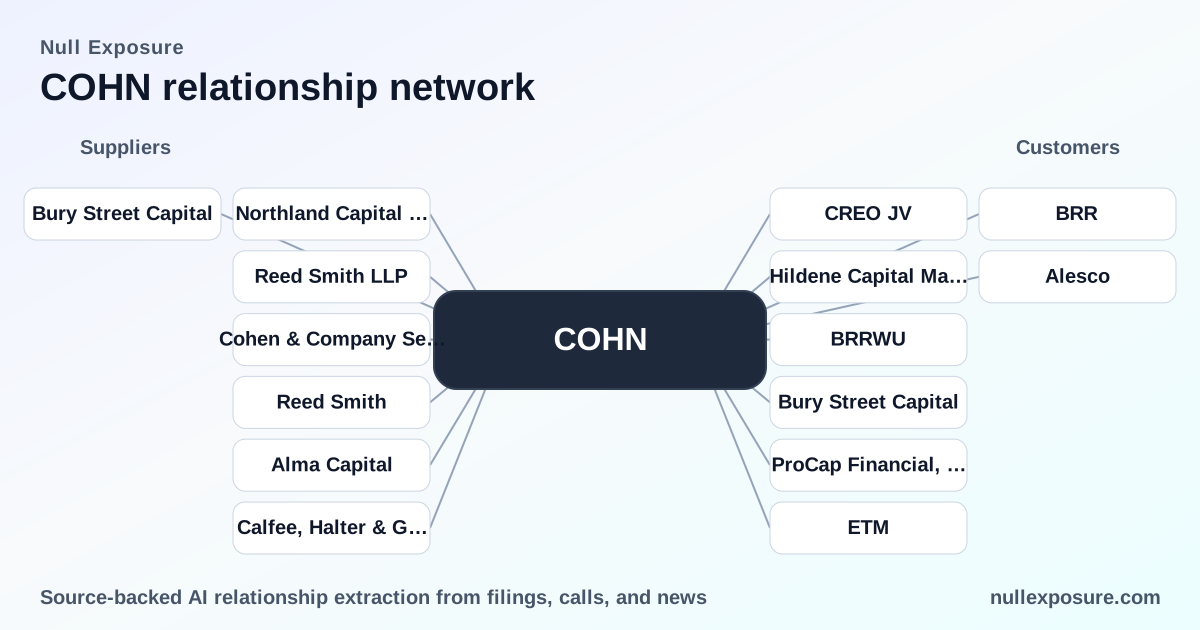
Below are concise, source-backed descriptions of every supplier relationship flagged in public coverage and news:
- Northland Capital Markets — Partnered with Cohen & Company and Cohen & Company Securities as sales agent on a $75 million ATM Equity Distribution Agreement (Feb 20, 2026) to provide on‑demand equity issuance capability. Reported by TradingView in March 2026.
- Cohen & Company Securities — Internal broker-dealer acting as a co-sales agent on the same $75 million ATM program announced February 20, 2026; coverage in TradingView (March 2026) shows the firm executing capital markets distribution alongside Northland.
- Reed Smith LLP / Reed Smith — Served as legal counsel to structure PriDe IV funds, with a Paris team led by Baptiste Gelpi assisting Cohen and Alma Capital in fund setup, as reported by SahmCapital and Artemis in February–March 2026.
- Alma Capital — Distribution partner that raised 43% of PriDe IV’s commitments through its network, cited in Artemis and SahmCapital reporting on PriDe IV fundraising (Feb–Mar 2026).
- Bury Street Capital — Distribution partner that secured 31% of PriDe IV commitments, playing a major role in the vintage’s success (Artemis, StockTitan, Feb–Mar 2026).
- Calfee, Halter & Griswold LLP — Served as legal counsel to Cohen & Company in the acquisition of Tasso and Company, with AccountingToday reporting the engagement in FY2025.
Each entry above includes the relevant news source and the fiscal/coverage period listed in those reports.
Discover combined counterparty analytics and how these relationships affect portfolio exposure at https://nullexposure.com/.
What these supplier ties imply for due diligence and valuation
Operationally, Cohen’s model is fee-driven and execution-dependent. For investors this generates three practical implications:
- Counterparty concentration risk: the Pershing clearing financing relationship and the two dominant European distributors create single‑point exposures that can affect liquidity and fundraising velocity.
- Execution risk tied to broker-dealers: ATM programs and securities financing put market and counterparty execution squarely in the hands of external brokers; successful capital raises depend on those agents’ market access and balance-sheet capacity.
- Outsourced legal/regulatory execution reduces fixed costs but increases vendor reliance: using firms like Reed Smith and regional counsel for transactions is efficient but raises the need to monitor vendor capacity and conflict management.
These are company-level characteristics documented in filings and media coverage, and they should be reflected in scenario modelling and stress tests for liquidity and fundraising outcomes.
Investment actionables and closing view
For investors and operators evaluating Cohen & Company, prioritize three actions:
- Review counterparty exposure to Pershing and confirm the current margin financing balance and terms in the latest filings and SEC disclosures.
- Monitor distribution concentration for European funds—specifically the ongoing roles of Alma Capital and Bury Street Capital—and adjust fundraising sensitivity assumptions accordingly.
- Track ATM execution updates from Northland and Cohen & Company Securities to assess dilution timing and capital flexibility.
Cohen’s model delivers growth through third-party distribution and capital markets levers, but that same model concentrates operational risk. For tailored supplier-risk intelligence and continuous monitoring of Cohen’s counterparty landscape, start here: https://nullexposure.com/.
Bold takeaway: Cohen scales via external execution — that drives lean margins and faster fundraising, but centralizes risk around a handful of brokers and distributors whose capacity and terms materially affect near-term liquidity and fund-raising outcomes.