COIA: Who issues the shares, who distributes them, and what that means for investors
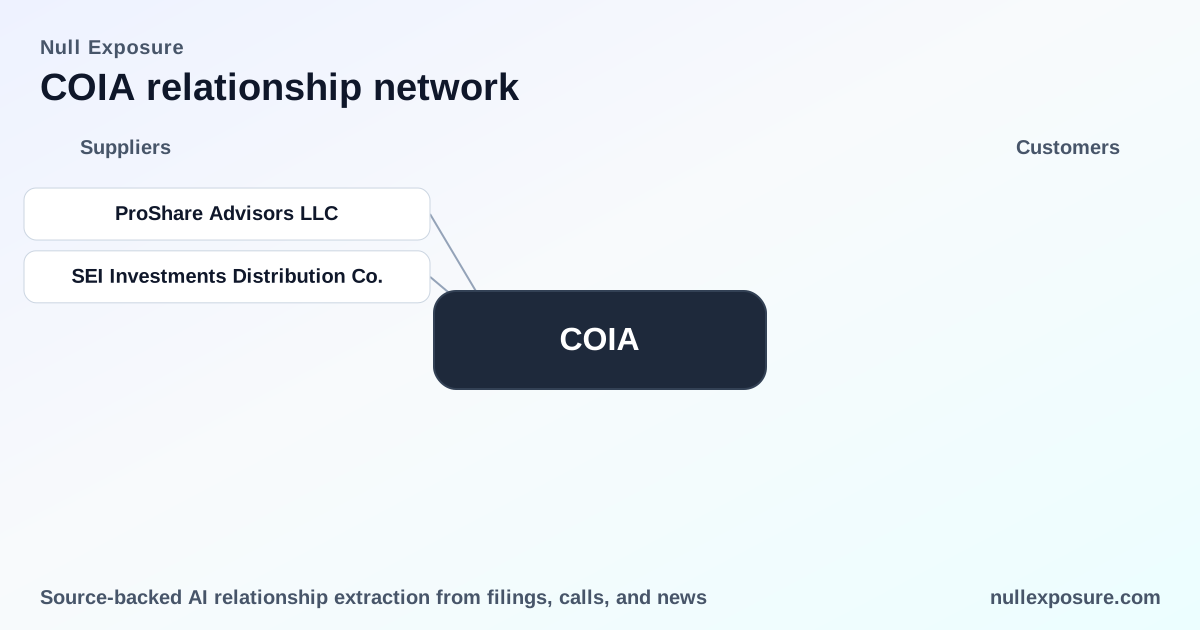
COIA is an exchange-traded instrument whose share issuance and distribution are managed through a classic issuer/distributor pairing. ProShare Advisors LLC issues the shares and captures advisory/management economics; SEI Investments Distribution Co. handles distribution and intermediary routing, enabling market access and order flow. Revenue for the instrument is therefore driven by advisory/management fees and distribution arrangements, while investor outcomes depend on liquidity and how those two counterparties execute their respective roles. For further supplier mapping and ongoing monitoring, visit https://nullexposure.com/.
The simple supplier map that matters to portfolio managers
COIA’s public supplier footprint in the dataset is narrow and functionally focused: an issuer/advisor and a distributor. That structure is common in exchange-listed funds but carries specific operational and concentration implications for investors who underwrite counterparty risk or manage trading execution.
ProShare Advisors LLC — issuer and manager
ProShare Advisors LLC is listed in the COIA profile as the entity that issues COIA shares; this places ProShare in the primary fiduciary and fee-collection role for the instrument. According to the TradingView AMEX-COIA profile (FY2025, first referenced Mar 9, 2026), ProShare Advisors LLC is the issuing adviser for COIA, implying control over portfolio construction, fee schedules, and primary issuer governance.
SEI Investments Distribution Co. — distributor
SEI Investments Distribution Co. is recorded as the distributor for COIA, making it the principal channel for share distribution and intermediary settlement processes. The TradingView AMEX-COIA profile (FY2025, first referenced Mar 9, 2026) identifies SEI as the distributor, which concentrates execution, clearing relationships, and institutional distribution responsibilities with a single named counterparty.
What the supplier list tells investors about operating posture and concentration
The supplier list is short and functional, and that yields several company-level signals about COIA’s operating model:
- Contracting posture: The issuer/distributor split signals a traditional principal-agent arrangement where ProShare retains strategic control and fee capture, and SEI executes distribution and settlement functions on behalf of the issuer. This posture centralizes strategic risk with the issuer while outsourcing market access and execution functions to the distributor.
- Concentration risk: Only two named counterparties in the dataset indicates concentrated supplier relationships, which elevates single-point-of-failure risk for distribution or issuance interruptions. Investors should treat distribution continuity and counterparty operational resilience as material due diligence areas.
- Criticality of partners: Both relationships are operationally critical—issuance and distribution are core to the security’s existence and liquidity. Disruption at either node directly impacts investor access and secondary-market functioning.
- Maturity signal: The dataset records the relationships for FY2025 and the references were first logged in March 2026, which reads as a standard lifecycle snapshot for a listed instrument rather than evidence of transitory or ad-hoc arrangements. Absence of frequent supplier churn is a positive governance signal.
For monitoring and comparative supplier intelligence across instruments, see https://nullexposure.com/.
Operational and market risks derived from the supplier map
Investors and operators should focus on a short list of high-impact risks that follow from the supplier configuration:
- Distribution concentration risk. A single named distributor concentrates counterparty exposure for order routing and post-trade settlement.
- Issuer governance and fee dependence. With ProShare in the issuing role, management-fee policy and strategic decisions are concentrated with the adviser; any changes to fee structure or share creation policy will have immediate investor impact.
- Operational dependency. Market access, NAV dissemination, and runs on liquidity are mediated through SEI and ProShare systems; operational outages at either party would be immediately consequential.
- Regulatory and compliance linkage. Both nodes sit squarely in regulated activities; regulatory actions or enforcement against either counterparty would materially affect product distribution and investor access.
Practical diligence checklist for investors and operators
- Confirm contractual arrangements and term lengths with both issuer and distributor as part of counterparty due diligence; prioritize continuity and escalation provisions.
- Validate distributor clearing and settlement chains—know where trade routing terminates and which custodians are in play.
- Monitor fee schedules and issuance policies controlled by the adviser; changes are value-relevant and potentially fast-moving.
- Maintain alternative distribution or liquidity strategies if you rely materially on COIA for exposure.
Dataset constraints and what they imply for monitoring
The supplier dataset for COIA contains no recorded constraints. This company-level signal should be interpreted as: no disclosed contractual restrictions, special covenants, or supplier constraints were captured in the source data for the FY2025 snapshot. That absence is informative: it reduces the visibility of latent limitations on supplier relationships and increases the importance of direct contractual review and ongoing monitoring of counterparties.
Mid-cycle monitoring should therefore emphasize direct counterparty documentation and operational testing rather than relying solely on public supplier snapshots. For streamlined supplier intelligence and continuous monitoring, visit https://nullexposure.com/.
Bottom line and next steps for investors
COIA’s supplier footprint is compact and functional: ProShare Advisors LLC issues the shares and captures advisory economics; SEI Investments Distribution Co. operates as the distributor. That structure delivers simplicity and clarity of responsibility, but it concentrates operational and distribution risk. Investors should prioritize contractual checks, distribution continuity planning, and active monitoring of both counterparties.
If you need a structured supplier map and ongoing alerts for COIA and related instruments, NullExposure provides tailored monitoring and analysis—start your review at https://nullexposure.com/.