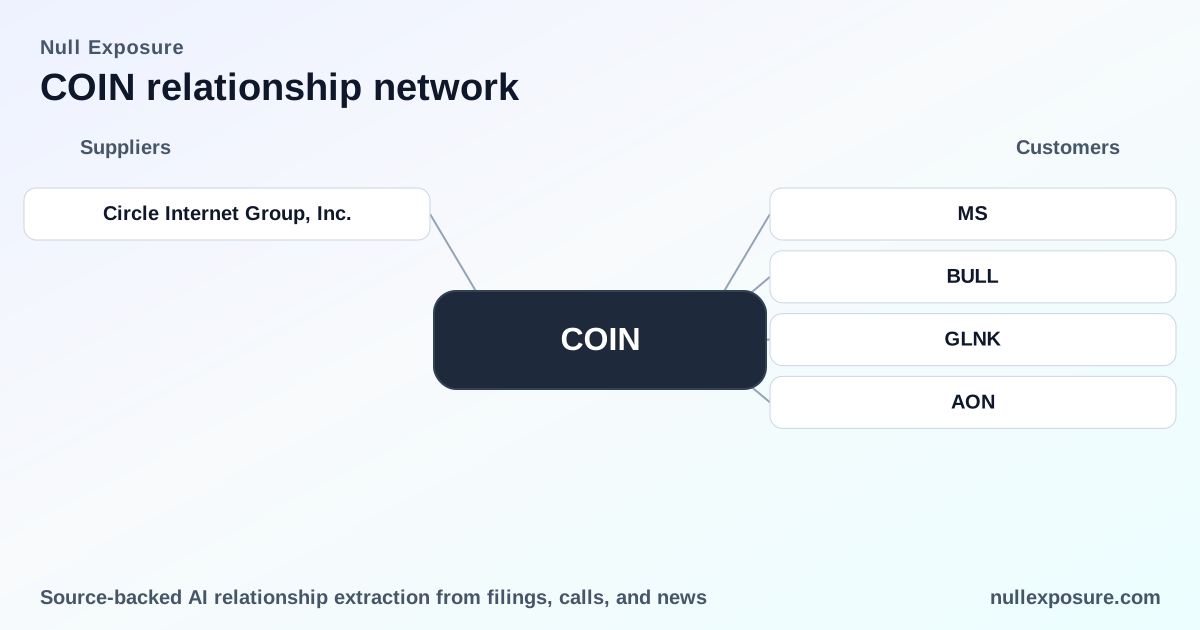
Coinbase (COIN) as a Supplier: what investors should know about counterparties and operational constraints
Thesis: Coinbase operates crypto financial infrastructure and monetizes through trading and services fees, custody and asset-management arrangements, and platform revenue tied to crypto activity; its supplier relationships and contract posture shape operational resilience more than raw market metrics. As of the latest filings, Coinbase generates roughly $6.9 billion of trailing revenue with a market capitalization near $54.8 billion, high beta and concentrated technology-service commitments that create specific supplier risk vectors for counterparties and operators evaluating COIN. For a focused supplier-risk dashboard and relationship intelligence, visit https://nullexposure.com/.
How Coinbase makes money and why suppliers matter
Coinbase is a platform business that converts crypto transaction flow into fee income and recurring service revenues — custody, staking, and institutional services amplify per-customer lifetime value. Platform uptime, custody integrity and third‑party tech integrations are therefore critical to revenue continuity: interruptions to key vendor services or changes in stablecoin economics can impair trading volumes and the fee base. Operating metrics show healthy profitability on a margin basis (profit margin ~18.3%), but the business remains sensitive to crypto market cycles and regulatory shifts that propagate through suppliers and stablecoin issuers.
The Circle (USDC) relationship — the one explicit counterparty in the record
Circle Internet Group, Inc. — Coinbase integrates USDC stablecoin economics into customer-facing yield-style programs and broader payments infrastructure. Recent reporting highlights the regulatory risk: a Reuters Breakingviews summary noted that the 2025 Genius Act prohibits stablecoin issuers from paying interest directly to holders, which affects how platforms like Coinbase structure USDC-based rewards programs and reserve-income economics. (News coverage, March 2026.)
Why the Circle link matters for suppliers and operators
Circle’s policy and reserve income model directly intersect with Coinbase’s product design: changes to stablecoin issuer economics can force Coinbase to reprice reward programs, shift reserve management, and alter merchant and custody flows, which in turn affects fee capture and product stickiness. Investors should track stablecoin regulatory developments and product reengineering costs as a supplier‑facing risk to platform revenue.
All supplier and counterparty signals from filings and public reporting
The public record supplies clear signals about Coinbase’s supplier posture and operational constraints. These are company-level attributes that influence how Coinbase engages vendors and how critical those vendors are to platform execution:
- Short-term contracting posture: Coinbase maintains some annual commercial crime insurance with a one‑year term and no automatic renewal provision; that annual reset exposes insurance coverage to yearly renegotiation and premium volatility. (Company filings, FY2025 disclosure.)
- Geographic concentration in North America: Operating leases and headquarter footprint center in San Francisco and New York, establishing regional concentration for corporate operations and vendor ecosystems. (Company filings, FY2025.)
- Immaterial third‑party custody for asset-management: Following the Coinbase Asset Management acquisition, Coinbase stores only an immaterial amount of cryptocurrencies at third‑party custodians for asset management products; this reduces large counterparty custody exposures at the product level. (Company filings, FY2025.)
- Service‑provider dependence: Coinbase explicitly depends on third‑party service providers for parts of its operations; interruptions at those vendors can impair customer support and platform functionality. (Company filings, FY2025.)
- Services segment concentration: Non‑cancelable purchase obligations are reported primarily for technology services, indicating multiyear commitments to software and infrastructure suppliers that create vendor concentration risk. (Company filings, FY2025.)
Together these signals describe a company that is vendor-reliant for critical tech services, operates with some short-term insurance coverage, and has immaterial outsourced custody on its asset‑management side — a mix that raises different diligence priorities than a capital‑intensive manufacturing supplier.
Operational posture and what it implies for counterparties
- Contract maturity: short-term insurance and a mix of non‑cancelable tech commitments mean inflection points are frequent — annually for insurance and at vendor contract renewal windows for tech. Counterparties should prepare for price and coverage volatility at those cadence points.
- Criticality and concentration: technology services are critical and appear to be a concentrated category of obligations; loss of a core vendor or a failure to replace a critical service quickly would have outsized operational impact.
- Materiality: the company discloses immaterial third‑party custody for asset management, reducing one class of counterparty exposure, but that does not eliminate critical operational dependencies on service providers.
- Geography: North American lease concentration focuses operational risk and recovery planning in those jurisdictions.
Mid‑article action item
If your firm evaluates counterparties or integrates with Coinbase, prioritize vendor resilience checks and stablecoin policy scenario analysis today: https://nullexposure.com/.
Investment implications — risks and upside through a supplier lens
- Regulatory risk filters through suppliers: stablecoin issuer rule changes (as reported in March 2026) alter product economics and require product redesign or margin compression. This is a clear revenue-routes risk that travels via the Circle relationship and stablecoin mechanics.
- Operational risk is concentrated in tech vendors: non‑cancelable technology commitments lock Coinbase into service paths; that supports continuity but creates switching and concentration risk that underwriters and partners must price.
- Insurance cadence increases event risk: the one‑year commercial crime policy with no automatic renewal puts the company at risk of coverage gaps or sharply higher premiums following large events, which suppliers and counterparties should factor into worst‑case loss scenarios.
- Balance of scale and market cyclicality: Coinbase’s size and margins give it resilience, but the business is cyclical and highly beta; supplier failures in a downturn would amplify revenue declines.
A practical due‑diligence checklist for operators and investors
- Confirm which tech services are non‑cancelable and assess alternate providers and migration timing.
- Model stablecoin regulation scenarios against Coinbase’s fee pools and rewards programs.
- Review insurance renewal timelines and limits for commercial crime/cold‑wallet coverage.
- Evaluate geographic continuity plans tied to San Francisco and New York office footprints.
Closing recommendation and next steps
For investors and counterparties, the priority is scenario planning and vendor robustness checks: regulatory changes to stablecoins and concentrated tech service commitments are the two vectors most likely to translate into economic impact. For ongoing supplier intelligence and real‑time relationship analytics, access our research hub at https://nullexposure.com/. If you need a tailored supplier-risk brief or contractual stress test for Coinbase, start with https://nullexposure.com/ and schedule a deep-dive.