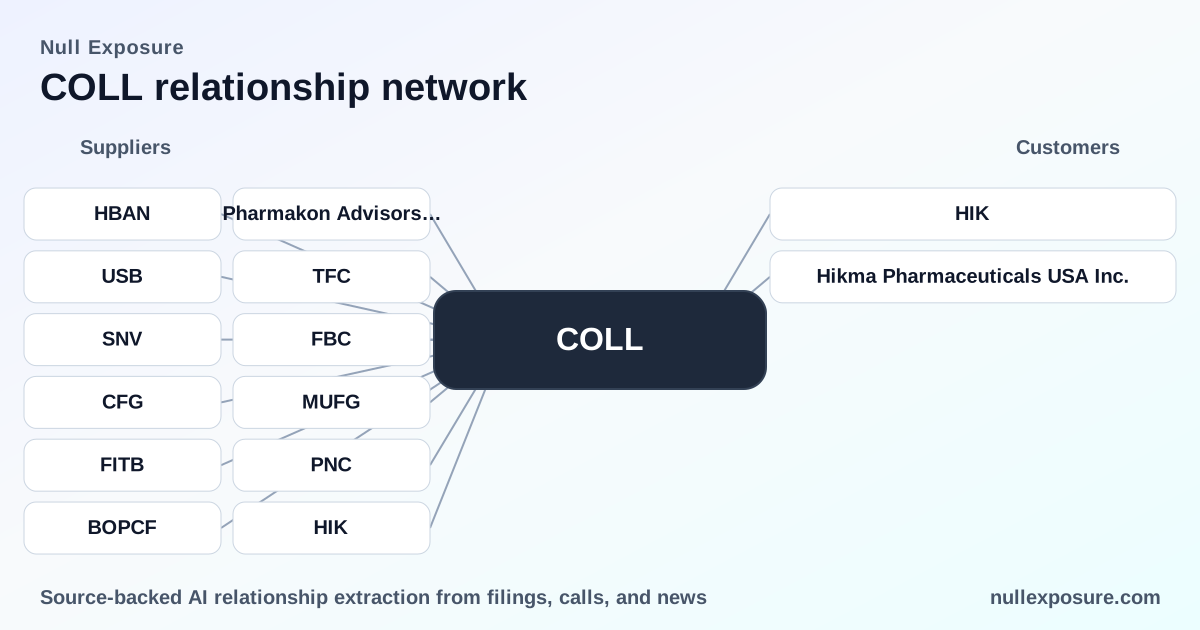
Collegium Pharmaceutical (COLL): Supplier and lender map for investors
Collegium Pharmaceutical operates as a specialty pain-management drug company that monetizes through product sales, licensing royalties and selective authorized-generic arrangements, while funding growth and balance-sheet activity with secured bank debt. The firm’s commercial footprint rests on a handful of branded products and licensed rights that generate recurring royalties and gross-margin rich revenue, and its capital structure is now anchored to a large syndicated credit facility that replaced prior lender commitments. For a quick organizational view, visit https://nullexposure.com/.
What the new credit package reveals about capital posture
Collegium has restructured its debt into a substantial senior secured credit agreement that consolidates multiple lending relationships under a syndicate led by Truist and a group of bookrunners and arrangers. This refinancing reduces exposure to a single lender facility, broadens banking relationships and creates a clearer debt amortization profile tied to term loans, delayed draws and a revolver. According to trading and press coverage, the original July 2024 facility was terminated and liens released as part of the refinancing process, improving flexibility for the company’s R&D and commercialization cadence.
Counterparty roster — every reported relationship and what it means
Below are concise, plain-English descriptions of every counterparty reported in the supplied results, with source context.
-
Pharmakon Advisors, LP — Collegium used part of the proceeds from the new term loan to repay approximately $581 million of principal that represented the remaining balance of a prior term loan secured from funds managed by Pharmakon Advisors. This was reported in a March 2026 news release covering the closing of the syndicated credit. (StockTitan / March 2026)
-
Truist Bank — Truist Bank served as administrative agent for the new senior secured credit agreement and is the lead banking counterparty in the financing syndicate that provided a $580 million term loan plus delayed draws and a $100 million revolver. (TradingView and StockTitan coverage, March 2026)
-
Truist Securities, Inc. — Truist Securities acted as a joint bookrunner and joint lead arranger in the new syndicate, coordinating underwriting and placement for the credit package. (StockTitan / March 2026)
-
Citizens Bank, N.A. — Citizens Bank participated as a joint bookrunner and joint lead arranger on the syndicated facility, signaling broad U.S. regional bank involvement in the deal. (StockTitan / March 2026)
-
MUFG Bank, Ltd. — MUFG was listed among the joint bookrunners and joint lead arrangers for the syndicate, providing international bank participation to the financing. (StockTitan / March 2026)
-
Fifth Third Bank, National Association — Fifth Third served as one of the joint bookrunners and joint lead arrangers on the syndicated credit, contributing to the multi-bank underwriting group. (StockTitan / March 2026)
-
The Huntington National Bank — Huntington was named among the joint bookrunners and lead arrangers for the syndicate. (StockTitan / March 2026)
-
U.S. Bank National Association — U.S. Bank participated as a joint bookrunner and joint lead arranger in the syndicated loan package. (StockTitan / March 2026)
-
Flagstar Bank, N.A. — Flagstar operated as a joint bookrunner and joint lead arranger for the facility and was also identified among co-documentation agents, reflecting support from regional lenders. (StockTitan / March 2026)
-
PNC Bank, National Association — PNC served as a co-documentation agent on the transaction, indicating involvement in finalizing credit documents and administrative structuring. (StockTitan / March 2026)
-
Synovus Bank — Synovus was named among co-documentation agents for the syndicated credit, rounding out the collection of regional bank support. (StockTitan / March 2026)
-
Biopharma Credit — Collegium repaid and terminated a July 2024 facility led by Biopharma Credit, with commitments ended and liens released as part of the refinancing activity. (TradingView reporting, FY2025)
-
Hikma Pharmaceuticals — Collegium announced supply and quality agreements with Hikma in January tied to an authorized-generic arrangement for Nucynta and Nucynta ER, reflecting a supplier and manufacturing partner role for authorized-generic supply. (Collegium Q4 2025 earnings call)
Operational constraints and company-level supplier signals
Collegium’s public disclosures and filings generate several company-level operating signals that are material for counterparty assessment and operational planning:
-
Licensing obligations drive cost structure: Collegium has explicit licensing arrangements that create ongoing royalty payments (for example, a 14% royalty to Grünenthal on Nucynta products). This establishes a predictable usage-based royalty line in gross margin. (Company license excerpts)
-
Usage-based royalty liabilities exist on certain products: The company carries deferred royalty obligations tied to product sales (Jornay), with changing rates over time and semi-annual payment schedules, which are effectively structural debt-like cash outflows. (Royalty payment disclosures)
-
Manufacturing concentration creates supply risk: Filings state reliance on sole or limited suppliers for active pharmaceutical ingredients and third-party manufacturers for products such as Jornay, which introduces a single/limited-source operational risk that could be material if disrupted. (Supplier concentration disclosures)
-
Role mix includes licensee and manufacturer dependencies: Collegium functions both as licensee to third parties (e.g., obligations to remitters under prior licenses) and as a counterparty that relies on contract manufacturers, which elevates the importance of robust supply agreements and contingency planning. (License and supply excerpts)
-
Committed minimum purchase obligations are modest but present: Contract manufacturing obligations include minimum annual purchase commitments in the low millions (up to roughly $3.0 million per year), indicating operational spend floors that impact short-term working-capital planning. (Purchase-obligation disclosure)
These signals underscore that Collegium’s operating model blends high-margin product sales with recurring royalty outflows and concentrated manufacturing relationships, requiring active supply-chain oversight and capital management.
For a deeper counterparty analysis and ongoing monitoring tools, check https://nullexposure.com/.
What investors and operators should watch next
- Refinancing execution reduces single-lender concentration risk and increases covenant transparency; monitor covenant tests and roll-forward liquidity figures at each quarterly report.
- Supplier concentration is a strategic operational risk: verify dual-sourcing options or validated secondary manufacturers for key APIs and finished doses.
- Royalty schedules that are usage-based can compress cash flow in periods of higher sales — model semi-annual royalty payment timing into free-cash-flow scenarios.
To review Collegium’s supplier and lender map alongside peer comparators, visit https://nullexposure.com/.
Bottom line
Collegium’s recent financing transaction realigns its banking relationships and extinguishes a prior private credit facility, while its commercial model continues to rely on licensed royalties and a small set of manufacturing suppliers. For investors, the combination of a broad banking syndicate, material licensing royalties and manufacturing concentration defines the primary financial and operational lever points; for operators, the priorities are supply diversification and precise cash-flow management against semi-annual royalty schedules. For ongoing coverage and counterparty intelligence, return to https://nullexposure.com/.