CONX Supplier Relationships: What investors need to know
CONX monetizes by leveraging third‑party distribution and channel partnerships to put its products and services in front of end customers; revenue flows from contractual supplier fees, distribution commissions, and service agreements tied to those intermediary relationships. The supplier footprint is a direct amplifier of market access and therefore a material driver of commercial performance and risk exposure. Explore supplier dynamics with confidence at https://nullexposure.com/.
One partner stands out — the roster in plain English
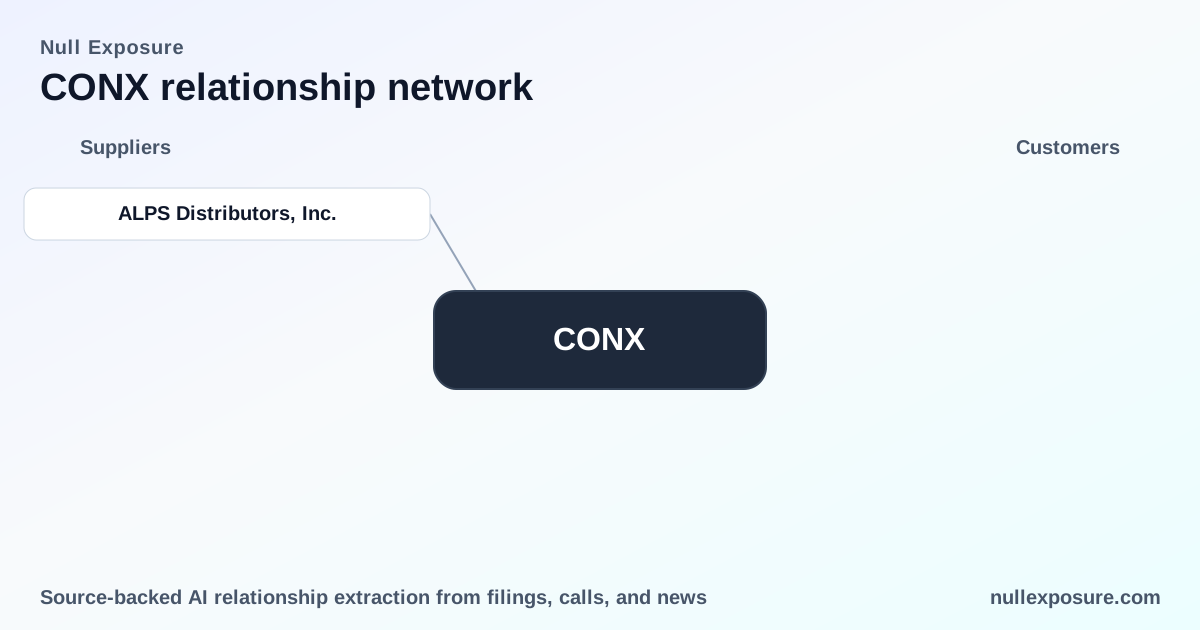
ALPS Distributors, Inc. — ALPS acts as a U.S. distributor for fund shares connected to the group of relationships under CONX’s supplier scope; the published mention specifies ALPS as the distributor for Direxion Shares in the United States only. According to a Direxion posting dated March 9, 2026, ALPS Distributors, Inc. is the distributor for the Direxion Shares in the United States only. This single entry is the only supplier relationship surfaced in the query results and therefore commands attention from investors evaluating distribution concentration and channel reliability.
What the supplier list implies about how CONX operates
With one disclosed supplier relationship in the provided results, CONX’s operating model exhibits the characteristics of a company that relies on third‑party channels to commercialize its offerings. Translate that into investor‑grade signals:
- Contracting posture: The firm operates through contractual distribution arrangements rather than owning full‑stack retail or sales channels. That implies negotiation of fee schedules, service SLAs, and compliance responsibilities with intermediaries.
- Concentration: The limited sampling implies concentration risk at the distribution layer; a small number of channel partners can create outsized revenue volatility if terms change or partnerships end.
- Criticality: Distribution partners are critical to reach and liquidity for the products that generate fees. Market access is therefore a principal operational dependency.
- Maturity: Relationships structured around established distributors like ALPS reflect a conventional, market‑standard distribution model rather than an experimental or proprietary route to market.
These company‑level signals matter for valuation and diligence: investors should treat distribution counters as operational magnifiers—driving both upside through scale and downside through concentrated counterparty risk. For a deeper look at supplier exposure across your portfolio, visit https://nullexposure.com/.
How the ALPS relationship translates into financial and operational realities
ALPS Distributors is a recognized fund distributor in the U.S.; for CONX this means access to retail and institutional investor channels without the fixed cost of owning those platforms. Distribution via ALPS converts product availability into monetizable flows, but it also embeds fee sharing and compliance dependencies into revenue. The Direxion post from March 9, 2026, supplies the single explicit mention of ALPS’s distributor role for Direxion Shares in the United States.
Operational implications tied to this arrangement include:
- Revenue mechanics — fees and commissions are structured around distribution usage rather than direct product sales.
- Compliance overlay — distributors often assume responsibilities for local regulatory disclosure and suitability processes, transferring certain costs and risks to the distributor but also making the distributor a potential legal and reputational vector.
- Renewal and negotiating dynamics — distributors set renegotiation cycles and can reprice or reallocate shelf space, which directly affects revenue forecasts.
Risk factors investors should price into CONX’s valuation
The supplier evidence drives several actionable risk considerations for portfolio managers and operators:
- Counterparty concentration risk is elevated. A small supplier universe amplifies the impact of a single termination or adverse contract renegotiation.
- Commercial re‑pricing is a persistent risk. Distribution partners control shelf access and fee mechanics; downward re‑pricing pressures reduce margins quickly.
- Regulatory and compliance spillover is real. Distribution arrangements offload some responsibilities but can create shared legal exposure in stressful market conditions.
- Operational continuity is dependent on partner maturity. Even established distributors introduce business continuity and tech‑integration risks that affect go‑to‑market performance.
These risks are not theoretical: the single documented relationship with ALPS is a concrete example of how distribution partners can dominate the supplier surface for a company like CONX. Investors should incorporate scenario analyses that stress contract loss, fee compression, and regulatory disruption into model runs.
Due diligence checklist for commercial and credit teams
To convert the supplier signal set into actionable diligence, teams should prioritize:
- Contract review: termination clauses, notice periods, exclusivity, and fee escalators.
- Concentration limits: measure revenue dependency by partner and define acceptable thresholds.
- Compliance mapping: who bears which regulatory obligations and what indemnities exist.
- Contingency planning: alternative distribution routes and conversion costs if a primary distributor exits.
These items determine how quickly revenue can be restored and how materially earnings would be impacted under shock scenarios.
Final takeaways and next steps for investors
CONX’s supplier profile—as surfaced in the results—is distribution‑centric and concentrated. The explicit ALPS Distributors relationship is useful for validating that the company uses established intermediaries to reach U.S. investors, but it also signals reliance on third‑party commercial arrangements that can compress margins and increase operational risk.
For teams that want continuous, structured coverage of supplier exposures and counterparty linkages, visit https://nullexposure.com/ to see how supplier mapping and relationship monitoring can be integrated into investment workflows.
Conclude diligence by quantifying revenue at risk from partner loss, stress‑testing contract renegotiation scenarios, and building playbooks for rapid re‑distribution. For strategic monitoring and to begin mapping supplier concentration into your financial models, go to https://nullexposure.com/.
Relationships covered in this briefing:
- ALPS Distributors, Inc. — ALPS is the U.S. distributor for Direxion Shares, cited in a Direxion news post dated March 9, 2026.