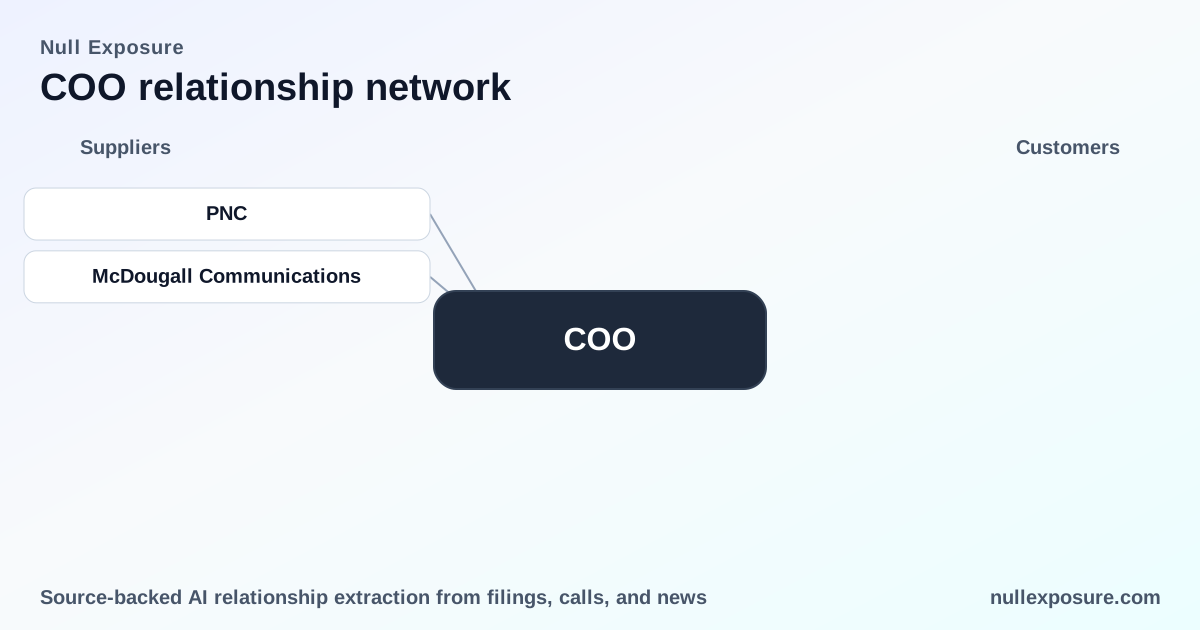
CooperCompanies (COO) — supplier map and implications for investors
Thesis: CooperCompanies operates as a global medical-device and vision-care platform that monetizes through recurring product sales (contact lenses and surgical products), periodic product launches that drive volume and mix, and disciplined capital management that supports growth without paying dividends. Revenue is driven by durable consumables and differentiated R&D-led product introductions, while earnings leverage shows up in healthy gross margins and operating margin. Investors should treat supplier relationships as extensions of Cooper’s working-capital and communications strategy: financing arrangements alter liquidity and leverage profiles, while retained PR and marketing partners shape revenue momentum and market perception.
If you want a focused supplier-risk briefing or benchmarking for this name, see the firm overview at https://nullexposure.com/.
What the recent supplier signals say about Cooper’s operating posture
The supplier records to date show two distinct relationship types: a financing counterparty managing debt structure and a PR agency supporting product launches and investor-facing communications. These are functionally different yet both influence near-term cash flow and investor sentiment—one by changing debt maturity and covenant flexibility, the other by shaping product adoption narratives, especially in key growth markets like Japan.
According to company financials, Cooper reported roughly $4.15 billion in trailing revenue and strong gross profit, underscoring the economic importance of smooth supplier and financing arrangements to protect margin and growth. For more supplier intelligence on healthcare names, visit https://nullexposure.com/.
PNC Bank — amendment to a term loan facility (FY2026)
CooperCompanies executed an amendment to its term loan agreement with PNC Bank acting as Administrative Agent, extending maturities and enhancing financing flexibility for a $950 million tranche through February 3, 2031. This transaction directly affects Cooper’s liquidity runway and interest-cost profile and should be modeled against the company’s EV/EBITDA and forward leverage targets. (Source: TradingView coverage of the PNC amendment, March 2026).
McDougall Communications — PR contact for CooperVision product launch (PR Newswire, FY2026)
McDougall Communications is listed as the media contact for CooperVision’s press release announcing the MiSight 1 day launch in Japan, indicating an ongoing agency role in global product rollout and earned-media execution. The firm’s presence on the press release demonstrates Cooper’s use of retained PR partners to accelerate adoption narratives in strategic markets. (Source: PR Newswire press release, March 2026).
McDougall Communications — repeat media contact appearance (StockTitan coverage, FY2026)
A second placement of the CooperVision launch citing McDougall Communications confirms the same agency acted as the primary external communications contact across multiple distribution channels, reinforcing that Cooper centralizes launch communications with a consistent external partner. (Source: StockTitan news republication of the CooperVision announcement, March 2026).
McDougall Communications — event/research PR citation (Finviz synopsis, FY2026)
A third reference shows McDougall Communications listed as media contact for CooperVision research and event communications, which underscores the firm’s role not only in product launch PR but also in supporting research dissemination that underpins clinical credibility and market penetration. (Source: Finviz news item summarizing CooperVision research support, March 2026).
How these supplier relationships translate into operational constraints and signals
The documented constraints provide company-level signals about procurement scale and third-party governance:
- Contracting posture: Cooper uses external service providers for specialized functions such as security testing and communications, which signals a hybrid in-house/outsourced operating model that prioritizes control over core manufacturing while outsourcing niche capabilities. This is consistent with the firm’s explicit use of external service providers for security and monitoring activities (company disclosures on third-party use).
- Concentration and spend: The company reports purchase obligations of roughly $585.1 million as of October 31, 2025, with $279.3 million due within the next 12 months—a clear indicator that supplier spend is material and that procurement decisions meaningfully affect short-term cash flow.
- Criticality: Management acknowledges that third-party legal or security failures could have a material adverse effect on operations; this raises the bar for vendor risk management and points to elevated oversight for suppliers that touch regulatory, privacy, or supply-chain-critical functions.
- Maturity: The presence of large committed obligations and formal amendments to financing agreements suggests a mature procurement and treasury function capable of negotiating multi-year commitments and dealing with complex counterparty arrangements.
These are company-level constraints; they do not attribute a particular risk to a specific supplier unless explicitly named in disclosures.
Investment implications — liquidity, narrative control, and risk prioritization
- Financing flexibility matters: The PNC amendment extending a $950 million tranche into 2031 reduces near-term refinancing pressure and should be modeled as a positive for free-cash-flow stability and deleveraging cadence. That change supports higher forward P/E and EV/EBITDA multiples staying intact during growth investments. (See TradingView note on the PNC amendment, March 2026.)
- Communications partners affect demand visibility: A retained PR firm active across press releases and event outreach increases the probability that new product launches—such as the MiSight 1 Day launch in Japan—translate into faster adoption curves and clearer analyst coverage. Effective PR reduces execution risk around commercial rollouts. (See PR Newswire, StockTitan, Finviz items, March 2026.)
- Operational risk remains material: Given the firm’s own language on third-party breaches producing material effects, investors should prioritize diligence on supply continuity, data-security controls with third parties, and the structure of key contracts where termination or breach could impair regulatory compliance or distribution.
For a granular supplier risk scorecard and peer comparisons, check our research hub: https://nullexposure.com/.
What to watch next (for operators and investors)
- Monitor Cooper’s disclosures for covenant language tied to the amended term loan and any associated cross-default provisions with other lenders; changes here will be the fastest lever on leverage and cash returns.
- Track earned-media cadence and clinical readouts for MiSight and other launches—consistent external PR signals increase likelihood of sustained sales growth in priority geographies.
- Watch purchase-obligation roll-forward in the next 10-Q/10-K cycle to see how the $585.1 million commitment evolves and whether near-term payables compress or extend.
Bottom line
CooperCompanies manages supplier relationships across two critical vectors: capital structure via secured loan amendments with major banks, and market execution via repeat PR partners. Both materially influence cash-flow predictability and revenue momentum. Investors should treat financing counterparties and retained communications agencies as strategic suppliers—each has a distinct, measurable effect on the company’s risk-adjusted growth story.
Explore deeper supplier and counterparty intelligence at https://nullexposure.com/ to align your valuation model to these operational levers.