COOT — Supplier Relationships and What Investors Should Price In
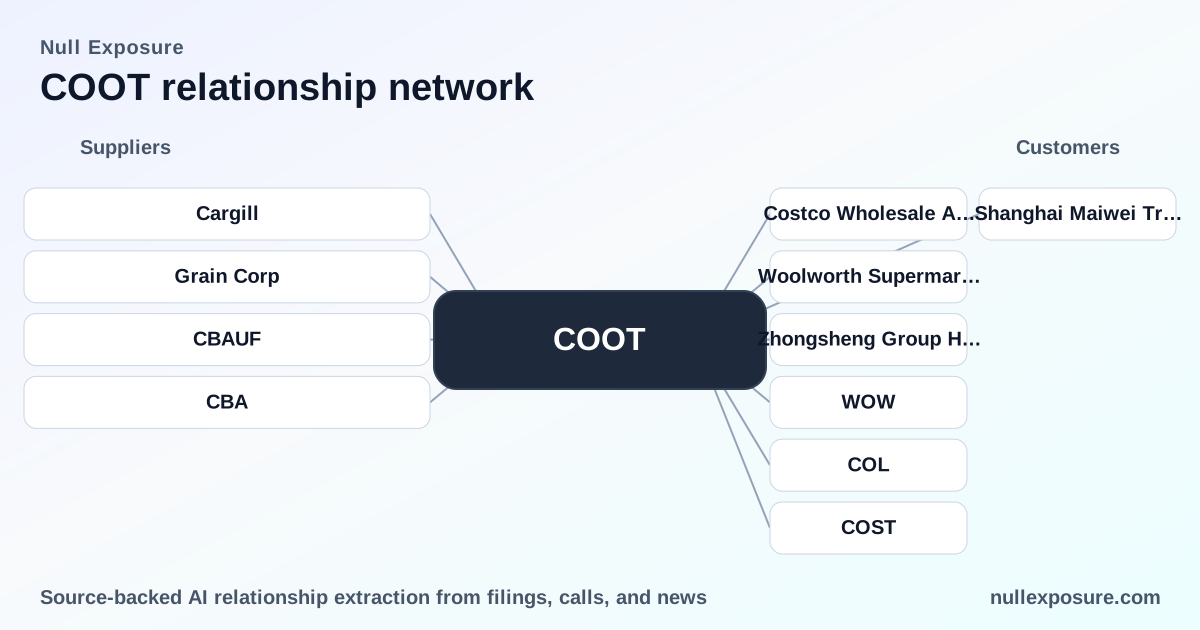
Australian Oilseeds Holdings (COOT) cultivates, processes and sells premium non‑GMO canola and related oilseed products; it monetizes through edible oils and protein meal sales to domestic and international buyers while sourcing seed and working capital from a concentrated set of agricultural suppliers and a senior banking facility. Revenue of roughly USD 41.7m with material procurement costs and a modest gross margin make supplier terms and bank funding central to near‑term liquidity and margin stability. For a deeper supplier-risk view and supplier mapping, visit https://nullexposure.com/.
The short thesis: procurement and financing drive the margin story
COOT operates as an agriculturally integrated packager: seed procurement, processing, and sale of oil and meals. The company’s cost base is dominated by raw seed purchases—cost of materials reported at ~AUD/USD equivalent of ~17.4m—which creates direct exposure to supplier concentration, seasonal supply shocks, and trade logistics in APAC. Operational leverage runs through processing capacity and the company’s ability to convert volatile input costs into stable product pricing.
How supplier relationships show up in filings and reporting
COOT’s public filings and trading reports identify a small number of counterparties that underpin both inputs and capital. These relationships are operationally critical given the size of procurement relative to revenue and the presence of a senior bank facility that supports capex and working capital. Below I cover every named relationship found in the latest source set, with concise takeaways and source citations.
Cargill — large agricultural trader supplying seed
COOT identifies Cargill as a source of high‑quality canola seed used in the company’s processing operation; Energreen purchases seed from Cargill alongside GrainCorp and other trade companies, indicating Cargill’s role as a material supplier in FY2024. According to the FY2024 company filing, Energreen sources quality canola seed from Cargill in Australia (COOT 10‑K, FY2024).
GrainCorp — local grain merchant participant
GrainCorp is listed alongside Cargill as a supplier of canola seed to Energreen, reflecting COOT’s reliance on both global and domestic grain merchants for raw inputs. The FY2024 filing names GrainCorp as a supplier of quality canola seed used in manufacturing (COOT 10‑K, FY2024).
Commonwealth Bank of Australia — senior lender and asset financier
Commonwealth Bank provides a senior debt facility (AUD 14.0m total facility, AUD 8.0m unused as at 30 June 2024) and has also supported plant expansion through asset finance, linking bank funding to both liquidity and capacity growth. The FY2024 filing details the senior lending facility and a TradingView report (SEC 10‑Q commentary) notes Commonwealth Bank‑backed asset finance for plant expansion (COOT 10‑K, FY2024; TradingView, FY2025).
What these relationships imply for operations and risk
- Concentration and spend scale: COOT’s procurement profile — with material costs around AUD 17.4m and single supplier line items like Energreen purchases of AUD 12.65m — signals meaningful vendor concentration in the 10m–100m spend band, making supplier terms and continuity a financial lever for margins. This is a company‑level signal drawn from cost disclosures and purchase line items in FY2024.
- Short contract posture: Trade and other payables are reported as unsecured, non‑interest bearing and normally settled within 30 days, which reflects a short‑term contracting stance that supports cash conversion but increases sensitivity to working capital volatility.
- Regional sourcing and logistics: Purchase activity is concentrated in APAC, with seed purchases and grower contracts anchored in New South Wales; this regional footprint concentrates weather, harvest timing and local logistics risk.
- Buyer and seller roles in the supply chain: The company operates as a buyer of seed from market traders and also sources directly from grower‑supply contracts; the constraints evidence shows Energreen functioning as a seller of seed to the company, while COOT is a buyer in grower and regional farmer arrangements.
- Relationship maturity and activity: The filings describe ongoing, active purchase flows (e.g., recurrent canola seed purchases), indicating mature, operational relationships rather than one‑off transactions.
Key takeaway: supplier terms, regional harvest outcomes and the Commonwealth Bank facility together determine COOT’s near‑term liquidity and capacity to scale processing — these are the levers investors must underwrite.
Risk and upside vectors investors should price
- Liquidity and covenant risk: Continued access to the AUD 14m facility and the unused AUD 8m headroom are material to going‑concern dynamics; any tightening of bank support would compress operational flexibility. (COOT 10‑K, FY2024)
- Commodity and operational risk: Given the short payables cycle and concentrated single‑season sourcing in APAC, a poor harvest or logistics disruption immediately pressures procurement costs and margins.
- Expansion and productivity upside: Asset finance from Commonwealth Bank tied to plant expansion increases throughput potential and could improve per‑unit margins if raw materials are secured on favorable terms (TradingView coverage, FY2025).
For a structured, actionable view of supplier concentration and bank dependencies, see the full analysis and supplier mapping at https://nullexposure.com/.
Relationship-by-relationship quick reference
- Cargill: A named supplier of quality canola seed feeding COOT’s processing lines; cited in the FY2024 filing as a material seed source for Energreen purchases. (COOT 10‑K, FY2024)
- GrainCorp: Listed alongside Cargill as a domestic grain merchant supplying canola seed used in COOT’s production chain; described in FY2024 procurement notes. (COOT 10‑K, FY2024)
- Commonwealth Bank of Australia: Senior debt provider with an AUD 14m facility and headroom cited at 30 June 2024; also the financier of plant expansion through asset finance as reported in company filings and a trading news summary in FY2025. (COOT 10‑K, FY2024; TradingView report, FY2025)
What investors should do next
- Reconcile procurement timing with upcoming seasonal reports and watch covenant language in the next bank filing; liquidity is the primary near‑term valuation risk.
- Monitor receivable and payable days; the company’s short payables posture gives COOT some operational agility but increases vulnerability to input price spikes.
- Consider supplier‑level diligence for Cargill and GrainCorp exposures and track Commonwealth Bank communications on facility terms.
For a deeper supplier exposure model and tailored counterparty reports, visit https://nullexposure.com/ — our portal aggregates these counterparty signals into investable summaries.
Final read: facts to price into the model
COOT is a small‑cap processor where procurement economics and bank funding are the decisive variables for margin recovery or deterioration. The FY2024 filings and FY2025 reporting show active, APAC‑centred seed supply relationships and a material senior bank facility that underwrites capacity expansion; investors must therefore underwrite both the agricultural cycle and the banking relationship when valuing COOT. For ongoing monitoring and supplier‑concentration alerts, explore the COOT supplier dossier at https://nullexposure.com/.