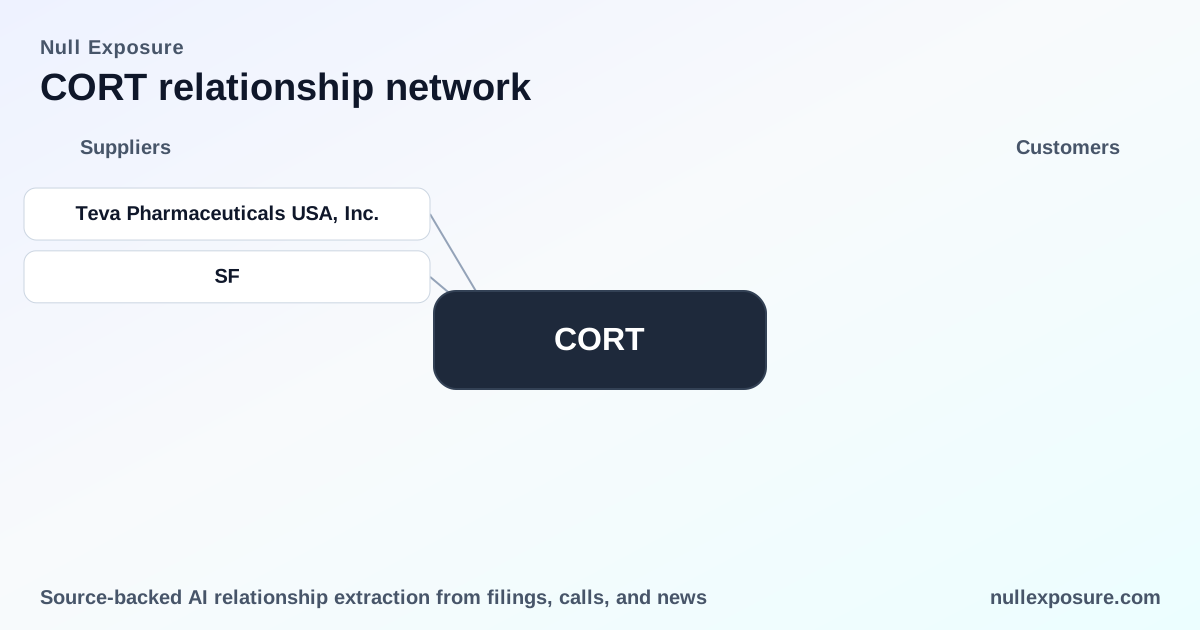
Corcept Therapeutics (CORT) — supplier map and what investors need to know
Corcept discovers, develops and commercializes specialty therapies and monetizes primarily through prescription sales of its marketed products, supported by a single specialty pharmacy and a specialty distributor that handle logistics and billing. Revenue collection and patient access for Corcept are centralized through that pharmacy channel, while manufacturing and clinical development are outsourced to contract manufacturers and contract research organizations (CROs). For an at-a-glance supplier risk feed and relationship tracking, visit https://nullexposure.com/.
Thesis: a specialty-biotech that outsources the plumbing — and that concentration is the risk
Corcept’s commercial model is high-margin product sales supported by a tightly controlled distribution and reimbursement engine. Optime, the company’s single specialty pharmacy, handles dispensing and insurer collections for essentially all product revenue, creating a single-point dependency for cash collection and patient services. Manufacturing and clinical execution are outsourced, and Corcept contracts with third-party CROs under short-term arrangements. Together these features produce a business that captures upside from product pricing and specialty distribution, while exposing the company to outsized supplier concentration and switching risk.
Visit https://nullexposure.com/ for supplier diligence tools and provider intelligence.
How Corcept runs the supply chain and why that matters to investors
- Revenue capture is centralized. Corcept’s 10‑K states that its single specialty pharmacy dispenses products and handles patient support and insurer collections that account for more than 99% of revenue — a critical dependency for both cash flow and patient access.
- Manufacturing is outsourced. The company relies on contract manufacturers to make marketed products and candidates, establishing material but distributed manufacturing risk that depends on the quality and continuity of third‑party operations.
- Clinical services are outsourced with short-term contracts. Corcept names CROs by contract (Syneos Health and Medpace Research) and retains termination rights on short notice (for example, a 60‑day termination right for Syneos), indicating a short-term contracting posture for clinical services that gives Corcept operational flexibility but also implies potential churn or transition risk if trials require continuity.
- Distribution role is clearly outsourced. Corcept uses a specialty distributor alongside its specialty pharmacy to support logistics to physicians and patients, positioning distribution as a vendor-managed function rather than in‑house infrastructure.
Taken together, these characteristics create a supplier footprint that is operationally lean and commercially centralized: high leverage on a small number of service partners and a single pharmacy-distributor channel.
Constraints shaping supplier risk and operational posture
- Short-term contracting for CRO services. The company discloses that it may terminate agreements with Syneos Health on 60 days’ written notice and may terminate with Medpace Research without cause at any time, signaling a short-term, flexible contracting stance for trial execution.
- Critical revenue concentration at a single pharmacy. Corcept discloses that Optime dispenses its products and collects payments from insurers representing more than 99 percent of revenue — a critical concentration that elevates counterparty risk and operational single-point-of-failure concerns.
- Material reliance on contract manufacturers. The firm explicitly states dependence on contract manufacturers for production, which is a material but diversifiable manufacturing risk depending on the number and capacity of suppliers.
- Defined supplier roles. The company describes using a specialty pharmacy, a specialty distributor, contract manufacturers, and CROs — reflecting a distributed supplier ecosystem where distribution and patient services are outsourced and manufacturing/clinical roles are delegated to third parties.
Where constraint excerpts name vendors, they reflect explicit relationship roles (for example, Syneos and Medpace as CROs and Optime as the pharmacy). Where constraints are generic, treat them as company-level operating signals rather than ties to a single external counterparty.
The recorded relationships in Corcept’s public filings and filings coverage
Below are the relationships captured in the supplied records. Each relationship is followed by a concise, plain‑English note and the cited source.
-
Teva Pharmaceuticals USA, Inc.
Corcept reports that Teva launched a generic version of Korlym in January 2024, introducing a direct competitor to Corcept’s marketed product and altering the commercial terrain for that indication. This development is disclosed in Corcept’s FY2024 Form 10‑K. (Source: Corcept FY2024 10‑K, disclosure on generic launch.) -
Stifel Nicolaus & Company Inc.
A Form 144 filing reported on StockTitan in early March 2026 names Stifel Nicolaus & Company Inc. as the broker‑dealer associated with a planned sale of 20,000 Corcept common shares, signaling a specific execution channel for insider or restricted sales. (Source: SEC Form 144 reported via StockTitan, March 2026.)
What investors should take away from these relationships
- Competitive pressure from generics is explicit and documented. The January 2024 Teva launch is a factual read through to product revenue risk; investors should model accelerated pricing and market-share pressure for the affected label and review sales trends post‑launch in quarterly results. Teva’s presence changes revenue durability assumptions for Korlym.
- Insider liquidity events are trackable through broker filings. The Form 144 naming Stifel reflects a point execution method for planned secondary sales and is a signal to monitor insider activity and downward pressure on float in the short term.
- Operational concentration is the dominant supplier risk. The Optime dependency (99% of collections) is the single largest supplier‑related risk to cash and patient access; Corcept’s ability to maintain payer relationships and uninterrupted dispensing through that pharmacy is a critical operational KPI for investors to monitor.
- Short-term CRO contracts reduce lock-in but require active vendor management. While the 60‑day termination right gives Corcept flexibility, it also requires robust vendor transition planning if trials become contingent on long‑running capabilities or data continuity.
If you want a consolidated supplier risk dashboard and continuous monitoring for Corcept, explore supplier intelligence at https://nullexposure.com/.
Actionable steps for investors and operators
- Monitor Corcept quarterly revenue and product‑level disclosures for the post‑generic impact on Korlym.
- Track Form 4/Form 144 filings and broker disclosures for insider selling channels and volumes.
- Evaluate contingency plans and redundancy for Optime and major contract manufacturers — assess whether backups exist and how rapidly transitions could be executed.
For ongoing monitoring and deeper relationship mapping of Corcept’s supplier footprint, visit https://nullexposure.com/ — the hub for supplier diligence and risk scoring.