Core Scientific (CORZ) — Supplier relationships, capital posture, and operational constraints investors should price in
Core Scientific operates large-scale digital-asset and high-performance computing (HPC) infrastructure across the United States and monetizes through two principal avenues: hosting/colocation services for AI and HPC workloads and historical digital-asset mining operations that generate or monetize compute capacity and related services. Revenue derives from long-term hosting contracts and capacity sales, while capital intensity is funded through large financing packages and vendor equipment agreements. For investors and operators evaluating supplier risk, the company’s commercial profile is defined by heavy upfront capital commitments, concentrated equipment sourcing, and critical utility and financing counterparties.
Explore the full supplier mapping at https://nullexposure.com/.
What matters most up front
Core Scientific runs a capital-intensive transition from mining to HPC colocation. This is a balance of converting existing facilities, sourcing specialized ASICs and servers, and securing flexible electricity contracts—each element creates supplier dependencies that affect cash flow, execution timing, and audit integrity. Key implications for investors: capital commitment concentration, counterparty risk with financiers, and audit/controls scrutiny.
Every reported relationship, one by one
Below I list each relationship mentioned in the data feed and give a concise plain-English takeaway with a source reference.
-
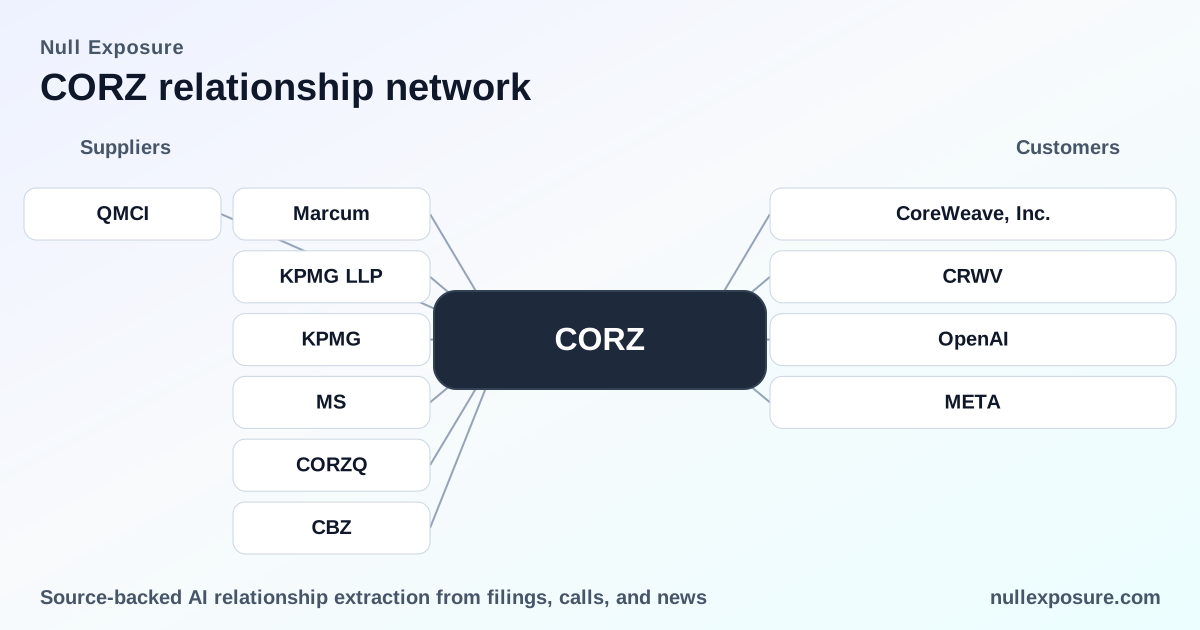
Marcum — Marcum served as the company’s auditor before the early‑2025 auditor change; management explicitly states they changed auditors to KPMG in early 2025. According to a transcript of the Q4 FY2025 earnings call reported in March 2026, Core Scientific confirmed the switch away from Marcum. (The Globe and Mail / Motley Fool, FY2026 transcript, March 2026)
-
KPMG LLP / KPMG — KPMG is now the company’s independent registered public accounting firm and was engaged in the FY2025–FY2026 financial statement preparation that identified an overstatement of property, plant and equipment due to improper capitalization tied to facility conversions. Core Scientific disclosed that determination in its FY2026 press release and attributed the adjustment to work performed during the change in independent auditors. (Core Scientific investor press release, FY2026; March 9, 2026)
-
Morgan Stanley — Morgan Stanley is a principal financing counterparty; press coverage and analyst notes reference a reported $1 billion loan provided to Core Scientific to support the AI/HPC pivot and working capital needs. That financing is material to execution of the capex program and the company’s liquidity profile. (Finviz and financial news reports relaying Morgan Stanley coverage, FY2025–FY2026)
-
Morgan Stanley Senior Funding RE — Core Scientific entered a loan facility or credit agreement with an affiliate described as Morgan Stanley Senior Funding RE, indicating structured financing beyond a bilateral bank loan that supports the company’s infrastructure conversion. This facility is cited in FY2026 earnings and market reporting. (MarketScreener earnings flash and FY2026 market coverage, March 2026)
-
Core Scientific (internal contractor mention / CORZQ entry) — Reporting noted that CoreWeave has teams working with contractors and Core Scientific on site to accelerate remediation and conversion work at facilities. This illustrates reliance on third‑party contractor coordination during the transition to HPC. (CNBC coverage on operational delays and remediation, November 11, 2025)
-
CBIZ — Prior to KPMG, CBIZ (formerly associated with Marcum LLP in disclosures) is referenced in the company’s FY2026 press release as the predecessor auditor in the auditor transition and in the review of interim statements where PPE was overstated. (Core Scientific investor press release, FY2026; March 9, 2026)
-
QuoteMedia — QuoteMedia is used to power market data on Core Scientific’s investor pages, indicating a vendor relationship for investor-facing market information and site data. This is visible on the company’s investor releases and web pages. (Core Scientific investor relations release referencing Market Data powered by QuoteMedia, FY2025)
Operating-model constraints that shape supplier risk
The company-level constraints reported provide a clear view of how supplier relationships translate into execution risk and margin exposure:
-
Geography and scale: Core Scientific is converting and operating facilities across multiple U.S. states—Alabama, Georgia, Kentucky, North Carolina, North Dakota, Oklahoma, and Texas—with ten sites undergoing construction, refurbishment, or conversion to support AI workloads. This national footprint creates varied regulatory, utility, and labor exposure while diversifying geographic power risk. (Company disclosures describing 2024 conversion activity)
-
Contracting posture: The company contracts for equipment with significant refundable deposits and advance payments, indicating a vendor payment profile that front-loads cash outflows and creates recovery risk if projects are delayed or cancelled. This is a buyer signal in vendor relationships. (Vendor agreement language cited in corporate disclosures)
-
Supplier concentration and manufacturing relationships: Historically, Core Scientific sourced substantially all miners from Bitmain and entered a deal with Block, Inc. for customized 3 nm ASICs—evidence of concentrated manufacturing relationships for specialized mining hardware that can create single‑source risk for replacement capacity. (Corporate supplier history statements)
-
Critical service dependencies: The company maintains fixed, variable and interruptible bilateral power supply agreements with large electric utilities—electricity is an operational prerequisite and a directly consequential service-provider relationship. Interruptions or price shocks in power agreements are operationally critical. (Utility contracting disclosures)
-
Capital intensity and spend maturity: As of December 31, 2024, Core Scientific reported approximately $1.14 billion of contractual capital commitments for infrastructure modifications, equipment procurement, and labor tied to the conversion program—this establishes the company’s 100m+ spend band and highlights multi‑year execution and financing risk. (Corporate filings and FY2024/2025 disclosures)
If you want a consolidated supplier risk scorecard or a prioritized counterparty heatmap for CORZ, go to https://nullexposure.com/ for the full supplier view.
Why the audit and accounting disclosures change the risk profile
The audit transition to KPMG and the company’s admission that property, plant and equipment were overstated in interim statements is an operational red flag for investors: it signals weaknesses in capitalization controls during a period of rapid asset conversion, and it increases the likelihood that vendor invoices, asset retirements, and demolition liabilities are not being synchronized with accounting entries. Core Scientific disclosed this in its FY2026 press material when describing the auditor change and the subsequent accounting correction. (Core Scientific investor press release, March 2026)
Financing and operational execution are tightly linked
The Morgan Stanley financing and the Morgan Stanley Senior Funding facility are not peripheral; they are cornerstone counterparty relationships that enable the $1.14 billion conversion program. Any disruption to these financing lines or covenant strain will translate directly into delayed equipment deliveries and postponed utility contract activations. Analyst coverage has framed the Morgan Stanley support as central to the company’s AI pivot. (Market reporting and analyst notes, FY2025–FY2026)
Final read and action items for investors and operators
- Audit & controls: Monitor subsequent filings for the final quantified impact of the PPE overstatement and for any auditor commentary on remediation—accounting control weakness is the primary near‑term supplier risk signal.
- Counterparty concentration: Track supplier concentration with Bitmain/ASIC suppliers and financing terms with Morgan Stanley affiliates; both are critical to execution.
- Cash and capex sequencing: The $1.14 billion contractual capex footprint demands scrutiny of milestone payments, refundability of deposits, and sequencing of supplier deliveries.
For an in-depth supplier risk assessment and prioritized counterparty heatmap tailored to CORZ, visit https://nullexposure.com/.
If you want a downloadable counterparty list and the source-links used for this analysis, start here: https://nullexposure.com/.
Bold takeaway: Core Scientific’s supplier landscape is defined by heavy upfront vendor commitments, concentrated hardware sourcing, critical utility contracts, and financing relationships that are essential to completing the company’s strategic pivot to HPC—these attributes materially influence execution risk and must be priced into any investment decision.