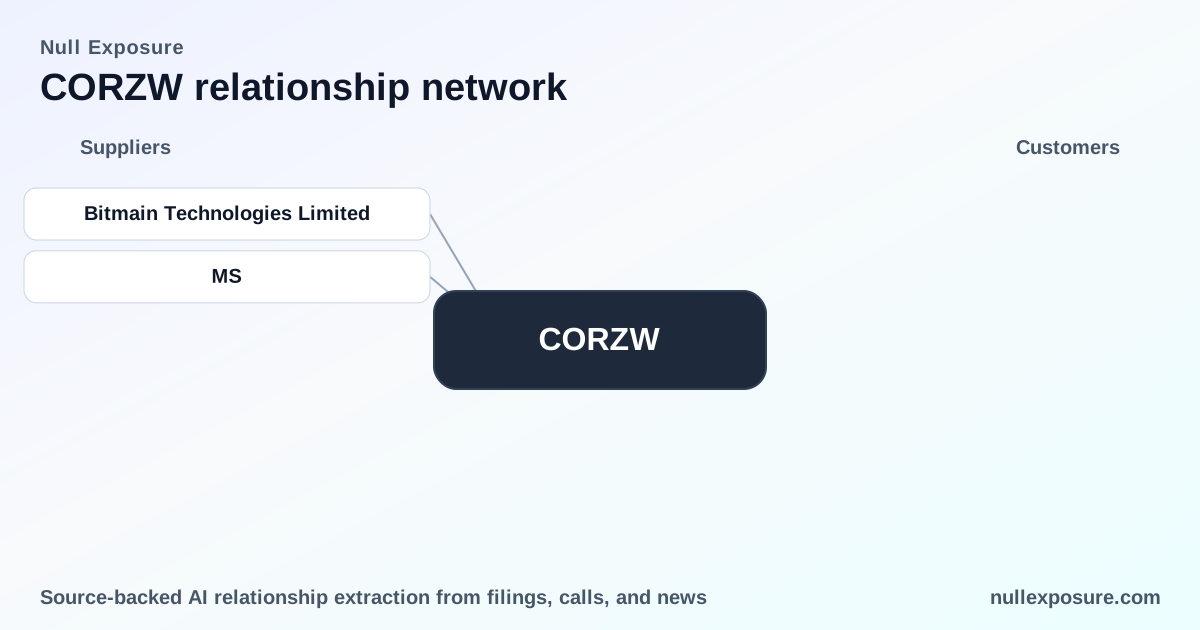
Core Scientific (CORZW) — supplier relationships and what they mean for investors
Core Scientific operates large-scale digital infrastructure: it owns and hosts ASIC miners for bitcoin mining while increasingly converting compute capacity to support AI/HPC workloads, and it monetizes through mining revenues, hosted infrastructure services and by selling or financing capacity where capital partners are available. The business combines asset-heavy operations (mining rigs and facilities) with power-intensive cost structures and intermittent financing relationships, creating a profile where supplier, power, and capital partners directly shape margin outcomes. For a concise supplier-risk snapshot and relationship tracking, visit https://nullexposure.com/.
How Core Scientific’s commercial model converts hardware and power into cash
Core Scientific purchases specialized mining equipment, contracts for electricity, operates hosted mining and sells compute outcomes (bitcoin and HPC services), and accesses capital markets or financers to fund large equipment purchases and facility work. The company reported $319,019,000 in revenue (TTM) with negative EBITDA of $107,388,000, showing operational scale but persistent cash-flow pressure that increases reliance on short-term suppliers and financing partners.
Key business drivers: heavy concentration of cost in electricity, large exposure to ASIC hardware supply chains, and active use of financing to bridge capital-intensive growth. These dynamics make supplier stability and contract terms central to near-term performance. Learn more about supplier exposure and monitoring at https://nullexposure.com/.
Who supplies Core Scientific — the relationships investors must watch
Below I cover every supplier or partner relationship captured in the public record for CORZW in the available results and summarize the practical takeaways.
-
Bitmain Technologies Limited
Core Scientific discloses that substantially all of the miners it owns and hosts were manufactured by Bitmain, which means the company’s hardware stack and spare-parts pathway are concentrated with a single major ASIC vendor. This creates dependency on Bitmain’s delivery schedules and product lifecycle. According to Core Scientific’s FY2024 Form 10‑K, the majority of the company’s mining rigs incorporate Bitmain ASIC chips (FY2024 10‑K filing). -
Morgan Stanley
Morgan Stanley functions as a capital partner: Core Scientific secured up to $1 billion in financing tied to Morgan Stanley, indicating the firm’s approach to augment liquidity and fund equipment or operations through large financial counterparties. The financing arrangement was reported in market coverage referencing Core Scientific’s financing activity (CNBC coverage of Core Scientific / Morgan Stanley financing, public market reporting).
What the contractual and operational constraints tell us about the firm
The company filings and disclosures produce clear operational signals relevant to supplier risk and commercial strategy. These are company-level characteristics rather than relationship-level judgments unless explicitly stated.
-
Short-term contracting posture. Delivery schedules for equipment have ranged from one month to 12 months, indicating Core Scientific operates with relatively short supplier lead times and flexible replenishment cycles. That short-term posture compresses negotiating leverage for large-scale, long-lead procurement but allows faster technology refresh. (Evidence cited in FY2024 10‑K.)
-
Usage-based and interruptible power contracts. The company uses fixed, variable and interruptible bilateral power supply agreements across facilities, which signals a cost structure that is partly variable and can be flexed but also exposed to spot and demand-response risks. Electricity is a first-order cost driver. (FY2024 10‑K excerpt.)
-
Geographic diversification within North America. Core Scientific is substantially engaged in construction, refurbishment and conversion of ten U.S. facilities across Alabama, Georgia, Kentucky, North Carolina, North Dakota, Oklahoma and Texas to support AI/HPC workloads and mining. That spread reduces single-site concentration but increases operational complexity and regional regulatory/power exposure. (FY2024 10‑K.)
-
Power cost materiality. The company states that electric power costs account for a significant portion of cost of revenue, making the power supply relationship material to margins and a strategic focus for supplier negotiations and hedging. (FY2024 10‑K.)
-
Buyer role and supplier payment structure. Core Scientific purchases mining equipment on multi-month contracts with installment payments due in advance of scheduled deliveries; that payment profile requires working capital and elevates the importance of financing partners to underwrite advance payments. (FY2024 10‑K.)
-
Service-provider relationships with utilities. Historically, the company contracts with large electric utilities to secure sufficient electricity for mining operations, which makes utility counterparties de facto strategic providers for ongoing production. (FY2024 10‑K.)
Investment implications — what operators and investors should prioritize
- Supplier concentration risk is real: heavy dependence on Bitmain for ASIC hardware ties Core Scientific’s upgrade cadence, warranty coverage, and spare-parts availability to a single vendor. Investors should price supply-chain concentration into downside scenarios for mining throughput and recovery timelines.
- Power is the main operational lever: because electricity costs drive margins, the stability, terms and mix of fixed vs. interruptible power contracts determine cash generation capacity. Securing low-cost, stable power is a route to margin improvement.
- Financing relationships dictate runway: transactions like the Morgan Stanley financing show Core Scientific’s reliance on institutional capital to support purchases and conversions; changes in credit terms or investor appetite will impact procurement and growth plans.
- Short-term contracts create agility and vulnerability: short delivery windows enable rapid tech refresh but also mean the company is continuously in the market for inventory and power — both potential sources of cost volatility.
Mid-article action point
If your mandate requires active monitoring of supplier counterparty risk or financing exposures for infrastructure operators, consult more detailed supplier profiles and alerts at https://nullexposure.com/ for continuous updates and document-level sourcing.
Practical due diligence checklist for operator/investor engagements
- Confirm the proportion of active miners sourced from a single OEM and review spare-parts and warranty covenants.
- Map power contracts by facility: fixed vs. interruptible, term length, and escalation mechanics.
- Review financing covenants and availability from counterparties like Morgan Stanley to understand advance-payment capacity.
- Model downside mining revenue scenarios with adjusted power-costs and delayed equipment deliveries.
Final recommendations and closing judgement
Core Scientific runs a capital- and power-intensive model that is strategically exposed to two categories of counterparties: hardware OEMs (Bitmain) and capital providers (example: Morgan Stanley). The company-level signals — short delivery windows, usage-based power contracts, multi-state facility conversions, and material reliance on electricity — define a supplier-risk profile that investors should price into valuations and covenant terms.
For specialists assessing counterparties and supplier concentration in critical infrastructure, persistent monitoring is essential: visit https://nullexposure.com/ to track filings, financing events, and supplier mentions in near real time. Key takeaway: supplier and financing relationships are not peripheral for Core Scientific — they are the levers that will determine operational resilience and the speed of any recovery in profitability.