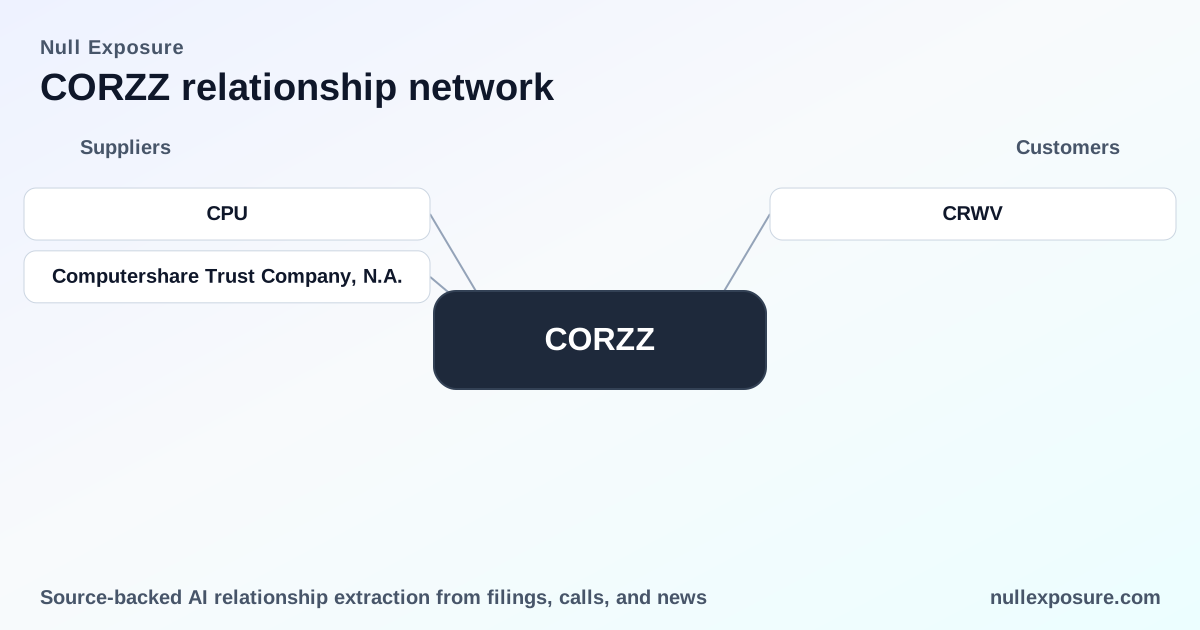
Core Scientific (CORZZ) — Supplier relationships and operational constraints that drive risk
Core Scientific operates high-performance data centers focused on Bitcoin mining and hosted computing services, monetizing through mined digital assets, hosting fees for third-party customers, and by leveraging its balance sheet through structured financial instruments such as tranche warrants. Revenue comes from mined bitcoin and hosting services, while capital commitments and warrants are used to finance scale and facility conversions. This note dissects supplier-facing relationships disclosed in recent filings, and translates company-level constraints into actionable insights for investors and counterparties evaluating exposure to CORZZ.
If you want a consolidated view of supplier exposures and constraints, visit https://nullexposure.com/ for the full platform.
What the Computershare entries reveal about the warrant structure
The public relationships in this supplier scope are limited but instructive: two Computershare entities appear in the Warrant Agreement disclosures related to CORZZ.
Computershare, Inc.
Computershare, Inc. is referenced in the Warrant Agreement as a party tied to the definition of a “TEV Triggering Event” and the broader warrant mechanics, indicating its role at the issuer/agent level for the tranche warrants in FY2024. According to the company's SEC exhibit for the Tranche 2 Warrants (FY2024), Computershare is a named counterparty in the agreement and linked to warrant-administration triggers.
Source: company SEC exhibit on Tranche 2 Warrants filed FY2024 at the issuer investor site (investors.corescientific.com).
Computershare Trust Company, N.A.
Computershare Trust Company, N.A., an affiliate acting as Warrant Agent, is explicitly named in the same Warrant Agreement and handles agent functions tied to TEV-triggering events and execution mechanics for the tranche warrants. The FY2024 filing lists the Trust Company as the formal warrant agent under the agreement.
Source: company SEC exhibit on Tranche 2 Warrants filed FY2024 at the issuer investor site (investors.corescientific.com).
Company-level constraints that shape supplier risk and contracting posture
The filing-level constraints provide a clear picture of how Core Scientific structures supplier and capital relationships. These are company-level signals — they apply broadly to CORZZ’s procurement, operations, and capital commitments rather than to the Computershare relationships listed above.
- Short-term contracting posture, with multi-month installments. The company notes purchases are typically on contracts from one to 12 months, with installment payments due in advance of deliveries. This implies suppliers receive advance cash flows but face rapid turnover and frequent renegotiation windows.
- Supplier concentration on large manufacturers. Historically, mining equipment was sourced substantially from Bitmain, signaling concentration risk with a large-enterprise counterparty.
- Critical cost drivers anchored to electricity. Electric power is a substantial portion of cost of revenue, making utility suppliers and power contracts operationally critical.
- Dual buyer and manufacturer relationship characteristics. The firm acts as a significant buyer (large refundable deposits and advance payments for equipment) and historically as a purchaser from major manufacturers.
- Service-provider reliance across operations. Core Scientific contracts large electric utilities, engages third parties for cybersecurity, and uses a single third-party custodian for substantially all digital assets, indicating concentrated operational service dependencies.
- Large-capital commitments. As of December 31, 2024, the company reported approximately $1.14 billion of contractual capital commitments primarily for infrastructure conversion, equipment procurement, and labor — a clear signal of substantial ongoing vendor spend and execution risk.
These constraints collectively define Core Scientific’s supplier profile: high advance-payment requirements, concentrated sourcing, critical dependence on utilities and custodians, and large-scale capital commitments. For counterparties, this means cash flow certainty from advances but exposure to contract churn and operational-critical delivery obligations.
How these signals affect counterparty negotiation and credit exposure
Core Scientific’s procurement and capital pattern creates a distinct negotiation environment:
- Suppliers that provide mining equipment or infrastructure face substantial advance payments and multi-month delivery schedules, which compress working capital cycles but shift delivery and performance risk toward the supplier.
- Utilities and hosting partners are critical counterparties because power costs dominate margins; any interruption or price shock directly impairs profitability and covenant headroom.
- Concentration with large manufacturers like Bitmain presents single-source dependency, which elevates supply chain and pricing risk if alternative sourcing cannot be mobilized quickly.
- The $1.14 billion of committed capital expenditure implies meaningful future demand for construction, equipment, and services — an opportunity for suppliers but also a demand concentration that exposes them to execution delays and insolvency cascades if Core Scientific’s financing or operational performance deteriorates.
If you are evaluating exposure to Core Scientific as a supplier or investor, consider how advance-payment structures, utility dependence, and supplier concentration affect your counterparty risk profile. For a broader supplier risk framework and supplier mapping tools, see https://nullexposure.com/.
Practical risktakes for investors and operators
- Monitor electricity contract terms and counterparty diversity. Given power’s outsized impact on margins, control of stable, long-term power supply is a direct driver of enterprise value.
- Assess deposit and advance payment recoverability. Suppliers holding refundable deposits should evaluate the legal and practical recoverability of those funds in stressed scenarios.
- Track custody concentration and cybersecurity arrangements. Substantial custodial concentration for digital assets heightens operational risk; incremental disclosures on custody arrangements materially affect valuation and counterparty risk.
- Watch capital-commitment execution. Delays or overruns on the $1.14 billion of committed conversions and procurement will stress liquidity and supplier cashflows.
Bottom line and next steps
Core Scientific’s disclosed supplier relationships are narrow in the warrant exhibits but the company-level constraints reveal a high-advance, short-term contracting model built on large capital commitments and operationally critical utility and custody partners. For investors and vendor managers, the combination of concentrated sourcing, critical power dependency, and large spend commitments creates both opportunity and elevated counterparty risk.
For a consolidated intelligence package or to map supplier exposures across your portfolio, visit https://nullexposure.com/. If you need a bespoke supplier-risk briefing focused on energy and equipment counterparties for Core Scientific, start an evaluation at https://nullexposure.com/ and we will prepare a targeted report.