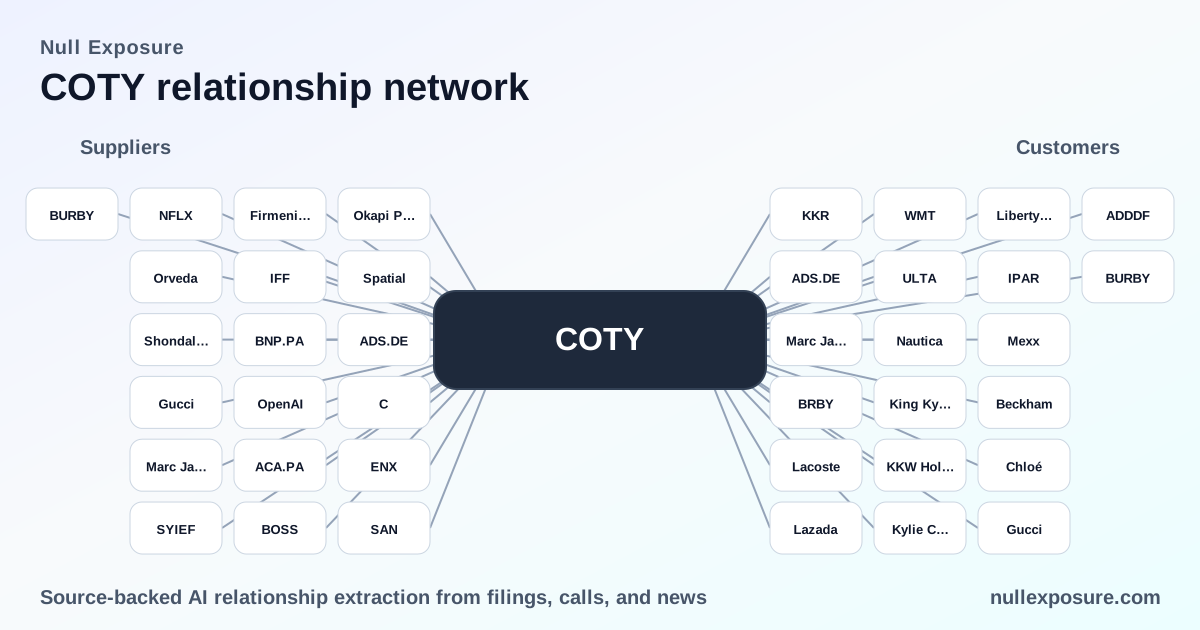
Coty Inc. — supplier and partner landscape investors should price into the thesis
Coty is a global beauty company that monetizes through brand licensing, product sales across fragrance, color cosmetics, and skin & body care, and strategic partnerships that extend reach and lower fixed-cost exposure. Revenue flows from owned brands, long-term license agreements, and wholesale/distribution arrangements; margin and cash conversion depend heavily on licensing renewals, third-party manufacturing, and capital market access.
Explore deeper supplier and counterparty intelligence at https://nullexposure.com/ to stress-test partner concentration and counterparty risk.
Why the supplier map matters for Coty’s turnaround
Coty’s operating model is outsourced and license-driven: the company relies on third-party manufacturers, fragrance houses, and financial institutions for capital markets activity and listings. That structure reduces CapEx but increases dependence on external counterparties for product quality, supply continuity, and access to capital. Investors should treat partner stability and contract scope as first-order drivers of margin recovery and brand continuity.
Where Coty’s partners sit today — concise relationship-by-relationship read
Below I cover every relationship in the public results and what each means for investors.
Okapi Partners LLC
Coty points investors to Okapi Partners as its information agent for tender-offer materials, indicating formal, outsourced investor communications support during corporate actions. Source: Coty press release regarding a tender offer extension (FY2022).
Spatial
Coty partnered with Spatial to build an internal metaverse for its 11,000 employees, reflecting investment in digital collaboration and employee engagement platforms rather than direct revenue generation. Source: Coty news on the Coty Campus metaverse (FY2023).
adidas
Coty renewed a long-term licensing agreement with adidas, reinforcing recurring revenue from sports-lifestyle fragrance and personal care licensing and signaling brand-extension stability for that franchise. Source: CosmeticsDesign report on the adidas licensing renewal (FY2023).
Citigroup
Citigroup acted as a Joint Global Coordinator and Joint Book Running Manager in Coty’s global offering and Paris listing, demonstrating reliance on tier-1 investment banks for capital markets execution. Source: Coty press release on pricing of global offering and admission (FY2023).
Euronext Paris
Coty secured admission of its Class A common stock to trading on Euronext Paris, a strategic listing move that broadens investor access and distribution in European markets. Source: Coty press release on Paris listing (FY2023).
Santander
Santander served as a Joint Global Coordinator and Book Running Manager for Coty’s Paris listing, underscoring multi-bank syndication for cross-border capital raises. Source: Coty press release on global offering and admission (FY2023).
Firmenich
Firmenich is named among Coty’s perfumers/suppliers engaged to produce high-quality fragrance ingredients for premium launches, pointing to outsourced fragrance R&D and supply from top perfumers. Source: WWD feature on Infiniment Coty (FY2024).
IFF
IFF is cited as one of the fragrance suppliers Coty used to develop concentrated, high-quality perfumes, indicating supply reliance on established aromatic houses for core fragrance products. Source: WWD feature on Infiniment Coty (FY2024).
BNP Paribas
BNP Paribas acted as a Joint Global Coordinator and Book Running Manager on Coty’s offering and Paris listing, evidencing bank syndication and debt/equity market access through major European banks. Source: Coty press release on offering (FY2023).
OpenAI
Coty entered a partnership with OpenAI to deploy AI tools across global operations, signaling operational digitization aimed at efficiency and marketing/product innovation. Source: SahmCapital report on Coty–OpenAI partnership (FY2026).
Crédit Agricole Corporate and Investment Bank
Crédit Agricole CIB participated as a Joint Global Coordinator and Book Running Manager for Coty’s offering, showing diversified investment bank engagement for European listing mechanics. Source: Coty press release on global offering (FY2023).
Hugo Boss
Hugo Boss renewed its license agreement with Coty, reinforcing recurring licensing revenue and long-term commercial ties in designer fragrance. Source: HAPPI news on Hugo Boss–Coty license renewal (FY2022).
Netflix
Coty released a limited-edition Bridgerton-inspired fragrance collection in collaboration with Netflix and Shondaland, an example of co-branded limited releases that lift short-term sales and marketing visibility. Source: SahmCapital coverage of Bridgerton fragrance (FY2026).
Orveda
Coty signaled it would exit the Orveda licence as it refocuses on scale and profitability, reflecting portfolio pruning to prioritize high-return, scalable brands over boutique or founder-led partnerships. Source: SahmCapital update on Coty strategy under new CEO (FY2026).
Shondaland
Coty collaborated with Shondaland on a Bridgerton fragrance collection tied to Netflix IP, showing strategic entertainment partnerships that drive product storytelling and category hype. Source: SahmCapital report on the Bridgerton collection (FY2026).
Gucci
Coty will lose its exclusive Gucci fragrance and beauty licence in 2028 after Kering’s transaction with L’Oréal, representing a material upcoming revenue and brand-franchise risk as a major license expires. Source: SahmCapital coverage of license loss tied to Kering–L’Oréal deal (FY2026).
Marc Jacobs
Coty lists Marc Jacobs as one of its long-term licences that the company views as a core asset, highlighting stable licensing revenue from established designer brands. Source: SahmCapital update on Coty’s focus on core licences (FY2026).
Symrise
Symrise is cited among fragrance suppliers tapped for high-quality perfumery work, confirming outsourced ingredient and formulation sourcing from global fragrance houses. Source: WWD feature on Infiniment Coty (FY2024).
Burberry
Burberry is described as a long-term licence and a highlighted asset for Coty, indicating continuing revenue from luxury licensing agreements. Source: SahmCapital remark on Coty’s best assets (FY2026).
Operating constraints and what they signal for investors
- Global, outsourced manufacturing posture: Coty uses third-party manufacturers globally for a meaningful share of finished products, which reduces fixed production costs but increases supply-chain dependency and geographic exposure to supplier disruption.
- Material supplier risk: Coty’s filings describe supplier loss or disruption as a potentially material adverse event — this is a company-level signal that supplier continuity is critical to revenue and margins.
- Mix of roles across counterparties: Coty engages counterparties as manufacturers, sellers (raw materials and packaging suppliers), and service providers (logistics, web-hosting, factoring), which creates multi-vector vendor risk that must be monitored across finance, operations, and brand licensing.
- Large-enterprise counterparty engagement: Coty uses large financial institutions for hedging and buyback-related forward contracts, signaling sophisticated capital markets dependency for balance-sheet management.
- Active stage relationships: Public disclosures describe ongoing outsourcing arrangements, indicating the majority of supplier relationships are active and operationally integrated.
Investor implications — risks and levers to monitor
- License churn is the single largest business risk: the Gucci contract expiry is a tangible hit to franchise economics; investors should model license renewals and lost-margin scenarios.
- Supply concentration is material: Coty’s outsourced manufacturing and reliance on fragrance houses means a disruption at a major supplier would rapidly affect gross margins. Monitor supplier health and geographic concentration.
- Capital markets access shapes flexibility: recent global offering and Paris listing activity required top-tier banks and listing agents; access to syndication and liquidity is central to refinancing and restructuring options.
- Digital and AI investments are operational levers: partnerships with Spatial and OpenAI signal management’s use of technology to drive productivity and marketing efficiency — track realized cost saves and go-to-market impact.
For a detailed counterparty risk scorecard and supplier exposure heatmap, see NullExposure’s analysis at https://nullexposure.com/.
Actionable next steps for investors
- Stress-test models for license revenue attrition, particularly loss of Gucci; update cash-flow scenarios and covenant headroom.
- Request supplier concentration data from management and prioritize disclosure on manufacturing geographic split and key fragrance-house contracts.
- Track execution metrics on AI and digital investments for measurable SG&A leverage and marketing ROI.
Perform a targeted counterparty review and subscribe to ongoing supplier monitoring at https://nullexposure.com/ to convert these relationship signals into portfolio action.