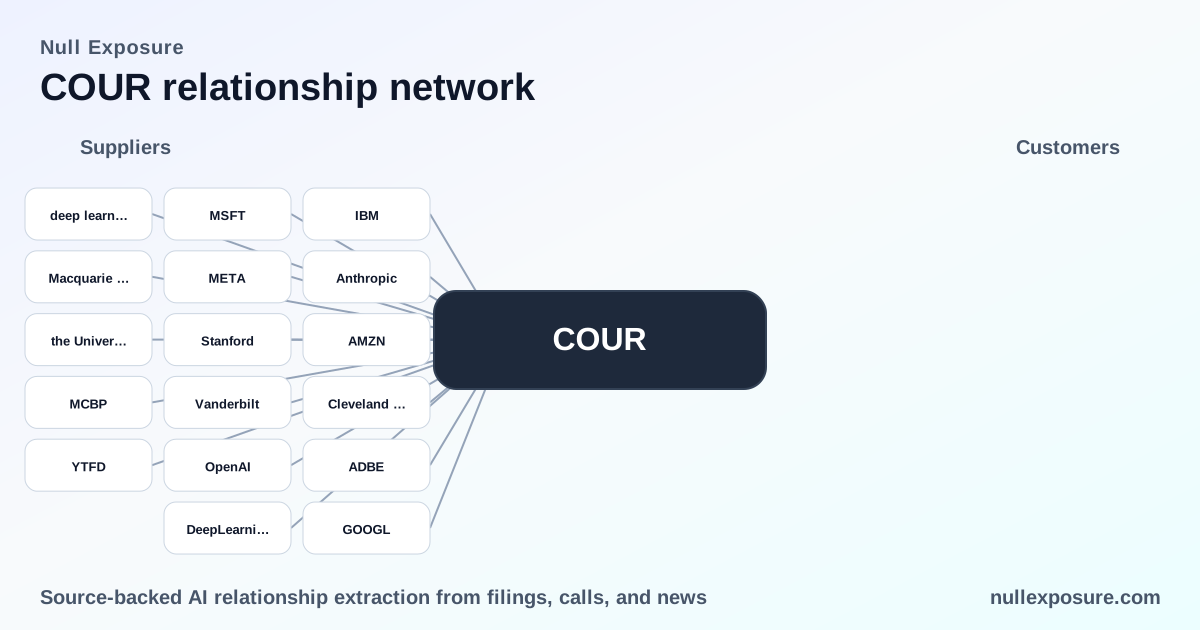
Coursera’s supplier map: content partners, cloud providers and what they mean for investors
Coursera operates a two‑sided online learning marketplace that monetizes by selling subscriptions and enterprise learning contracts, plus revenue‑sharing degree and certificate programs with content partners; revenue streams include individual subscriptions, Coursera for Business enterprise contracts, and partner/licensing arrangements. The platform’s economics depend on a steady flow of high‑quality course supply from major universities and technology companies, and on reliable third‑party infrastructure to deliver courses at scale — together those relationships shape both upside (engagement, pricing power) and downside (partner concentration, operational risk). For a concise supplier risk and opportunity read, see NullExposure’s supplier analysis. https://nullexposure.com/
Why this matters to investors: Coursera’s top‑line growth (Revenue TTM $757.5M) and gross margin (Gross Profit TTM $413.4M) are driven by content breadth and enterprise adoption, both of which are functions of the supplier ecosystem rather than owned IP alone.
What the supplier list reveals about Coursera’s operating model
Coursera acts as a curator and distribution platform: it sources credentialed content from universities and branded courses from leading tech firms, then monetizes learner access and enterprise licensing. Two operating characteristics jump off the supplier roster:
- Concentration of marquee industry partners — partnerships with Google, Microsoft, Amazon/AWS, IBM, Meta and Adobe signal that Coursera’s product differentiation depends materially on third‑party brand equity and technical content. That is a powerful demand driver but a commercial dependency.
- Service‑provider posture for infrastructure — Coursera outsources cloud hosting and requires SOC 2/ISO 27001 controls from vendors, which indicates mature vendor governance but also operational concentration risk around cloud providers and their SLAs.
These observations are supported by company disclosures and recent earnings commentary; the operating implications are that contracting is primarily subscription‑based for core services and partner relationships are both commercial (content licensing/revenue share) and strategic (co‑branded credentials).
For a deeper supplier risk breakdown and monitoring tools, visit NullExposure’s platform. https://nullexposure.com/
Relationship‑by‑relationship: each supplier and what they provide
Below are every named relationship in the available results, summarized plainly and cited to the original reporting.
-
Google (Alphabet) — Coursera lists Google as a long‑time industry partner responsible for some of its most popular courses and professional certificates, a key content supplier that drives learner demand. According to the Q4 2025 earnings call transcript reported on InsiderMonkey (March 9, 2026), Google is among Coursera’s leading technology course creators. https://www.insidermonkey.com/blog/coursera-inc-nysecour-q4-2025-earnings-call-transcript-1690269/
-
Microsoft — Microsoft is cited as a long‑standing partner producing popular courses and certificates, supporting Coursera’s enterprise and individual offerings. This relationship was mentioned in the Q4 2025 earnings call transcript on InsiderMonkey (March 9, 2026). https://www.insidermonkey.com/blog/coursera-inc-nysecour-q4-2025-earnings-call-transcript-1690269/
-
Amazon / AWS — AWS (Amazon) provides both content partner courses and likely cloud ecosystem alignment; Coursera names AWS among major industry partners supplying popular certificates. This is referenced in the Q4 2025 earnings call transcript on InsiderMonkey (March 9, 2026) and Forbes India coverage. https://www.insidermonkey.com/blog/coursera-inc-nysecour-q4-2025-earnings-call-transcript-1690269/
-
IBM — IBM is called out as a creator of popular courses and certificates that sit on Coursera’s platform, reinforcing the enterprise‑grade content mix. The Q4 2025 earnings call transcript on InsiderMonkey (March 9, 2026) lists IBM among leading partners. https://www.insidermonkey.com/blog/coursera-inc-nysecour-q4-2025-earnings-call-transcript-1690269/
-
Meta — Meta is named as one of the technology companies producing top courses and certificates for Coursera’s catalog, contributing to tech skills content. The Q4 2025 earnings call transcript on InsiderMonkey (March 9, 2026) references Meta as a partner. https://www.insidermonkey.com/blog/coursera-inc-nysecour-q4-2025-earnings-call-transcript-1690269/
-
Adobe — Adobe is listed among industry partners producing generative AI and content creation courses that have measurable learner demographics, indicating content relevance and appeal. Forbes India and other coverage (FY2025–FY2026 reporting) note Adobe’s role supplying practical GenAI course content. https://www.forbesindia.com/article/news/bringing-coursera-and-udemy-together-gives-learners-more-choice-coursera-ceo/2989683/1
-
DeepLearning.AI — DeepLearning.AI is identified as an industry content partner contributing specialized AI training and is named alongside other tech partners in Coursera commentary. The Q4 2025 earnings call transcript on InsiderMonkey (March 9, 2026) includes deep learning.AI. https://www.insidermonkey.com/blog/coursera-inc-nysecour-q4-2025-earnings-call-transcript-1690269/
-
Anthropic — Anthropic is a newer AI partner with courses launched in November (prior fiscal year), providing hands‑on experience with Claude and integrating AI collaboration skills into offerings; cited in the Q4 2025 earnings call transcript (InsiderMonkey) and finviz news. https://www.insidermonkey.com/blog/coursera-inc-nysecour-q4-2025-earnings-call-transcript-1690269/
-
OpenAI — Coursera partnered with OpenAI to integrate learning experiences into ChatGPT, aiming to convert conversational interactions into structured learning moments inside workflows. This was reported in coverage of Coursera’s 2026 AI learning trends (MexicoBusiness, FY2026). https://mexicobusiness.news/talent/news/coursera-outlines-2026-trends-shaping-ai-driven-learning
-
Stanford — Stanford is cited as a foundational university partner responsible for early courses on the platform, underpinning Coursera’s academic credibility. Forbes India highlighted Stanford among university partners (FY2025). https://www.forbesindia.com/article/news/bringing-coursera-and-udemy-together-gives-learners-more-choice-coursera-ceo/2989683/1
-
Yale — Yale is listed as one of Coursera’s university partners that seeded the platform’s course catalog, contributing flagship academic content. Forbes India mentions Yale in the FY2025 partner roster. https://www.forbesindia.com/article/news/bringing-coursera-and-udemy-together-gives-learners-more-choice-coursera-ceo/2989683/1
-
University of Michigan — The University of Michigan is named among early university partners that provided many of Coursera’s courses, reinforcing academic depth. Forbes India included Michigan in its FY2025 coverage. https://www.forbesindia.com/article/news/bringing-coursera-and-udemy-together-gives-learners-more-choice-coursera-ceo/2989683/1
-
Vanderbilt University — Vanderbilt is quoted as a university teaching new skills on Coursera, supporting healthcare and other specialty content expansions. The Q4 2025 earnings call transcript (InsiderMonkey) references Vanderbilt (March 9, 2026). https://www.insidermonkey.com/blog/coursera-inc-nysecour-q4-2025-earnings-call-transcript-1690269/
-
University of Colorado Boulder — Named as a contributor of new skills courses, supporting Coursera’s expansion in applied and regional university content. Cited in the Q4 2025 earnings call transcript (InsiderMonkey). https://www.insidermonkey.com/blog/coursera-inc-nysecour-q4-2025-earnings-call-transcript-1690269/
-
Macquarie University — Macquarie University in Australia is listed as a partner teaching new skills, backing Coursera’s global academic footprint. Quoted in the Q4 2025 earnings call transcript (InsiderMonkey). https://www.insidermonkey.com/blog/coursera-inc-nysecour-q4-2025-earnings-call-transcript-1690269/
-
Cleveland Clinic — Cleveland Clinic joined Coursera in January as one of the world’s largest health systems contributing healthcare content, marking expansion into clinical and professional learning. This arrival is mentioned in the Q4 2025 earnings call transcript (InsiderMonkey). https://www.insidermonkey.com/blog/coursera-inc-nysecour-q4-2025-earnings-call-transcript-1690269/
What the contractual constraints tell investors
Coursera discloses that its purchase obligations include third‑party cloud infrastructure agreements, subscription arrangements, and service agreements, which supports a company‑level signal that core operations rely on subscription contracts and hosted services. The company also states that cloud‑hosting providers and third parties with access to PII must be SOC 2 attested and/or ISO 27001 certified, indicating that Coursera treats vendors as service providers under formal security requirements. These are company‑level signals drawn from Coursera’s disclosures rather than being tied to any single partner.
- Implication: contracting posture is subscription‑centric and compliance‑focused; that reduces some vendor risk through certification requirements but concentrates operational risk in a small set of certified cloud providers and service vendors.
Investment implications and a short risk checklist
-
Upside: Branded content from Google, Microsoft, IBM, Adobe and top universities is a durable demand driver and supports premium pricing for enterprise contracts. Finviz and earnings commentary reinforced the marketplace thesis (FY2026). https://finviz.com/news/302300/coursera-inc-cour-a-bull-case-theory
-
Key risks: partner concentration for marquee courses, operational dependence on cloud hosts, and execution risk integrating rapid GenAI partnerships (Anthropic, OpenAI) at scale.
-
Quick checklist for monitoring: track renewal terms with enterprise customers, cadence of new co‑branded credentials with tech partners, any cloud‑service disruptions or SOC2/ISO audit issues, and enrollment trends for newly launched AI courses.
If you want continuous monitoring of supplier exposures and concentration trends for Coursera, explore NullExposure’s supplier intelligence. https://nullexposure.com/
Bottom line
Coursera’s supplier ecosystem is both a competitive asset and a governance challenge: content partnerships with Big Tech and top universities materially drive demand, while subscription‑based service contracts and certified cloud providers govern platform resilience. For investors, the critical questions are whether Coursera can convert partner content into scalable enterprise revenue and keep operational risk contained as it integrates an accelerating slate of AI partnerships. For direct access to structured supplier risk signals and ongoing coverage, visit NullExposure’s homepage. https://nullexposure.com/