COYA Therapeutics: Supplier footprint, partner economics, and operational risk profile
Coya Therapeutics develops Treg‑modulating biologics and currently monetizes through partnerships, licensing and milestone/funding arrangements while it advances clinical assets; the company outsources manufacturing and clinical trial execution and receives non‑dilutive funding and in‑licensing support from strategic collaborators. Investors should judge COYA more as a partnership‑dependent developer than a vertically integrated manufacturer, where supplier terms and continuity directly influence trial timelines, cash burn and commercialization optionality. For a concise vendor risk assessment and to track supplier‑level disclosures, visit https://nullexposure.com/.
How COYA runs R&D without a factory: the operating model that creates supply risk
COYA does not own cGMP manufacturing capacity and outsources all production and many clinical functions, a posture that compresses fixed capital needs but concentrates operational risk with third parties. The company’s own filings state that it lacks the staff and facilities for clinical or commercial manufacturing and depends on CROs, contract laboratories and third‑party manufactures to advance trials. That contracting posture produces four practical characteristics investors and operators must monitor:
- Concentration of execution: Outsourcing creates single‑point dependencies where a partner disruption delays trials and increases costs.
- Commercial immaturity: COYA is clinical‑stage and therefore supplier relationships are mission‑critical for near‑term value realization rather than routine supply of an established product.
- Operational criticality: Manufacturing and clinical CRO partners directly gate data generation and regulatory filings.
- Material supply risk: The company explicitly flags global supply chain disruptions as having a potential material adverse effect on results in its 10‑K.
These are company‑level signals to weigh when modeling timelines, cash‑runway sensitivity and partner negotiation leverage.
Catalog of relationships disclosed in filings and press
Below I summarize every supplier or partner mention surfaced in the available results, with a short plain‑English note and the source context.
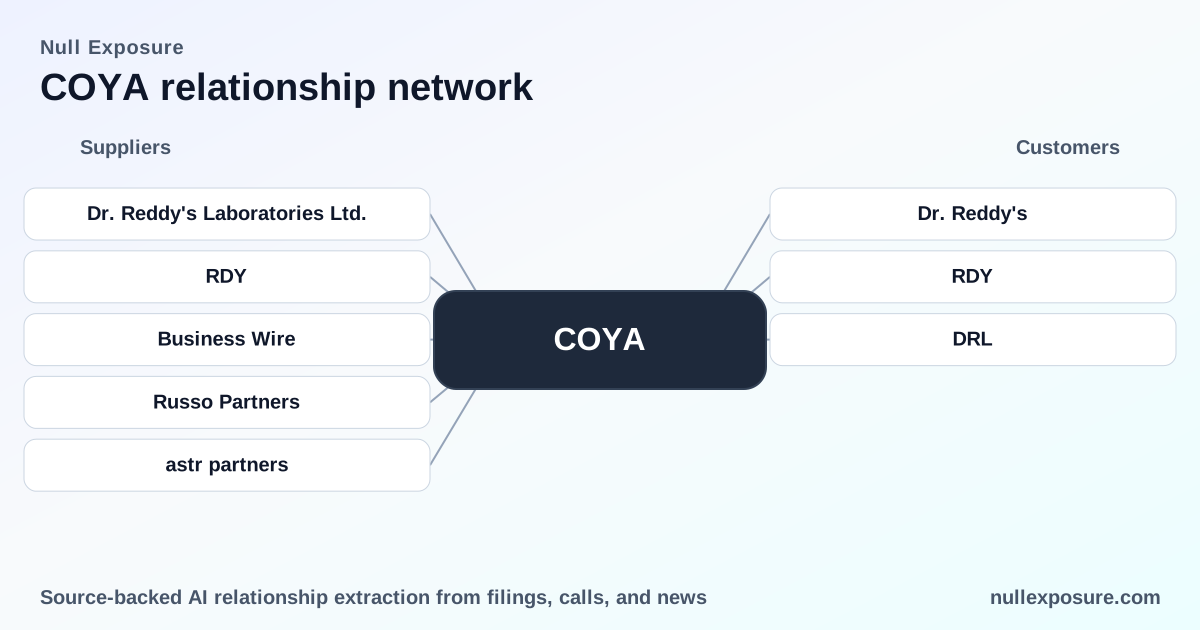
Dr. Reddy’s Laboratories / Dr. Reddy’s Laboratories Ltd.
COYA entered a formal DRL Agreement effective April 1, 2023, and has used in‑licensing from Dr. Reddy’s to incorporate a proposed abatacept biosimilar as a component of COYA‑302; Dr. Reddy’s also provided $8.4 million in non‑dilutive funding in 2025. According to COYA’s 2024 Form 10‑K, the DRL Agreement became effective on April 1, 2023; an ALS News Today report described an earlier in‑licensing arrangement for the proposed biosimilar in COYA‑302 (FY2023); and COYA’s letter to stockholders (Pharmiweb, Jan 20, 2026) disclosed the $8.4M strategic funding from Dr. Reddy’s (FY2025/FY2026).
Business Wire (press distribution of regulatory milestone)
A Business Wire release dated December 23, 2025 announced that Health Canada accepted COYA‑302 ALSTARS for clinical trial application (CTA) review, signaling regulatory progress for the ALS program. The press release is the company’s public notice of CTA acceptance and was distributed via Business Wire (FY2025).
Russo Partners (media relations)
Press materials for the December 23, 2025 CTA announcement list Russo Partners as media contacts, indicating Russo Partners handled external communications for that milestone. The Business Wire release and related reposts contain Russo Partners contact details (FY2025).
astr partners (investor relations)
Investor contact information included in the Dec 23, 2025 announcement identifies astr partners as COYA’s investor relations firm, which managed investor outreach tied to the ALSTARS CTA filing. The Business Wire release and subsequent reposts to investor sites list astr partners contact data (FY2025).
StockTitan reposts of press materials
StockTitan republished the December 23, 2025 release and reproduced the same investor and media contact lines for astr partners and Russo Partners, amplifying the CTA announcement to retail investor channels (FY2025).
What these relationships mean in practice for valuation and operational risk
Dr. Reddy’s is both strategic partner and near‑term financier: the DRL Agreement and in‑licensing arrangement give COYA access to an important biologic input for COYA‑302 and inject non‑dilutive capital that extends runway. That structure reduces immediate cash pressure but increases dependency on the partner for supply of the abatacept biosimilar and for execution milestones tied to the program’s value.
PR/IR relationships (Russo Partners, astr partners) are disclosure amplifiers, not operational suppliers, but consistent communication through these firms affects market perception and should be monitored as part of investor relations risk. Reposting of releases via outlets such as StockTitan broadens retail visibility and can magnify market reaction to trial updates.
From an operational view, the company’s explicit reliance on third‑party manufacturers and CROs is an active relationship posture: outsourced manufacturing and outsourced clinical operations are central to COYA’s ability to deliver data and file for approvals. The firm’s 10‑K calls out supply chain disruptions as a material risk, so model scenarios should include 6–12 month timeline slippage and cost overruns as reasonable stress cases when a single third‑party supplier is involved.
If you want a supplier‑level risk briefing tailored to COYA’s public disclosures and partner contracts, start here: https://nullexposure.com/.
Key takeaways for investors and operators
- Strategy driver: COYA’s go‑to‑market path is partnership‑first — licensing, joint supply and strategic funding are the primary mechanisms to advance COYA‑302 and other programs.
- Material dependency: The DRL Agreement is a high‑impact relationship because it supplies a core biologic component and provided $8.4M in funding; treat this partner as mission‑critical when modeling program success.
- Execution risk concentrated: Outsourced manufacturing and clinical execution translate supplier continuity directly into trial timelines and cash runway; include supplier failure and extended lead times in downside scenarios.
- Communications risk: PR/IR firms and widespread reposting shape investor expectations; mismatch between execution and messaging will amplify stock volatility around milestones.
Operational recommendations for COYA operators: secure multi‑sourcing clauses where possible, negotiate clear supply continuity and indemnity terms with manufacturers, and build regulatory contingency timelines into clinical plans.
For a deeper supplier risk matrix and contract clause checklist tailored to COYA’s disclosures, visit https://nullexposure.com/.
Bottom line
Coya Therapeutics is a partnership‑centric, clinical‑stage developer where supplier and partner relationships are the operative drivers of near‑term value. Dr. Reddy’s stands out as both a supplier source and a non‑dilutive funder; PR and IR firms have handled milestone communications; and the company’s 10‑K explicitly positions supply chain disruptions as material. Investors should price COYA as dependent on third‑party execution and structure their models and monitoring protocols accordingly. Learn more about supplier disclosures and relationship monitoring at https://nullexposure.com/.