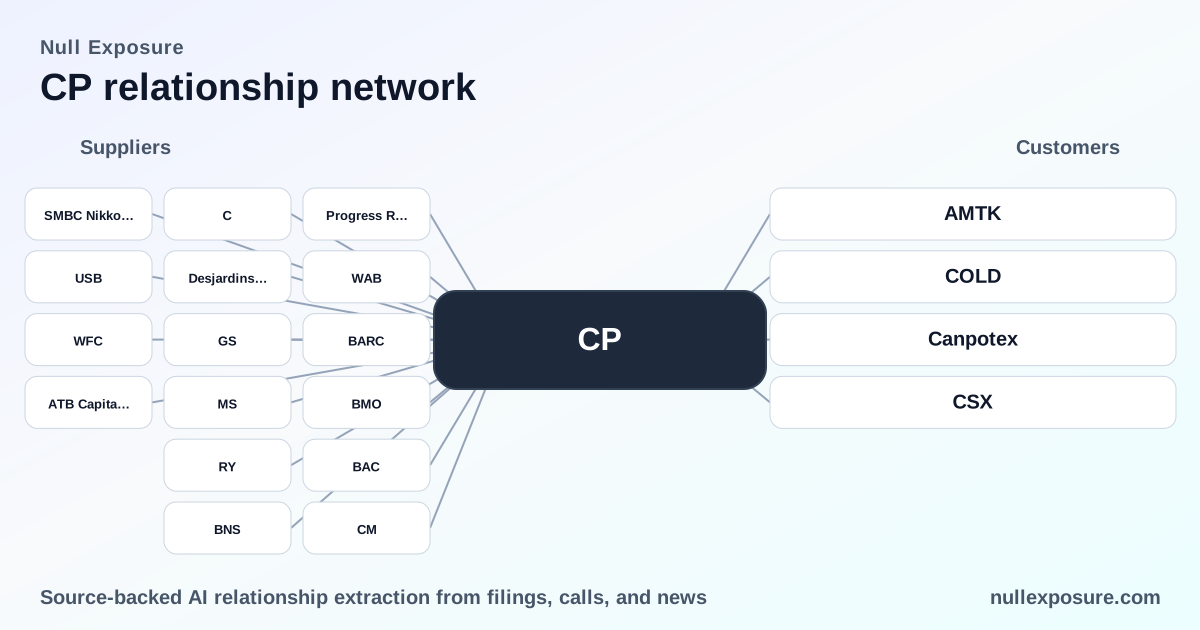
Canadian Pacific (CP): Supplier footprint, capital partners and what investors should price in
Canadian Pacific Railway (CPKC/CP) generates revenue by hauling freight across a transcontinental North American rail network and monetizes through freight rates, network density advantages, and disciplined asset utilization; the company is executing an aggressive locomotive renewal program while maintaining active capital markets access to fund growth and refinancing. CP’s supplier relationships cluster around heavy-equipment OEMs for fleet renewal and a broad syndicate of global banks for debt issuance — both sets of partners drive near-term capital intensity and medium-term service continuity. For deeper supplier-risk mapping and partner exposure analysis, visit https://nullexposure.com/.
How CP’s supplier posture translates into cashflow and risk
CP is an asset-intensive operator: locomotives, track maintenance, fuel and overhaul contracts underpin revenue delivery and also drive large, lumpy capital and operating outlays. The company has disclosed multi-year supplier purchase commitments and long-term liabilities that create predictable capex cadence but raise execution and delivery risk when large orders cluster. Corporate disclosures show roughly $3.9 billion of supplier-related operating expenditure commitments across 2025–2035, signaling meaningful forward cash requirements tied to suppliers rather than one-off purchases.
Counterparty relationships for financial transactions are concentrated with high-credit-quality institutions, which supports liquidity management and bond-market access. Contracting posture is predominantly long-term for key maintenance and equipment agreements, creating both bargaining power for suppliers and higher switching costs for CP. These are company-level signals drawn from public filings and press releases in FY2026 and should be treated as structural characteristics of CP’s operating model.
For supplier exposure and capital partner detail, see the partner breakdown below. If you evaluate counterparty risk for portfolios or procurement, review the full supplier map at https://nullexposure.com/.
The supplier and capital partner list you need to know
Below are every named relationship identified in FY2026 reporting and press coverage, summarized in plain English with source context.
Progress Rail
CPKC has ordered 30 Tier 4 EMD SD70ACe-T4 locomotives from Progress Rail, to be manufactured in Muncie, Indiana, with deliveries expected in the second half of 2026. Source: Railway-News and related press coverage (March 2026).
Wabtec
CPKC completed a sizable program with Wabtec in 2025 (100 Tier 4 units) and expects delivery of another 70 Wabtec Evolution Series ET44AC Tier 4 locomotives in 2026 from the company’s Texas facility as part of an overall >US$800 million locomotive spend. Source: FinViz, Simply Wall St and StockTitan reporting (March 2026).
Goldman Sachs & Co. LLC
Goldman Sachs is named as a joint active bookrunner on CPKC’s US$1.2 billion debt offering, reflecting a primary banking role in CP’s capital markets access. Source: CPKC press release via Newswire (March 2026).
Barclays Capital Inc.
Barclays acted as a joint active bookrunner on the US$1.2 billion bond offering, indicating execution support for CP’s financing plan. Source: Newswire (March 2026).
Citigroup Global Markets Inc.
Citigroup is listed as a joint active bookrunner on the offering and part of the broader syndicate supporting CP’s debt issuance. Source: Newswire (March 2026).
SMBC Nikko Securities America, Inc.
SMBC Nikko is a joint active bookrunner, underscoring CP’s use of diversified global dealers for debt placement. Source: Newswire (March 2026).
BMO Capital Markets Corp.
BMO is included in the syndicate for the US$1.2 billion offering, signalling regional Canadian capital-market support. Source: Newswire (March 2026).
CIBC World Markets Corp.
CIBC is part of the syndicate supporting CP’s debt placement, consistent with CP’s Canadian banking relationships. Source: Newswire (March 2026).
RBC Capital Markets, LLC
RBC Capital Markets is a syndicate member on the offering, reflecting another domestic banking anchor for CP. Source: Newswire (March 2026).
Scotia Capital (USA) Inc.
Scotia Capital is listed in the syndicate for the debt transaction, expanding CP’s bank distribution footprint. Source: Newswire (March 2026).
BofA Securities, Inc.
BofA Securities is part of the underwriting syndicate for CP’s bond issue, providing US institutional distribution capability. Source: Newswire (March 2026).
Morgan Stanley & Co. LLC
Morgan Stanley is listed among syndicate members, indicating access to large buy-side desks for CP debt. Source: Newswire (March 2026).
Wells Fargo Securities, LLC
Wells Fargo is included in the debt syndicate, providing additional US distribution and sales coverage. Source: Newswire (March 2026).
U.S. Bancorp Investments, Inc.
U.S. Bancorp Investments is a syndicate participant on the deal, broadening mid-market institutional reach. Source: Newswire (March 2026).
Desjardins Securities Inc.
Desjardins appears in the syndicate list, representing cooperative-sector distribution in Canada. Source: Newswire (March 2026).
ATB Capital Markets Corp.
ATB Capital Markets is named among syndicate members, reflecting regional capital-market engagement in Alberta. Source: Newswire (March 2026).
What this partner mix implies for investors and operators
- Capex-driven revenue durability: The locomotive renewal program (over US$800 million) shows management is investing to maintain or improve service reliability and fuel efficiency — that supports medium-term margin resilience but requires reliable suppliers and timely deliveries. Source: Simply Wall St, FinViz and StockTitan reporting (FY2026).
- Concentration on two OEMs: Primary heavy-equipment suppliers cluster at Wabtec and Progress Rail, creating supplier concentration risk for rolling-stock availability and spare parts supply. This elevates operational risk if a supplier suffers production delays.
- Large, long-term supplier commitments: Public filings show long-term supplier purchase agreements and future operating expenditures (~$3.9 billion for 2025–2035), which create predictable capital needs and justify CP’s active use of the bond markets. These commitments are a structural funding requirement, not ad hoc spending. Source: CP FY2026 disclosures and press releases.
- Diverse banking syndicate reduces refinancing risk: The US$1.2 billion debt offering used a broad syndicate of global and Canadian banks, indicating deep capital markets access and a multi‑party distribution strategy that reduces single-counterparty placement risk. Source: CPKC press release via Newswire (March 2026).
Midway quick read: if you manage supplier risk or credit allocations, map delivery schedules from Wabtec and Progress Rail against CP’s working capital and bond maturities; actionable insights are available at https://nullexposure.com/.
Practical considerations for procurement, risk and portfolio allocation
- Negotiate service-level commitments and delivery penalties into future OEM contracts to protect throughput during concentrated delivery windows.
- Monitor production sites (Dallas, Texas and Muncie, Indiana) for labor or supply-chain disruptions that would affect rollout timing.
- Treat the bank syndicate as a liquidity buffer: diversified bookrunners reduce refinancing friction but do not eliminate macro interest-rate or covenant risk.
Actionable checklist for operators and investors:
- Track locomotive delivery milestones and spare-parts shipment confirmations.
- Stress-test liquidity against the $3.9 billion supplier commitment horizon.
- Maintain dialogue with CP’s investor-relations and procurement teams for vendor contingency plans.
Bottom line
CP’s near-term supplier story is clear: a capital-intensive locomotive refresh concentrated with two OEMs, funded via active debt markets and a broad banking syndicate. That setup supports service reliability and long-term revenue protection but increases execution and supply-chain risk in the next 12–24 months. For investors and procurement teams, the priority is monitoring delivery schedules, cashflow timing against long-term supplier commitments, and counterparty credit quality among both OEMs and the lending syndicate.
For a full counterparty exposure map and to model supplier-impact scenarios on cashflow and credit metrics, go to https://nullexposure.com/. For bespoke supplier-risk reports tailored to portfolios or operations teams, start at https://nullexposure.com/.