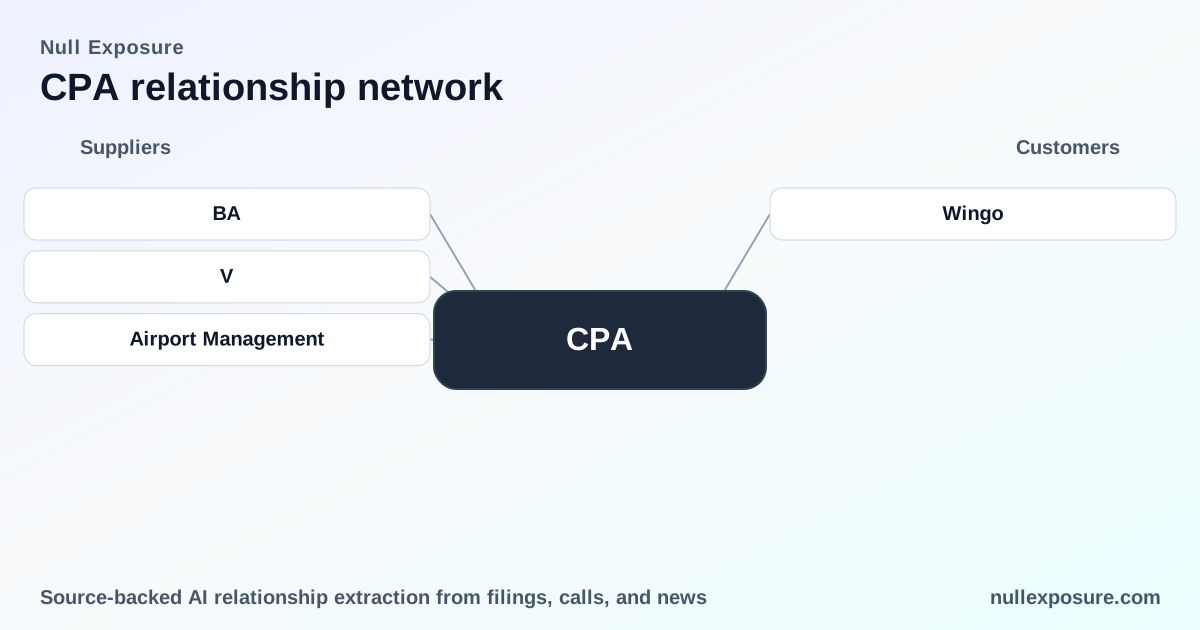
Copa Holdings (CPA) — supplier relationships and commercial signals investors need
Copa Holdings operates a network airline centered in Panama that monetizes through passenger ticketing, cargo services and ancillary fees while structurally leveraging a Boeing-centered fleet and a mix of owned and leased aircraft to scale capacity. Revenue generation is route- and asset-driven: seat-mile yield management plus cargo and partnerships are the levers, with capital intensity masked by operating leases and a material dividend policy that returns cash to shareholders. With a market capitalization near $4.7 billion and trailing P/E under 7, the company is a cash-generative regional carrier whose margins and capital decisions are tightly linked to supplier relationships—airframe manufacturers, payment networks and airport partners. For further commercial diligence and supplier analytics, visit https://nullexposure.com/.
How Copa makes money and why suppliers matter Copa’s P&L and balance sheet show a classic short-haul network airline profile: high fixed costs, concentrated supplier exposure and steady operating margins (operating margin ~22.5% TTM, profit margin ~18.6%). Fleet decisions determine fuel efficiency, capacity growth and maintenance cost curves; payment partnerships determine distribution economics and passenger conversion; airport arrangements determine route economics and operational resilience. The company’s capital allocation—dividends, aircraft orders and leases—signals a mature operator prioritizing cash returns and fleet modernization over aggressive balance-sheet expansion (EV/EBITDA ~4.45; dividend yield ~6.2%). Visit https://nullexposure.com/ for deeper supplier scoring and counterparty risk metrics.
What the supplier list reveals about operating posture Copa’s public disclosures and press reporting consistently show three categories of commercial counterparties: aircraft manufacturer/lessors, payment networks, and airport hosts/operators. Taken together these relationships describe a company that outsources key capital goods (airframes) while internalizing route control and revenue management. Fleet additions are implemented through a blend of direct deliveries and operating leases, which preserves balance-sheet flexibility but creates near-term operational dependence on vendor delivery schedules and aftermarket support. Institutional ownership north of 97% implies investor scrutiny is high and governance oversight on supplier contracts will be active.
Who Copa does business with — the counterparties, in plain English
- Boeing — Copa continues to expand and modernize its fleet with Boeing 737 family aircraft, both through deliveries and operating leases; the company reported deliveries of Boeing 737 MAX 8 and additions of 737-800 freighters across FY2025–FY2026 (GlobeNewswire and Yahoo Finance press releases, FY2025/FY2026). See Copa’s quarter releases: https://www.globenewswire.com/news-release/2025/11/19/3191455/0/en/Copa-Holdings-Reports-Third-Quarter-Financial-Results.html and https://sg.finance.yahoo.com/news/copa-holdings-reports-fourth-quarter-213000503.html.
- Visa — Copa renewed its agreement with Visa in the third quarter of FY2025, indicating continuity in card processing and payment-distribution arrangements that affect ticketing fees and consumer checkout experience (earnings call transcript coverage, FY2025). See the earnings call report: https://www.insidermonkey.com/blog/copa-holdings-s-a-nysecpa-q3-2025-earnings-call-transcript-1648868/.
- Airport Management (Johan Adolf Pengel International Airport) — Copa added Paramaribo (Suriname) to its route map through cooperation with the airport operator, a normal route-expansion partnership that expands network reach and local connectivity (travel2latam coverage, FY2025). See the route announcement: https://en.travel2latam.com/news-52952-copa-airlines-adds-suriname-to-its-extensive-network-of-destinations.
Why each relationship matters to investors and operators
- Boeing is strategic and critical: airframe deliveries and options directly control capacity growth, fuel economics and long-term maintenance exposure; the repeated mentions of MAX deliveries and a firm orderbook indicate a planned modernization path that reduces unit costs. (GlobeNewswire / company releases, FY2025–FY2026.)
- Visa is operationally important: payment network renewals affect payment acceptance, interchange costs and ancillary sales, so continuity here reduces transactional friction and protects revenue per passenger. (Earnings call coverage, FY2025.)
- Airport Management ties are tactical and route-specific: adding destinations through airport cooperation affects network density and market share in targeted countries; these arrangements are vital to executing the route-growth strategy. (Travel2Latam reporting, FY2025.)
Operational constraints and company-level commercial signals Although the sourced relationship entries do not include explicit contractual constraint excerpts, the publicly visible behavior and financials imply several company-level characteristics investors should track:
- Contracting posture: mix of direct purchases and operating leases—Copa uses operating leases to add capacity quickly while retaining flexibility, which stabilizes cash flow volatility but can concentrate operating-leasing counterparty exposure. This is consistent with multiple references to deliveries and operating-lease freighter additions in FY2025–FY2026.
- Concentration: high supplier concentration on a single airframe family limits diversification of technical support and creates vendor-dependence risk; fleet reports repeatedly reference Boeing 737 variants.
- Criticality: airframe and engine support are mission-critical for route reliability and yield optimization; payment and airport partners are secondary but still material to revenue capture and route economics.
- Maturity and governance: firm order activity and dividend policy suggest a mature commercial posture—a carrier that is optimizing cash returns while modernizing the fleet rather than pursuing aggressive network expansion funded by leverage.
Mid-article action point If you are modeling counterparty risk into a route-level cash flow model or mapping supplier concentration to valuation scenarios, use this analysis as a starting point and review the primary press releases cited above. Learn more at https://nullexposure.com/.
Investment implications and risk framing Copa is a leverageable exposure to the Latin American travel recovery: low forward P/E and strong margins imply upside if fuel and macro pressure remain benign, but investor returns are tied to supplier execution—timely Boeing deliveries, competitive payment terms and airport cooperation. Key risks include delivery delays, lessor pricing shocks, and local airport/regulatory changes that could compress yields on new routes.
Final recommendation for operators and investors For operators negotiating with Copa or counterparties to Copa, prioritize clauses that protect against delivery slippage and provide clear maintenance and aftermarket obligations. For investors, monitor Boeing delivery cadence, Visa/payment contract terms and route roll-outs with airport partners—each has direct top-line and cost-line implications. For a more granular supplier-risk scorecard and to benchmark Copa against peer carriers, visit https://nullexposure.com/.
Key takeaway (one sentence): Copa’s commercial performance is aircraft- and route-driven; Boeing deliveries, payment-network continuity, and airport partnerships are the levers that determine capacity, revenue capture and ultimately shareholder returns.