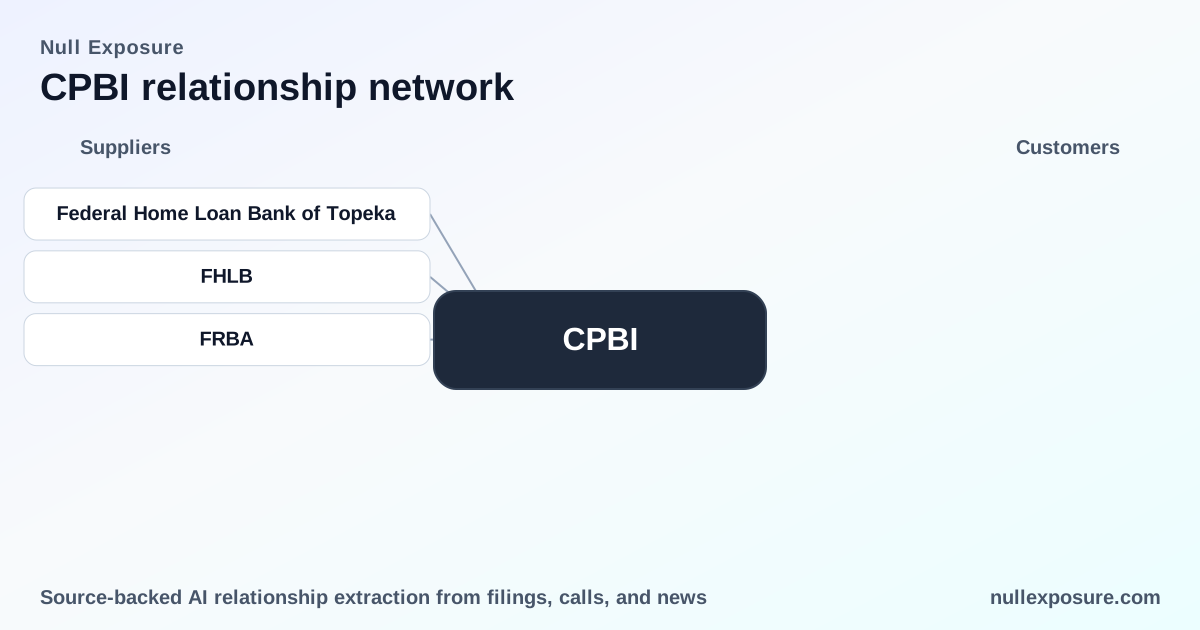
Central Plains Bancshares (CPBI): Supplier and Funding Relationships Investors Should Know
Central Plains Bancshares operates as a regional bank in Nebraska that earns through net interest margin on retail and small‑to‑medium commercial lending and deposit services, while maintaining contingent liquidity options through secured borrowings. The company monetizes via interest income on its loan portfolio and fee income from banking services; access to external advances (FHLB/FRB) and third‑party vendors for back‑office processing are core operational levers that underwrite growth and scale. For a quick deeper dive into related supplier intelligence, visit https://nullexposure.com/.
How the relationships fit the business model
CPBI is a small regional bank (market cap roughly $73 million) with modest profitability metrics and conservative balance‑sheet signals. Access to Federal Home Loan Bank (FHLB) and Federal Reserve Bank (FRB) advances provides explicit liquidity optionality to support loan originations beyond deposit funding. Simultaneously, the company outsources a majority of its data processing and holds operating leases for branch and office footprint — a mix of financial plumbing (funding counterparties) and operational suppliers (IT, occupancy) that together shape the bank’s operating posture.
- Contracting posture: the company carries long‑dated operating leases that run through October 2030, indicating fixed occupancy commitments and predictable cash outflows.
- Concentration and criticality: outsourcing of core data processing identifies a critical third‑party dependency; supplier performance there directly impacts customer servicing and regulatory reporting.
- Maturity and activity: these supplier and funding relationships are active and operationally integrated into the bank’s funding and servicing models.
- Spend profile: occupancy expense is modest — rent expense was $79,000 for the year ended March 31, 2025 — indicating low absolute spend on facilities relative to balance‑sheet size, consistent with a small‑bank cost base.
Relationship inventory: the filings and summaries behind the links
Federal Home Loan Bank of Topeka (FY2025 Form 10‑K)
Central Plains discloses the ability to obtain advances from the Federal Home Loan Bank of Topeka secured by its capital stock in the Bank and its one‑to‑four‑family residential real estate portfolio, establishing a pledged‑asset borrowing line for liquidity management. According to the FY2025 Form 10‑K filed March 31, 2025, this is an explicit funding channel CPBI can draw on for loan support.
FHLB — TradingView summary (FY2026 SEC 10‑Q)
A TradingView news summary of CPBI’s SEC 10‑Q (March 2026) states that management is prepared to access FHLB advances to support additional loan funding, underscoring continued operational reliance on that source for incremental liquidity. This public commentary confirms FHLB access remains part of management’s funding playbook.
FHLB — TradingView summary (FY2025 reporting)
A separate TradingView note referencing FY2025 disclosures reiterates that management remains prepared to access FHLB advances if necessary, reflecting a consistent, repeated policy across reporting periods to use FHLB advances as contingent funding. The recurring language across filings suggests the bank treats FHLB access as an ongoing liquidity instrument.
FRB (Federal Reserve advances) — TradingView summary (FY2026 SEC 10‑Q)
A TradingView summary of the FY2026 10‑Q further reports that CPBI is prepared to access FRB advances as needed to support loan growth, signaling that the Federal Reserve window sits alongside FHLB advances as an alternative source of secured funding. This gives CPBI a second institutional liquidity outlet beyond the FHLB.
What these relationships mean for investors and operators
Access to both FHLB and FRB advances provides CPBI with layered liquidity options: FHLB advances secured by mortgage collateral and FRB advances as an institutional backstop. For a small bank, this reduces immediate refinancing and deposit‑run risk while enabling disciplined loan growth when deposit inflows lag. However, collateral requirements and pricing of advances will directly affect net interest margin and funding cost dynamics.
Operationally, outsourcing of data processing as disclosed is a single‑point service dependency: vendor uptime, contract terms, and vendor replacement costs are operational risk vectors that influence regulatory compliance and customer experience. Leases that run through October 2030 lock in occupancy costs but at low absolute levels — rent expense was $79,000 in FY2025, which places facility spend in a modest band relative to peers.
Key takeaways:
- Liquidity optionality is explicit and active: FHLB and FRB advance lines are maintained as contingent funding sources.
- Vendor dependency is material for operations: majority of data processing is outsourced, creating concentration risk in core back‑office functions.
- Fixed costs are modest: committed lease obligations exist through 2030, but rent expense is low in dollar terms for FY2025.
For investors tracking supplier exposure and funding counterparties, detailed monitoring of CPBI’s collateral composition, advance utilization, and vendor contract terms is essential.
If you want to incorporate this supplier-level view into portfolio due diligence, explore enhanced coverage at https://nullexposure.com/.
Red flags and monitoring checklist
- Watch advance utilization rates and the collateral mix that secures FHLB borrowings — tightening collateral eligibility or adverse market pricing will compress margins.
- Track vendor performance and contract renewal timing for data processing providers; disruptions here create outsized operational risk for a small bank.
- Lease maturities and any required relocation or consolidation decisions as obligations that, while small today, could change with branch strategy or M&A.
Bottom line and next steps
Central Plains Bancshares runs a conservative funding strategy: low absolute operating spend, outsourced processing, and explicit recourse to institutional advances to fund loan growth. For investors and operators evaluating supplier relationships, the combination of FHLB/FRB optionality and third‑party dependence on data processing is a central risk/reward hinge. Monitor filings for changes in advance usage, collateral pledging, and vendor contract disclosures to anticipate margin and operational impacts.
For ongoing supplier intelligence and comparable relationship profiles across regional banks, visit https://nullexposure.com/ to sign up for deeper reports and alerts.