Central Pacific Financial Corp (CPF): Supplier relationships that shape execution risk and growth
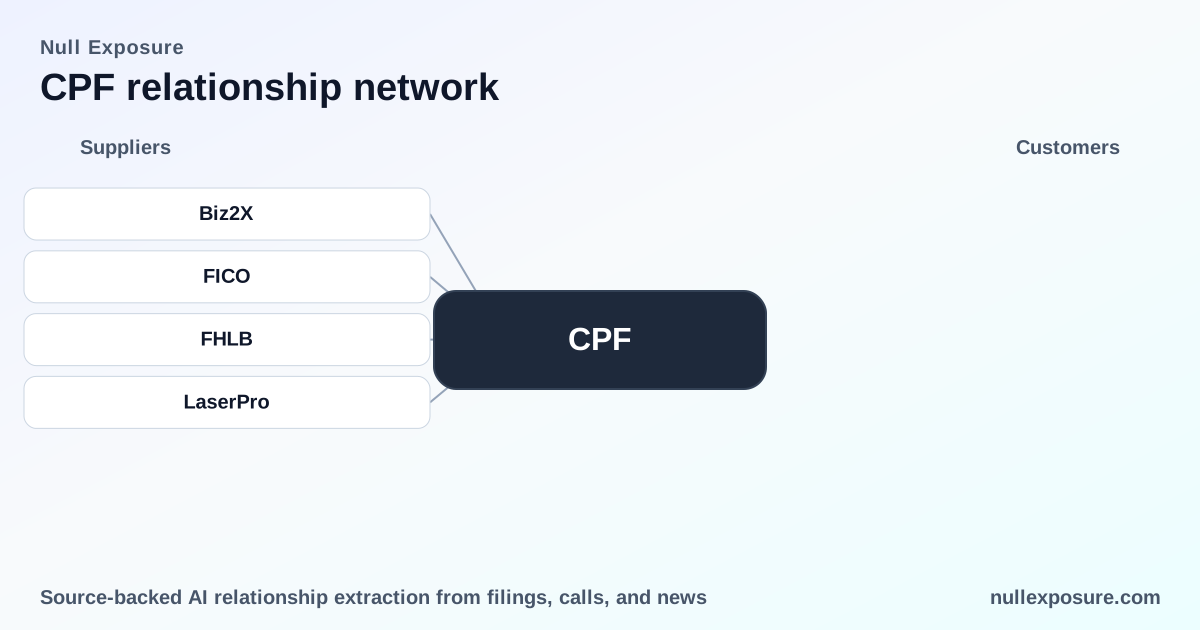
Central Pacific Financial Corp operates a regional banking franchise centered in Hawaii through Central Pacific Bank (CPB). The company monetizes primarily through net interest income on loans and securities, complemented by fee income and targeted commercial lending initiatives; operating performance is sensitive to credit spreads, funding costs and execution of digital transformation to scale SMB lending. Supplier relationships in 2025–2026 expose CPF to a mix of fintech platform partners for lending automation, core and loan-origination integrations, and a funding line from the Federal Home Loan Bank system — each relationship is operationally material to execution and product velocity. If you evaluate bank-supplier exposure for investment or counterparty diligence, these linkages matter for growth, cost structure and operational resilience. Learn more at https://nullexposure.com/.
Why these suppliers matter to an investor
CPF is a small-cap regional bank with roughly $821 million market capitalization and profitable core operations (reported EPS 2.86, return on equity near 13.7% TTM). Execution risk in digital lending and wholesale funding can compress margins or throttle revenue growth if third-party integrations or financing change. The supplier set here combines a lending SaaS partner, loan-origination and credit decisioning integrations, and a short-term wholesale funding instrument — a profile that speaks to both strategic modernization and conventional bank funding levers. Explore supplier intelligence at https://nullexposure.com/ for deeper due diligence.
The supplier map — concise, attributable takeaways
Below are each of the reported supplier relationships and plain-English takeaways, with source context.
-
Biz2X — CPB expanded an existing engagement to use Biz2X’s lending platform for small- and mid-size business (SMB) loan origination as part of a digital lending transformation in FY2026. According to a Biz2X press release dated March 9, 2026, this expansion emphasizes automation, faster decisioning and end-to-end efficiency for CPB’s SMB originations. (Biz2X press release, March 9, 2026)
-
FICO LiquidCredit — Biz2X’s platform integrates with FICO LiquidCredit for credit decisioning, giving CPB access to pre-built credit scoring and decisioning tools as part of its lending modernization in FY2026. The Biz2X announcement identified FICO LiquidCredit as an outbound integration to enhance borrower and bank workflows. (Biz2X press release, March 9, 2026)
-
LaserPro — The Biz2X platform also lists LaserPro among its out-of-the-box integrations, indicating CPB will leverage LaserPro for loan document production and compliance workflows as part of the same FY2026 transformation. The press release highlights LaserPro integration as a contributor to a smoother user experience for borrowers and bank staff. (Biz2X press release, March 9, 2026)
-
FHLB (Federal Home Loan Bank) — Management disclosed in a Q3 2025 earnings call that CPF had one $25 million FHLB advance outstanding, maturing in February 2028, indicating use of FHLB advances as part of CPB’s funding mix. The detail comes from a Q3 2025 earnings call transcript captured by InsiderMonkey. (Earnings call transcript / InsiderMonkey, Q3 2025)
What these relationships imply about CPF’s operating model
CPF’s supplier profile signals several company-level operating characteristics that investors must weigh:
-
Contracting posture — long-term orientation. Company documents disclose long-dated hedges and instruments with multi-year maturities, indicating CPF accepts long-term contractual commitments as part of its balance-sheet strategy; this suggests the bank manages vendor and capital relationships with a medium- to long-term horizon rather than purely tactical arrangements.
-
Service-provider dependence and criticality. CPF explicitly relies on third-party vendors for core processing, online and mobile banking, data hosting and network services, which makes vendors functionally critical to day-to-day operations and customer experience. That concentration increases operational risk if a core vendor underperforms.
-
Relationship maturity and activity. The cited vendors are active and integrated into current product delivery (e.g., Biz2X rollout, integrations with LaserPro and FICO), not hypothetical pilots; this reflects an active stage of digital transformation rather than exploratory procurement.
-
Spend and balance-sheet scale signals. A disclosed notional hedge of $115.5 million and the existence of a $25 million FHLB advance indicate CPF operates with multi-million-dollar financial commitments and uses both market instruments and institutional funding sources, pointing to meaningful vendor and capital intensity relative to the company’s size.
Investment implications — risk, runway and optionality
CPF’s supplier arrangements create three practical implications for investors:
-
Execution-driven growth: The Biz2X-led lending platform and its integrations with FICO and LaserPro should accelerate SMB origination throughput and reduce manual processing, supporting revenue growth without proportionate headcount increases; this is a positive delta to revenue-per-employee economics if adoption executes as intended.
-
Operational concentration risk: Reliance on external core processors and integrated third-party modules raises operational concentration risk. A material outage or integration failure would be an earnings and reputational event given the centrality of these services to CPB’s customer-facing channels.
-
Funding flexibility and interest-rate sensitivity: The FHLB advance is a standard bank funding tool; while it provides liquidity, it also ties CPF to institutional funding costs and maturities that affect net interest margin dynamics. The outstanding advance maturing in 2028 creates a finite funding horizon investors should monitor.
Key takeaways: these suppliers reduce time-to-market for lending scale but increase vendor concentration and funding dependency — a balanced mix of growth optionality and execution risk.
Tactical checklist for analysts and operators
- Validate timelines and KPIs for Biz2X rollout: originations, approval times, and cost per loan.
- Confirm SLAs and redundancy plans for core processing vendors to quantify operational risk.
- Model the funding cost and refinancing risk associated with the $25 million FHLB advance and the company’s hedging profile.
Next steps for diligence
For investors seeking a rapid follow-up, review the recent Biz2X announcement and CPF’s earnings call transcript to reconcile stated goals against funding and hedge disclosures. For a broader supplier-risk scan and continuous monitoring, visit https://nullexposure.com/ and request a supplier mapping briefing.
Closing thought: CPF’s supplier choices are strategic — shifting origination infrastructure to established lending platforms and integrating proven credit decisioning and document tools improves scalability, while continued reliance on institutional funding and third-party core services concentrates operational risk. Investors should therefore weigh execution metrics and vendor SLAs as heavily as traditional credit and interest-rate analysis. For ongoing coverage and supplier intelligence, see https://nullexposure.com/.