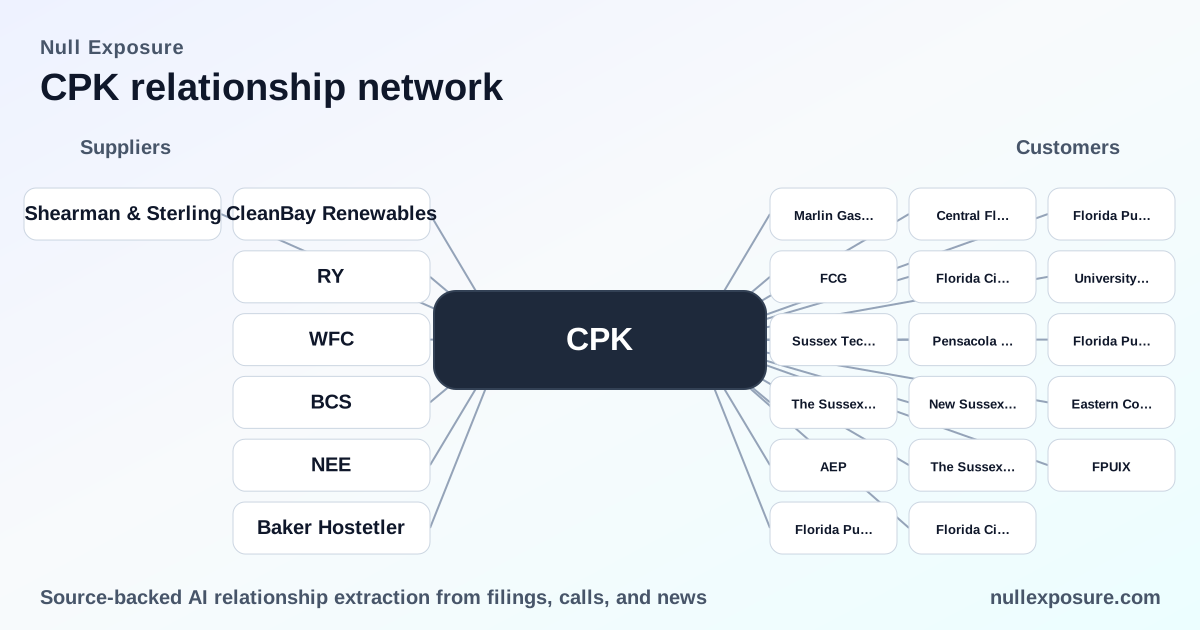
Chesapeake Utilities (CPK) — supplier relationships and the deal network that underpins growth
Chesapeake Utilities operates as a regulated natural gas and related energy services platform that monetizes through rate-regulated distribution, long-term commodity and capacity contracts, and accretive M&A. The company funds growth with a mix of long-term debt and equity and uses external banks and advisors to execute financings and transactions; for investors, the supplier and advisor network is a direct lever on capital access and execution risk. For deeper supplier analytics and relationship mapping visit https://nullexposure.com/.
Why the supplier and advisor map matters to investors
Chesapeake’s core cash flows are predictable — regulated gas margins and predictable EBITDA (reported TTM EBITDA roughly $365 million on ~$930 million revenue) — but value creation is concentrated in how management executes acquisitions and secures long-term supply and financing. Supplier counterparties that provide committed capacity, purchase agreements or financing shape both near-term liquidity and long-term margin stability. Legal and capital markets advisors, while not revenue-producing, materially reduce execution risk on multi-hundred-million-dollar deals.
The active counterparties and what they do for Chesapeake
Below I cover every named relationship surfaced in the results, with a concise plain-English take and a source for verification.
-
Wells Fargo Securities, LLC — Wells Fargo acted as a joint book-running manager on Chesapeake’s public offering tied to the company’s financing activity in March 2026, helping place equity/debt into the market to support growth and acquisitions. According to a StockTitan news posting (March 9, 2026), Wells Fargo was listed as a joint lead book-running manager for the offering.
-
RBC Capital Markets, LLC — RBC served alongside other investment banks as a joint lead manager for the same March 2026 offering, providing distribution and underwriting capacity that expands Chesapeake’s access to institutional buyers. StockTitan reported RBC Capital Markets as a joint lead book-running manager (March 9, 2026).
-
Barclays / Barclays Capital Inc. / BCS — Barclays is referenced multiple times as both a lead manager and a committed lender; the company obtained committed financing from Barclays to fund the $923 million acquisition of Florida City Gas and Barclays also participated as a joint book-running manager on the public offering. PR Newswire (March 2026) and StockTitan (March 9, 2026) list Barclays/Barclays Capital/BCS in financing and underwriting roles.
-
CleanBay Renewables — Chesapeake partners with CleanBay to deliver pipeline-quality natural gas produced from chicken litter, representing an operational supplier relationship that supports renewable natural gas initiatives and localized supply diversification on the Eastern Shore. DelmarvaNow reported the CleanBay partnership and Chesapeake’s role in delivering RNG (July 28, 2020).
-
NextEra Energy, Inc. / NEE — Chesapeake announced a definitive agreement to acquire Florida City Gas from NextEra for $923 million in cash, a transformational tuck-in that expands scale in Florida and shifts regulatory profile and capex needs. PR Newswire (March 2026) announced the definitive agreement with NextEra Energy as seller.
-
Baker Hostetler — Baker Hostetler is serving as a legal advisor to Chesapeake on the Florida City Gas acquisition, providing transaction and regulatory counsel that supports deal completion and integration. PR Newswire (March 2026) lists Baker Hostetler as a legal advisor.
-
Shearman & Sterling — Shearman & Sterling is the lead legal advisor alongside Baker Hostetler, advising on the transaction structure and cross-border or financing legal matters tied to the acquisition. PR Newswire (March 2026) identifies Shearman & Sterling as a legal advisor.
What the constraint signals say about Chesapeake’s operating posture
The textual constraint evidence gives a coherent view of how Chesapeake contracts and finances its business:
-
Long-term contracting posture is central. Multiple excerpts reference multi-year instruments — senior notes with maturities three to 15 years, 20-year power and steam purchase agreements, and a five-year credit tranche — indicating Chesapeake relies on long-dated contracts for rate-base stability and financing predictability.
-
Short-term liquidity is managed but present. The firm maintains shorter-duration facilities (for example, a 364-day tranche that expires in August 2025), signaling active working-capital management alongside longer-term debt.
-
Framework agreements and sponsor relationships are used to preserve optionality. Shelf agreements with large insurers through February 2026 (Prudential and MetLife named in filings) provide contingent capital channels without mandatory draw obligations.
-
Dual role across the value chain. Chesapeake is both a buyer (it holds firm transportation contracts and capacity release arrangements) and a service operator, purchasing gas from marketers and producers while maintaining transportation and storage contracts to meet demand.
-
Scale of commitments is material. Purchase-commitment line items in filings aggregate into a >$100 million spend profile over multi-year horizons, indicating supplier and capacity contracts that are consequential to cash flow planning.
Collectively, these constraints indicate a mature, contract-driven utility model with concentrated counterparty exposures in financing and long-term supply.
Investment implications and a risk checklist
- Financing execution is a primary value driver. The $923 million Florida City Gas acquisition increases scale but requires disciplined integration and financing; Barclays’ committed financing and recent public offering underwriting reduce execution risk, but raise leverage and integration risk (PR Newswire; StockTitan, March 2026).
- Long-term contracts de-risk cash flows but lock in obligations. Multi-decade PPAs and long-term transportation/storage commitments stabilize margins but limit flexibility to benefit from commodity dislocations; investors should treat contract maturity ladders and upcoming short-term tranche expiries as liquidity checkpoints.
- Renewable and RNG relationships are strategic optionality. The CleanBay partnership demonstrates Chesapeake’s ability to integrate non-traditional gas supply that can help regulatory positioning and ESG narratives (DelmarvaNow, July 2020).
- Legal and advisory roster reduces execution premium. High-caliber legal counsel and top-tier underwriters reduce transaction execution risk on large deals, a positive when management pursues bolt-on acquisitions (PR Newswire; StockTitan, March 2026).
For a focused view of supplier counterparty concentration and financing counterparties, consult additional relationship mapping at https://nullexposure.com/.
Bottom line
Chesapeake Utilities is a regulated utility platform that uses long-term contracts and strategic financing relationships to drive predictable earnings and selective growth. The company’s supplier and advisor network — from banks that underwrite its offerings to boutique renewables partners and top-tier law firms — is a critical determinant of transaction success and capital efficiency. Investors should monitor upcoming tranche expirations, integration progress on Florida City Gas, and any changes to committed financing or material counterparty terms as primary signals for downside risk or upside optionality.