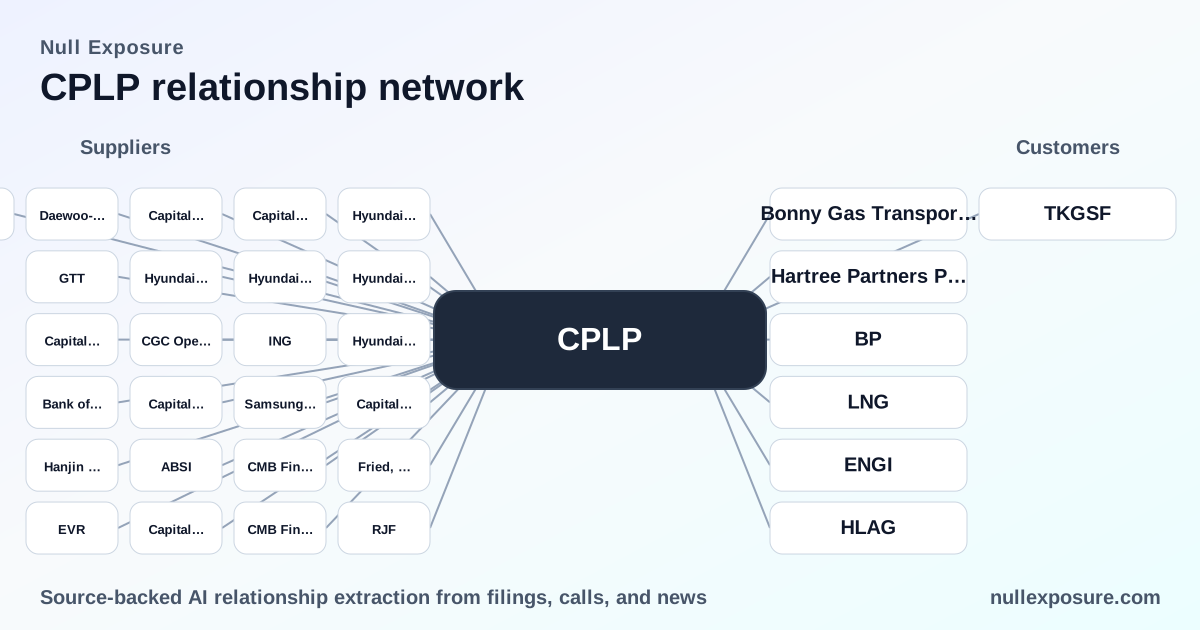
CPLP’s supplier map: how the partnership is buying growth and who gets paid
Capital Product Partners L.P. (NASDAQ: CPLP) operates as an owner of ocean-going vessels that monetizes through long-term and spot charters, sale-leaseback financing and selective asset sales. Over the last three fiscal cycles the partnership executed a strategic pivot into modern LNG tonnage — acquiring 11 newbuild LNG carriers from its sponsor and funding those purchases with a mix of cash, bank and lease financing while continuing to recycle older container assets into liquidity. That mix of newbuild commitments, sponsor-aligned purchases and third‑party finance defines CPLP’s commercial and credit profile. For a deeper look at counterparties and implications visit https://nullexposure.com/.
Why the supplier list matters to investors: one operating model, several levers
CPLP’s supplier and counterparty network shows a capital‑intensive, supplier‑concentrated operating model. The partnership sources core assets from a small group of South Korean shipyards and specialized ship systems vendors, while funding those assets through a dispersed set of financial lessors and bank syndicates and using related-party purchasing from its sponsor. That mix produces several predictable investor implications:
- Contracting posture: large fixed-price shipbuilding and acquisition commitments drive near-term cash calls (pre-delivery and delivery instalments) and create schedule risk tied to shipyard delivery windows.
- Concentration: shipbuilders (Hyundai family, Hyundai Samho, Samsung, Daewoo, Hanjin) and technical vendors (GTT, Hyundai‑WinGD) show supplier clustering around South Korea and a small set of technology providers.
- Criticality: specialized LNG containment and engine systems (GTT tanks, WinGD dual‑fuel engines) are operationally critical to voyage economics and emissions profiles.
- Maturity and financing mix: reliance on sale‑and‑leaseback lessors and bank facilities (CMBFL, ING, Bank of Communications) reflects the capital structure CPLP prefers — asset-backed, amortizing finance rather than equity dilution.
These are company-level signals drawn from announced transactions and financing structures; they describe CPLP’s supply-dependency and funding architecture rather than single-event risk. Learn more about counterparty footprints at https://nullexposure.com/.
Supplier and counterparty roll call — who CPLP is transacting with
-
Hyundai Heavy Industries Co., Ltd — CPLP took delivery of the 174,000 m3 LNG carrier Axios II on 2 January 2024 as part of an 11-vessel umbrella agreement entered November 2023. According to LNG Industry (FY2024), the vessel is a latest‑generation MEGA LNG carrier.
Source: LNG Industry, FY2024. -
Hyundai Heavy Industries — The partnership received the Assos (174,000 m3) on May 31 under the same 2023 umbrella agreement for 11 newbuild LNG carriers.
Source: Offshore‑Energy.biz, FY2024. -
Hyundai Heavy Industries (HHI) — HHI delivered the LNG carrier Asterix I to CPLP, representing earlier phases of the newbuild program.
Source: Offshore‑Energy.biz, FY2023. -
Capital Maritime — CPLP entered the November 13, 2023 Umbrella Agreement with Capital Maritime to acquire 11 LNG newbuilds for an aggregate headline price of ~$3.13 billion, demonstrating a sponsor‑facilitated asset pipeline.
Source: SupplyChainBrain / Maritime Executive, FY2023. -
Fried, Frank, Harris, Shriver & Jacobson LLP — Served as legal advisor to the committee in CPLP’s announced restructuring/transaction activities referenced in FY2024 filings and press releases.
Source: Yahoo Finance release, FY2024. -
Raymond James & Associates, Inc — Acted as financial advisor to the committee in the same FY2024 transaction announcements.
Source: Yahoo Finance release, FY2024. -
Hyundai Samho Heavy Industries Co. Ltd. — Listed as one of the shipyards that built or constructed vessels in CPLP’s 11‑vessel acquisition, reinforcing the South Korean shipyard concentration.
Source: Maritime Executive, FY2023. -
ING Bank N.V. — ING led a bank syndicate that financed an LNG carrier via a term loan structure, cited in vessel acquisition financing for deliveries in 2021.
Source: VesselFinder, FY2021. -
CMB Financial Leasing (CMBFL) — CPLP drew ~$184 million under a sale‑and‑leaseback with CMBFL to finance vessel acquisitions, showing reliance on leasing counterparties for liquidity.
Source: LNG Industry / FY2023 disclosures. -
Capital Maritime & Trading Corp. — Identified as the seller in the Umbrella Agreement and as CPLP’s sponsor; CPLP advanced a $12 million deposit in 2022 and agreed to staged deliveries through 2027.
Source: Maritime Executive / Yahoo Finance, FY2023–FY2024. -
Samsung Heavy Industries — The sale and earlier construction history for several 10,000 TEU container vessels point to Samsung as an original shipyard for assets CPLP later monetized.
Source: StarConcord press release, FY2024. -
CGC Operating Corp. — CPLP acquired three 174,000 cbm X‑DF LNG carriers from CGC Operating Corp. in a 2021 transaction that combined cash, assumed secured debt and unit issuance.
Source: VesselFinder, FY2021. -
Capital Ship Management Corp. — Identified as a fleet manager with relationships across CPLP’s vessels; the company manages ships that include CPLP assets.
Source: Cyprus Shipping News, FY2020. -
ABS — The classification society ABS is listed as class for at least one LNG carrier delivered into CPLP’s fleet, a standard technical counterparty for safety and regulatory compliance.
Source: Offshore‑Energy.biz, FY2023. -
GTT — CPLP’s LNG carriers are fitted with GTT Mark III Flex containment systems that the vendor certifies with a guaranteed boil‑off rate, a key performance input to fuel economics.
Source: Offshore‑Energy.biz, FY2023. -
Capital Gas Ship Management Corp. — Cited in delivery ceremonies and technical oversight; its technical team supervised recent LNG deliveries and emissions‑efficiency integrations.
Source: Offshore‑Energy.biz, FY2023. -
Bank of Communications Financial Leasing Co Ltd — Bank of Communications is a counterparty to sale‑and‑leaseback indebtedness on specific LNG vessels, illustrating geographic diversity in leasing partners.
Source: VesselFinder, FY2021. -
Capital Maritime & Trading Corp. (CMTC) — Separately cited for a right‑of‑first‑offer on six additional vessels (ROFO), indicating an ongoing pipeline of potential sponsor sales and related party optionality.
Source: VesselFinder, FY2021. -
Daewoo‑Mangalia Heavy Industries S.A. — Listed as the shipyard for older eco‑flex containerships that CPLP sold, showing the partnership’s active fleet rotation across multiple yards.
Source: StarConcord / StockTitan, FY2024. -
Hanjin Heavy Industries & Construction Co., Ltd. — Hanjin is the builder identified for older container tonnage that CPLP has marketed for sale, another node in the legacy shipbuilding footprint.
Source: StockTitan, FY2024. -
Capital Link, Inc. — Identified as the investor relations/media contact for CPLP, the firm handles external communications and IR outreach.
Source: StockTitan press notice, FY2024. -
Evercore Group L.L.C. — Named as financial advisor on earlier transaction committees tied to prior vessel acquisitions and corporate restructuring efforts.
Source: VesselFinder, FY2021. -
Fried, Frank, Harris, Shriver & Jacobson LLP (earlier citation) — Also served as legal advisor in prior transaction committees and acquisition activities referenced in CPLP’s press history.
Source: VesselFinder, FY2021. -
Hyundai‑WinGD — Hyundai‑WinGD supplied dual‑fuel 5X72DF engines for recent LNG carriers, enabling the vessels to run on both marine diesel and gas and supporting decarbonization claims.
Source: Offshore‑Energy.biz, FY2023.
What investors should take away and next steps
CPLP’s supplier footprint signals a deliberate shift into modern LNG tonnage executed through sponsor arrangements and asset-backed financing. That structure delivers fleet modernity and near-term growth in charterable LNG capacity, while concentrating execution risk in a few shipyards and financing partners. Key monitoring points for investors are: delivery schedule adherence from Hyundai/Samho, the performance of GTT containment and WinGD engines on boil‑off and fuel consumption, and the health of sale‑and‑leaseback markets through CMBFL, Bank of Communications and bank syndicates.
If you evaluate counterparty risk or portfolio exposure to shipping supply chains, review the full relationship map and underlying filings at https://nullexposure.com/ for sourcing and tracking tools. For bespoke intelligence on CPLP counterparties and financing counterparties, visit https://nullexposure.com/ and request a focused briefing.
Bold strategic takeaway: CPLP’s growth is financed and delivered through concentrated supplier relationships and structured leasing — that delivers scale fast but creates a predictable set of execution and financing sensitivities investors must price.