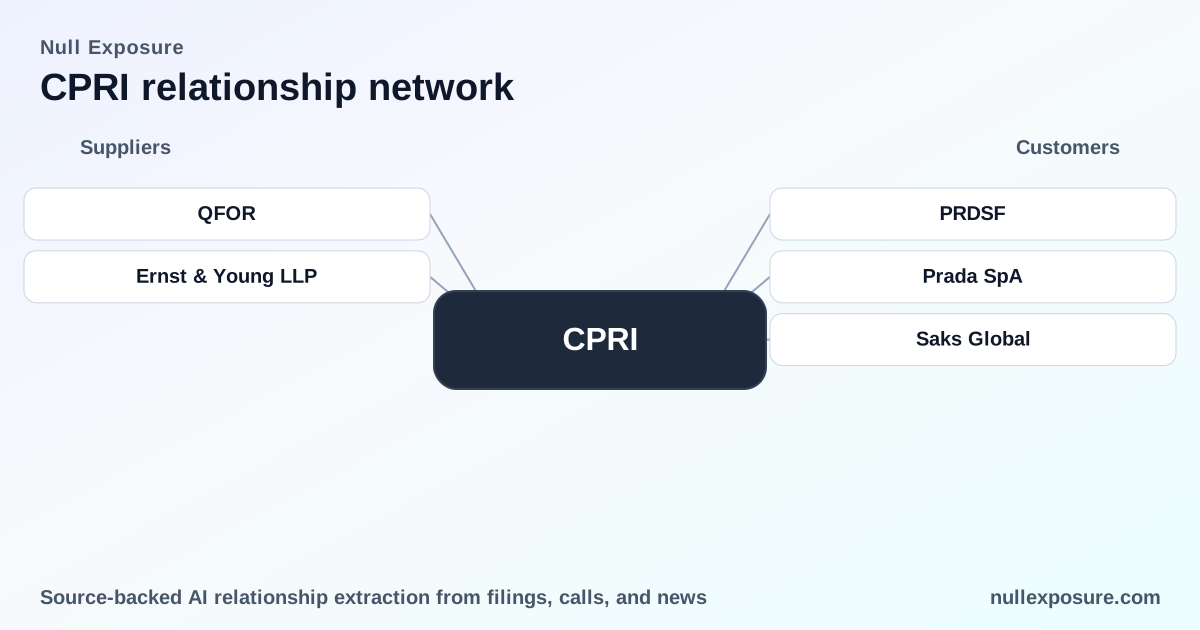
Capri Holdings (CPRI) — supplier relationships, constraints, and operational signals
Capri Holdings monetizes a global luxury apparel and accessories platform through branded retail, wholesale and direct-to-consumer channels across Michael Kors, Jimmy Choo and Versace. Revenue generation is driven by finished-goods sourcing from independent manufacturers, large-scale marketing spend and a retail footprint underpinned by long-term leases, while working capital and supplier financing mechanics compress the cash conversion cycle. Investors should view Capri as a brand-led retailer with material supplier concentration, significant marketing-driven spend, and hybrid short- and long-term contractual exposures that shape both margin stability and operational risk.
If you want a structured supplier risk view for investment or vendor negotiation, start here: https://nullexposure.com/
How Capri runs its supply base and who gets paid first
Capri purchases finished goods predominantly through independent third-party manufacturing contractors, largely offshore, where contractors handle the full manufacturing process and procurement of piece goods and trims. The company supplements manufacturing with independent agents who source finished goods for Michael Kors, and it outsources logistics to third-party distribution and fulfillment providers. Capri funds retail expansion and brand investment with high marketing spend—$363 million globally in Fiscal 2025—and carries long-duration retail leases that create fixed overhead. These dynamics produce a supply chain that is operationally critical but financially tight: the business uses a supplier financing program that enables suppliers to sell receivables on a non-recourse basis, while Capri’s actual payment obligations typically settle within a short window (generally not exceeding 90 days).
Key operational constraints that shape supplier risk
- Contracting posture — short-term supplier pay cycles vs long-term real estate commitments. Capri’s supplier payment obligations are structured around short vendor payment terms (scheduled payment dates generally do not exceed 90 days), while the company simultaneously carries long-term, non-cancelable retail leases that lock in fixed costs and increase leverage on operating cash flow.
- Concentration — single contractors and agents are material. One contractor represented approximately 11% of finished goods purchases in Fiscal 2025 (11% in FY2025, 12% FY2024, 15% FY2023), and one agent sourced roughly 15% of Michael Kors finished goods over the same trailing periods; this is a company-level signal of supplier concentration that amplifies counterparty risk.
- Criticality — manufacturing and logistics are mission-critical. The manufacturing contractors manage end-to-end production responsibilities, and third-party logistics providers handle distribution, warehousing and fulfillment—failures in these relationships directly impact inventory flow and retail availability.
- Maturity — established brand economics with legacy real estate. The presence of long-term leases and substantial marketing budgets signals an incumbent retail model: stable brand recognition but rigid fixed cost structure that reduces flexibility in downturns.
- Financial structuring — active supplier financing and large marketing spend. The supplier financing program transfers receivable risk to financial institutions (non-recourse) and accelerates supplier cash; concurrently, advertising and marketing expense of ~$363 million in FY2025 underscores the importance of demand-generation spend to revenue performance.
Relationship inventory — who Capri deals with (from recent records)
Below are the supplier/partner relationships surfaced in the referenced records and what they imply for investors.
-
Q4 Inc. — Capri’s investor relations web pages are powered by Q4 Inc., indicating a vendor relationship for investor communications technology and disclosures; the company’s quarterly results page in FY2025 contains the “Powered By Q4 Inc.” footer (Capri Holdings quarterly results page, FY2025: https://www.capriholdings.com/financials/quarterly-results/default.aspx). This is an immaterial technology supplier for IR functions but relevant for disclosure continuity and investor engagement.
-
Ernst & Young LLP — Capri’s corporate governance filings indicate shareholder action to ratify Ernst & Young LLP as the company’s auditor, with a shareholder record date of June 9, 2025, and proposals that include auditor ratification and omnibus incentive compensation plan approval (SEC/proxy materials referenced on StockTitan, FY2026: https://www.stocktitan.net/sec-filings/CPRI/page-3.html). EY is the principal audit firm and therefore a critical professional services supplier for financial reporting, control validation, and auditor attestation.
What these relationships mean for procurement strategy and investor risk
- Operational resilience is concentrated. The manufacturing model—outsourced, foreign contractors responsible for end-to-end production—creates single points of failure when a top contractor accounts for double-digit percentages of purchases. Procurement should treat these large contractors as strategic partners and build contingency sourcing or dual-sourcing plans.
- Supplier financing shifts working capital exposure off the balance sheet. The non-recourse supplier financing program accelerates supplier cash without changing Capri’s payment schedule; this reduces supplier pressure but creates a structural dependency on third-party financial institutions to provide receivable liquidity to suppliers.
- Fixed-cost exposure is asymmetric. Long-term leases reduce operational flexibility during demand shocks while marketing spend supports top-line growth; the combination means downside pressure can compress margins quickly, while upside depends on effective inventory flow and brand investments.
- Professional services oversight is standard. Retaining a Big Four auditor is a governance signal; consistent auditor relationships support credibility in financial statements, which investors should treat as a control factor when assessing supply-side disclosures.
If you want to convert this supplier intelligence into a decision-ready exposure map for due diligence or contract negotiations, visit https://nullexposure.com/
Investment implications and recommended monitoring
- Short-term liquidity versus long-term fixed costs: Investors should watch working capital trends, days payable outstanding (DPO) and lease commitments; rising DPO driven by supplier finance usage is not the same as improved supplier terms—it’s a structural funding mechanism.
- Concentration is a tangible sourcing risk: The fact that a single contractor or agent drives double-digit shares of finished-goods sourcing is a strategic vulnerability; monitor supplier spend concentration metrics disclosed in future 10‑Ks and 10‑Qs.
- Service continuity and quality matter: Outsourced manufacturing and third-party logistics are core to revenue delivery; changes in vendor performance or geopolitical disruptions in offshore sourcing regions will show up quickly in inventory turns and retail availability.
- Governance and transparency are intact: Auditor ratification (Ernst & Young) and an established investor relations platform (Q4 Inc.) reflect conventional corporate governance and communication channels, important for investor confidence in reporting.
For a structured supplier risk report tied to Capri’s disclosures and real-world vendor relationships, see practical tools and case studies at https://nullexposure.com/
Bottom line
Capri Holdings runs a classic brand-led luxury retail model: outsourced manufacturing, concentrated supplier sourcing, heavy marketing investment, and fixed retail lease exposure. The supplier financing program reduces short-term supplier cash pressure but does not eliminate concentration or operational criticality. Investors evaluating CPRI should prioritize monitoring of supplier concentration metrics, working capital mechanics, and lease commitments as the principal supply-side determinants of margin durability and downside risk.