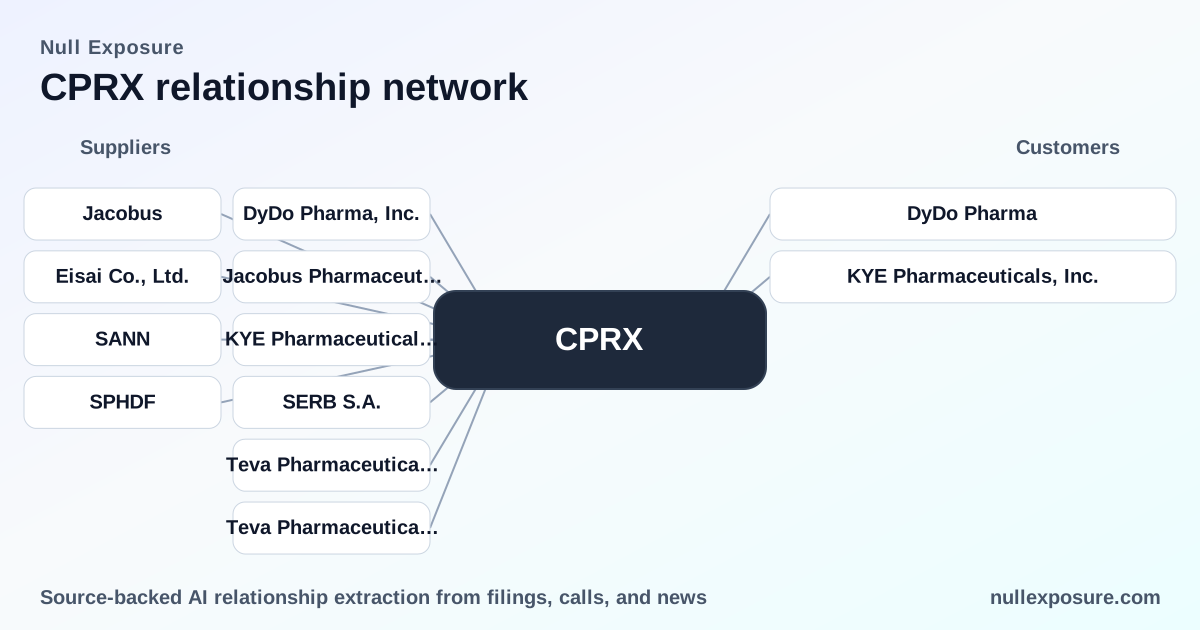
Catalyst Pharmaceuticals (CPRX) — Supplier relationships that define commercial risk and runway
Catalyst Pharmaceuticals commercializes therapies for ultra-rare neuromuscular and neurological conditions and monetizes primarily through product sales, licensing-derived royalties, and selective acquisitions of commercial rights (notably FIRDAPSE, FYCOMPA, AGAMREE, and RUZURGI in recent years). The company runs as a virtual manufacturer and relies heavily on third-party suppliers, contract manufacturers, licensors and distribution partners to deliver product and capture revenue; understanding those supplier ties is essential for investors assessing operational continuity, margin pressure from royalties, and the durability of product supply. Learn more at https://nullexposure.com/.
Why the supplier map matters to investors
Catalyst operates with a deliberate outsourcing posture: the company is licensed as a virtual drug manufacturer and intentionally outsources manufacturing, packaging, and certain commercial services. That posture creates a mix of operational exposures and leverage:
- Long-term manufacturing commitments exist for certain acquired products, implying supply continuity but also contractual lock‑ins for price and capacity.
- Short-term purchase obligations for other products introduce near-term concentration risk and transition costs.
- Royalty and licensing economics are material to cost of goods sold and therefore to gross margin—royalty bands reported in filings are an ongoing, quantifiable drag on profitability.
- Spend is uneven: the company records both modest recurring purchase commitments (hundreds of thousands annually) and one-off large acquisition payments (hundreds of millions), so counterparty importance varies by contract.
These signals justify focused diligence on counterparties that both manufacture and license Catalyst’s core franchises. If you want a consolidated, relationship-centric view for vendor diligence, visit https://nullexposure.com/ for more.
Full relationship rundown — each cited item from the record
Below I cover every supplier/licensor relationship disclosed in the results, with a concise plain‑English summary and a source citation for each entry.
DyDo Pharma, Inc.
Catalyst lists a License and Supply Agreement with DyDo Pharma dated June 28, 2021, indicating an ongoing contractual relationship for product rights or supply tied to that agreement. Source: Catalyst's 2024 Form 10‑K (FY2024 filing).
Jacobus Pharmaceutical Company, Inc. (10‑K disclosure)
Catalyst entered an exclusive license agreement with Jacobus on July 11, 2022 to develop and commercialize RUZURGI in the U.S. and Mexico, forming the commercial foundation for that product in Catalyst’s portfolio. Source: Catalyst's 2024 Form 10‑K (FY2024 filing).
KYE Pharmaceuticals, Inc.
Catalyst references a License and Supply Agreement with KYE Pharmaceuticals dated August 14, 2020, showing another licensing/supply relationship used to secure manufacturing or rights for relevant product lines. Source: Catalyst's 2024 Form 10‑K (FY2024 filing).
SERB S.A.
Catalyst reports that BioMarin transferred substantially all rights under a license agreement to SERB S.A., which now serves as the company’s licensor under that arrangement, establishing SERB as the contractual licensor for the underlying product rights. Source: Catalyst's 2024 Form 10‑K (FY2024 filing).
Teva Pharmaceuticals, Inc.
Catalyst announced that it and its licensor, SERB, entered into a Settlement Agreement with Teva on January 8, 2025 — a legal resolution that bears on rights and obligations tied to one or more licensed products. Source: Catalyst's 2024 Form 10‑K (referencing the January 8, 2025 settlement).
Teva Pharmaceuticals USA, Inc.
A parallel disclosure identifies Teva Pharmaceuticals USA, Inc. in the same January 8, 2025 Settlement Agreement, confirming the settlement’s applicability to Teva’s U.S. affiliate and its role in Catalyst’s U.S. commercial environment. Source: Catalyst's 2024 Form 10‑K (FY2024 filing).
Jacobus — royalty change reported in news (StockTitan)
A StockTitan SEC‑filings summary (March 2026) reported that, effective January 1, 2026 under Catalyst’s acquisition and license agreement for RUZURGI with Jacobus, the royalty rate payable on net U.S. sales of any amifampridine product increased from 1.5% to 2.5%. This is an explicit, quantifiable increase to cost of sales for that product family. Source: StockTitan SEC‑filings summary (March 2026).
Eisai Co., Ltd. (news)
News coverage notes that Catalyst acquired U.S. rights for FYCOMPA (perampanel) from Eisai in 2023 and that under the related supply agreement Eisai agreed to manufacture FYCOMPA for at least seven years, establishing a long‑term manufacturing commitment. Source: Finviz news report (March 2026) citing the FYCOMPA acquisition.
Santhera Pharmaceuticals (news)
Press and earnings coverage record that Catalyst acquired exclusive rights to manufacture and supply AGAMREE from Santhera in 2023, making Santhera a past or current manufacturing/licensing partner for that product. Source: Finviz news report (March 2026).
Jacobus — company press release (GlobeNewswire)
Catalyst’s press release reporting record financials (February 25, 2026) reiterates the Jacobus royalty increase—specifically, the royalty on net U.S. amifampridine sales rose from 1.5% to 2.5% as part of the acquisition and license agreement—affirming the company’s public disclosure. Source: Catalyst press release on GlobeNewswire (Feb 25, 2026).
Santhera (10‑K disclosure)
Catalyst’s 2024 Form 10‑K states that, under the License and Collaboration Agreement with Santhera, Catalyst agreed to purchase supplies of AGAMREE from Santhera until January 1, 2026, representing a time‑limited purchase obligation. Source: Catalyst's 2024 Form 10‑K (FY2024 filing).
(Multiple items above reference the same underlying counterparties but are reported via different documents; each disclosure has been cited directly.)
Mid‑analysis note: if you want a vendor‑level risk scorecard or a one‑page supplier map for executive review, visit https://nullexposure.com/ to get an investor‑centric view.
What the constraints tell investors about operating risk
The company filings provide clear operating signals that are material to investment analysis:
- Contracting posture: Catalyst relies on a mix of long‑term manufacturing agreements (Eisai’s seven‑year supply commitment for FYCOMPA) and short‑term purchase obligations (Santhera supply through January 1, 2026). Those terms create both supply certainty and transition risk depending on the product.
- Concentration and criticality: Catalyst has no in‑house manufacturing capacity and is therefore dependent on contract manufacturers and licensors to deliver core products; a supplier failure would be material to revenue, as the 10‑K warns.
- Economic impact: Royalties are a recurring, meaningful line in cost of sales—Catalyst disclosed tens of millions in royalties in 2024—so licensing economics directly compress gross margins and require monitoring as sales scale.
- Maturity of relationships: Several supplier ties are well‑established (multi‑year supply agreements and completed acquisitions), which reduces near‑term execution risk but locks in price and royalty structures that will affect margins over the contract terms.
- Spend profile: The company’s outlays range from modest annual purchase commitments (
$0.5m) to sizable acquisition consideration ($164m), so counterparty importance should be weighted accordingly.
Investment implications and action points
- Operational continuity depends on a small set of vendors. Investors should track contract expirations (e.g., Santhera through 2026) and the performance of long‑term manufacturers (Eisai for FYCOMPA).
- Licensing economics are non‑trivial and changing. The Jacobus royalty increase to 2.5% is a concrete example of rising cost pressure on U.S. amifampridine revenues.
- Legal resolutions can reset economic terms. The 2025 settlement with Teva impacts rights and risk in the U.S. market and should be reviewed for ongoing royalty or exclusivity implications.
If you want to convert this relationship analysis into a portfolio monitoring rule or vendor watchlist, start here: https://nullexposure.com/.
Bottom line
Catalyst’s commercial model is outsourced but contractually underpinned—long‑term supply deals grant continuity while short‑term purchase obligations and royalty bands create ongoing margin exposure. For investors, the critical monitoring items are contract durations with manufacturers, royalty rate movements (as with Jacobus), and any changes resulting from settlements (as with Teva). These factors have direct, measurable effects on gross margin volatility and the stability of revenue streams.