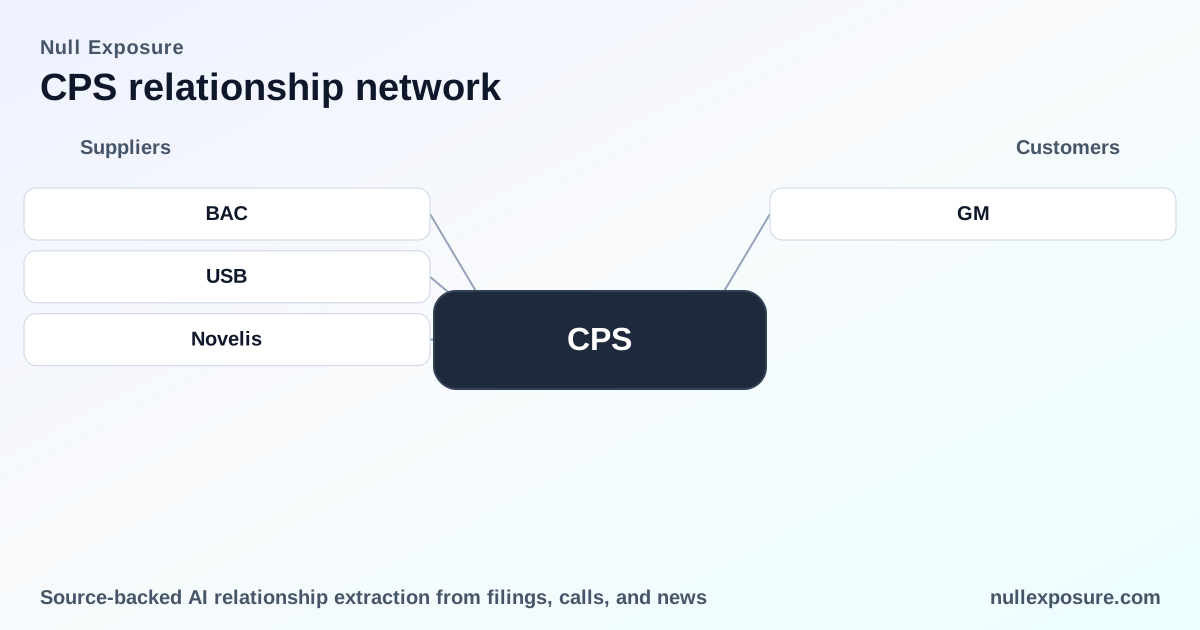
Cooper-Standard (CPS) — supplier relationships that shape refinancing and production risk
Thesis: Cooper-Standard is an auto-parts manufacturer that monetizes through OEM and tier-1 contracts for sealing, fuel, brake and fluid transfer systems, generating revenue from global vehicle platforms while operating with material exposure to commodity inputs and working-capital funding. Recent refinancing activity and an operational disruption at a raw-material supplier elevate both financial-side counterparties (credit agents and trustees) and supply-chain counterparties (raw-material and customer links) into key risk-monitoring items for investors and procurement operators. For direct vendor and counterparty intelligence, visit https://nullexposure.com/ for deeper supplier mapping and alerts.
How Cooper-Standard’s operating model converts production into cash
Cooper-Standard runs a hybrid commercial model: long-term platform agreements for program continuity combined with short-term, formula-priced procurement for raw materials. That structure delivers predictable OEM program volumes while transmitting commodity cost volatility directly to margins through formula-based inputs. On the financing front, the company layers structured debt — including first‑lien notes and an asset-based lending facility — to fund working capital and capital expenditures. Revenue is industrial-scale and global (Revenue TTM ~$2.74 billion), but margins are compressed and capital structure decisions therefore materially influence supplier payment flexibility and investment cadence.
- Key business drivers: OEM program awards and EV content wins, commodity cost pass-throughs embedded in procurement clauses, and access to secured credit markets.
- Financial state: Cooper-Standard completed a sizeable liability recapitalization in FY2026 while reporting modest operating margins and negative reported EPS; these dynamics raise the importance of its financing counterparties for operational continuity.
Explore supplier exposure dashboards at https://nullexposure.com/ to monitor counterparties in real time.
Counterparties and incidents that matter to investors and operators
Below are the relationships surfaced in recent press and filings that have direct bearing on CPS’s operational continuity and financing profile.
Bank of America — agent for the lenders in the FY2026 refinancing
Cooper-Standard executed a refinancing package that included pricing $1.1 billion of 9.25% first‑lien notes and an amendment to its ABL, with Bank of America acting as agent for certain lenders in the transaction. According to TradingView’s March 9, 2026 coverage, Bank of America served in the agent role as part of the refinancing syndicate (TradingView, March 9, 2026 — https://www.tradingview.com/news/tradingview:d7933093d82b8:0-cooper-standard-prices-1-1-billion-9-25-first-lien-notes-amends-abl-to-complete-refinancing/).
Takeaway: This positions Bank of America as a key credit intermediary whose underwriting and agent terms determine covenant mechanics and availability under the amended ABL.
U.S. Bank Trust Company — trustee and collateral agent in the financing
The refinancing record names U.S. Bank Trust Company as the trustee and collateral agent for the transaction, centralizing security administration and enforcement rights under the new capital structure. TradingView’s March 9, 2026 report identifies U.S. Bank Trust Company in this role (TradingView, March 9, 2026 — https://www.tradingview.com/news/tradingview:d7933093d82b8:0-cooper-standard-prices-1-1-billion-9-25-first-lien-notes-amends-abl-to-complete-refinancing/).
Takeaway: As trustee and collateral agent, U.S. Bank will control remedies and collateral realization mechanics if covenant or liquidity stress emerges; this raises operational risk around access to pledged receivables and inventory.
Novelis — downstream disruption that constrained Q4 production
Management disclosed that a fire at a Novelis plant, together with several cyber-attacks on customer operations, hampered Q4 production and order flow. Alphastreet’s March 2026 coverage relayed management commentary on these incidents impacting output (AlphaStreet, March 2026 — https://news.alphastreet.com/cooper-standard-reports-strong-q4-revenue-and-record-ev-awards/).
Takeaway: Novelis’s operational disruption is a classic supply-chain shock: it directly constrained Cooper-Standard’s ability to meet production schedules and underlines the company’s exposure to single-source aluminum and rolled products for certain components.
What the constraints tell investors about CPS’s supplier posture
The corporate-level constraints drawn from company disclosures paint a cohesive picture of procurement and counterparty risk:
-
Contracting posture — mixed maturity: Cooper-Standard operates with both long-term program agreements that secure OEM business and short-term procurement arrangements that tie pricing to commodity indices. That duality provides revenue visibility on the top line but shifts commodity-price exposure to the margin line. (Evidence: company disclosure citing short-term and long-term supply agreements and formula-based pricing.)
-
Geographic breadth — global sourcing: The company explicitly maintains suppliers around the world, which dilutes single-country risk but increases complexity and logistics exposure; global sourcing lowers raw-material cost but raises vulnerability to regional incidents like plant fires or cyber disruptions. (Evidence: management statement about adequate global suppliers.)
-
Role orientation — buyer with commodity risk: Cooper-Standard is a net buyer of key raw materials (e.g., carbon black, natural gas-sensitive processes). Procurement statements identify direct commodity price risk as a meaningful input for margin volatility. (Evidence: disclosure of commodity price risk.)
-
Maturity and criticality: The mix of long-term revenue contracts and short-term input pricing means financial counterparties (agents/trustees) and critical suppliers (material producers like Novelis) both exert outsized influence on cash-flow resilience. The FY2026 refinancing underscores that financing relationships are as operationally critical as supplier relationships.
These constraints collectively define a company that is operationally integrated with its suppliers while being financially tethered to secured capital markets.
Investor implications and operational actions
-
Credit counterparty monitoring is imperative. With Bank of America and U.S. Bank Trust Company playing central roles in the FY2026 refinancing, covenant flexibility and collateral enforcement mechanics are top-line governance risks. Investors should monitor the amended ABL terms and note triggers that could accelerate enforcement.
-
Supply-chain concentration risk requires active mitigation. The Novelis fire demonstrates that third-party plant disruptions translate immediately into reduced output and potential contract penalties with OEMs; procurement teams should prioritize alternative sourcing, inventory buffers, and supplier risk scoring.
For portfolio managers and operators seeking a consolidated view of these trade-offs, review our supplier risk profiles at https://nullexposure.com/ to align credit monitoring with operational contingencies.
Bottom line: where to focus next
Cooper-Standard runs a lean manufacturing model supported by program revenue but exposed to commodity cycles and financier control points. The FY2026 refinancing elevated Bank of America and U.S. Bank Trust Company into structural roles that shape recovery options under stress, while the Novelis incident highlights the brittle side of global sourcing. Active monitoring of financing covenants, collateralization, and supplier incident reports is essential for investors and operators alike.
If you need a consolidated counterparty dashboard, start here: https://nullexposure.com/. For bespoke alerts linking supplier incidents to covenant thresholds, visit https://nullexposure.com/ and schedule an engagement.