CPS Technologies (CPSH): Supplier map and operational implications for investors
CPS Technologies sells advanced materials and engineered composite solutions across transportation, energy, aerospace, defense and telecom markets and monetizes through product sales, exclusive manufacturing/licensing agreements, and government-sponsored development contracts. Revenue streams combine commercial manufacturing, licensing royalties and government subcontracting, while capital markets activity supports scale-up. For investors and operators evaluating supplier and partner exposure, the mix of exclusive technology rights, a distributed raw‑materials base, and reliance on external contractors defines both upside and operational risk. Explore the partner roster and implications below, and for ongoing supplier intelligence visit https://nullexposure.com/.
How CPS Technologies generates value and why partners matter
CPS Technologies is a small-cap materials company that converts specialty composite and advanced-metal technologies into saleable components and licensed products. Commercial revenue comes from selling manufactured parts and modules; strategic value accrues from exclusive licensing deals that let CPS manufacture proprietary technologies and pay royalty shares to originators. On the non-commercial side, CPS wins government R&D and prototype contracts where it acts as prime or subcontractor, which drive technical roadmaps and potential follow-on production work.
Financial scale underscores the sensitivity of supplier and partner choices: CPSH reports roughly $30.3 million in trailing revenue with negative net earnings and a market capitalization under $100 million, so partner performance and capital access directly affect product deliveries and growth execution. For investor tools and supplier tracking, see https://nullexposure.com/.
The partnership roster that shapes operations (each relationship covered)
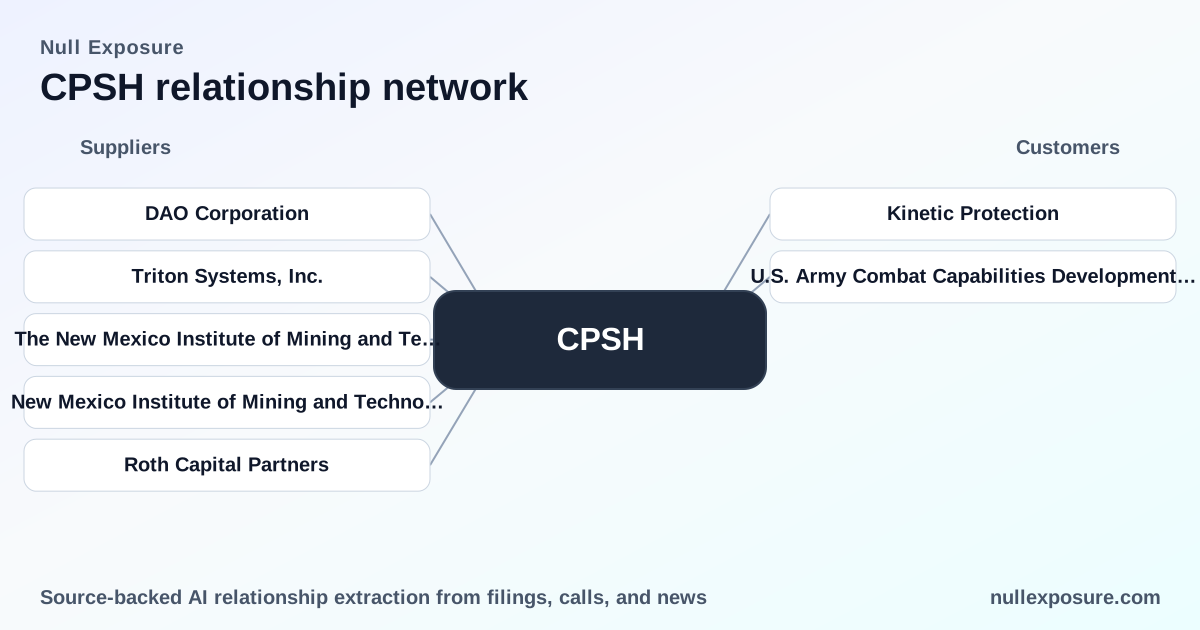
DAO Corporation — CPSH selected a general contractor CPS Technologies recently selected DAO Corporation to serve as its general contractor, positioning DAO to manage on-site execution and likely third‑party trades for a specified program referenced in the Q4 2025 earnings call transcript. This is a procurement/outsourcing posture that delegates construction and integration risk to DAO. According to the Q4 2025 earnings call and multiple transcript reports in early March 2026, CPS announced DAO as the general contractor for an ongoing initiative.
Triton Systems, Inc. — exclusive manufacturing and revenue‑share license Under an agreement disclosed in FY2024, CPS acquired the global, exclusive right to manufacture and sell products using Triton’s FRA Composite technology, with Triton protected by robust patents and compensated as a percent of revenue for every FRA item sold. This is a high-leverage licensing arrangement that converts intellectual property into manufacturing-led revenue while embedding ongoing royalty outflows. That commercial licensing arrangement and revenue-share structure were reported in a StockTitan news release summarizing the Triton deal (FY2024).
New Mexico Institute of Mining and Technology, Energetic Materials Research and Testing Center (EMRTC) — Phase II STTR subcontract CPS is listed as a subcontractor to the New Mexico Institute of Mining and Technology’s Energetic Materials Research and Testing Center for a Phase II Army STTR contract, signaling CPS’s role on defense R&D and warhead materials work where the institute is the prime. News coverage of the Phase II award in FY2025 described EMRTC partnering with CPS during Phase II development, confirming CPS’s position as a technical subcontractor on the program.
Roth Capital Partners — sole book‑runner on a financing Roth Capital Partners acted as sole book-running manager for a public offering that closed at roughly $10.35 million, reflecting how CPS accesses growth capital through underwritten public transactions. That financing disclosure was reported in FY2025 market coverage and confirms a direct capital‑markets relationship used to fund operations and program execution.
What the company‑level constraints signal about CPS’s operating model
CPS’s corporate reporting notes use of “a variety of raw materials from numerous domestic and foreign suppliers,” which is a company-level signal that CPS runs a geographically broad supplier base. From that single constraint excerpt, draw these operating-model inferences:
- Contracting posture: CPS uses a mix of outsourced execution (e.g., DAO as general contractor) and in‑house manufacturing for licensed technologies, indicating a hybrid contracting posture that shifts non-core execution outward while retaining manufacturing control where competitive IP exists.
- Concentration: The language on numerous domestic and foreign suppliers signals lower single‑vendor concentration for commodity inputs, but the company simultaneously holds exclusive rights and royalty obligations (Triton) and relies on specific partners for defense work, so commercial concentration risk persists around a small number of strategic relationships.
- Criticality: Raw materials and IP licenses are critical to product performance and revenue; disruptions in supplier flows or failures to commercialize Triton‑licensed products would have outsized financial effects given CPS’s modest revenue base.
- Maturity: Supplier relationships span mature capital‑market partnerships (Roth underwriting), established academic/government collaborations (EMRTC), and newer contractor engagements (DAO), indicating a mix of mature and nascent supplier dependencies rather than a uniformly mature supply chain.
Practical risk checklist for investors and operators
- Supply disruption risk: Global sourcing for raw materials reduces single‑country exposure but increases complexity and logistics risk.
- Royalty and IP dependency: The Triton license converts external IP into revenue but embeds recurring royalty outflows and requires successful commercialization to justify investment.
- Contract execution risk: Using DAO for general contracting reduces CPS’s direct execution burden but concentrates schedule and delivery risk with that contractor.
- Defense program timing: Subcontracting through EMRTC on an STTR Phase II aligns CPS with government cadence and funding, creating milestone-driven revenue that influences cash burn and ramp profiles.
- Capital access: The Roth-managed $10.35M offering demonstrates external capital reliance; future growth depends on continued access to underwritten financing or improved free cash flow.
Midway action: If you need structured supplier exposure reports or live partner tracking for CPS Technologies, start with a focused supplier profile at https://nullexposure.com/.
Recommendations and next steps for due diligence
Operators should validate DAO’s contracting scope and delivery guarantees, confirm inventory and alternative sourcing plans for key raw materials, and model the Triton royalty impact on gross margins under multiple commercialization scenarios. Investors should stress-test cash flow against missed program milestones on the STTR award and against slower-than-expected uptake of Triton‑based products.
For a consolidated view of CPS’s supplier relationships and alerts on changes, consult the firm’s partner intelligence hub at https://nullexposure.com/.
Bottom line
CPS Technologies runs a hybrid operating model where exclusive licensing, government subcontracting and outsourced execution combine to drive revenue — and also concentrate execution and IP‑commercialization risk. Investors should weight the upside from Triton‑licensed manufacturing and defense contracts against the small absolute revenue base and reliance on specific partners for capital, contracting and specialized R&D. For ongoing monitoring of CPSH supplier relationships and partner risk, visit https://nullexposure.com/.