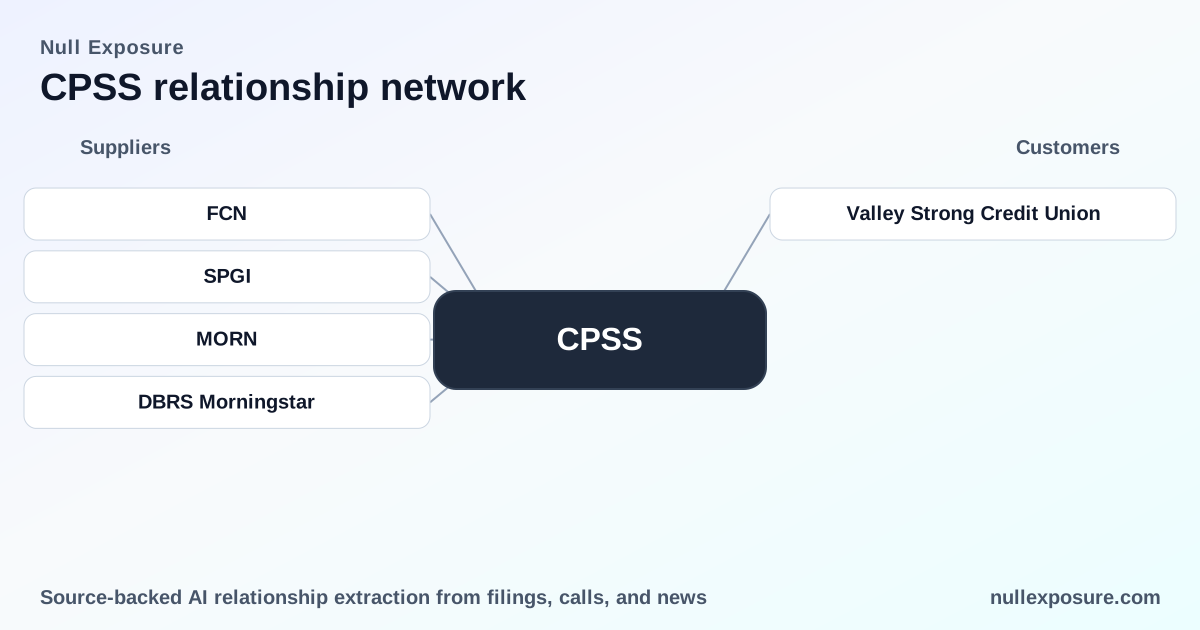
CPSS Supplier Map: Who CPS Pays, Who Prices Its Deals, and What That Means for Investors
Consumer Portfolio Services, Inc. (CPSS) operates as a specialized finance firm that buys and services retail automobile installment contracts originated by U.S. dealers and monetizes through interest margin on those receivables, acquisition and servicing fees, and recurring access to capital markets via asset-backed securitizations. The company funds purchase activity with a combination of credit facilities and periodic securitizations, extracting spread between cost of funds and contract yields while recycling capital by selling rated notes to investors. For investors evaluating counterparty and supplier risk, the key questions are funding posture, third‑party service reliance, and the stability of the securitization ecosystem that underpins CPS’s funding model.
Explore deeper supplier intelligence at https://nullexposure.com/.
How CPS’s operating model shapes supplier relationships
CPS’s business is fundamentally a short-term, high-turnover lending platform that buys contracts in the U.S. and then funds those contracts with revolving credit facilities and periodic securitizations. Several company-level signals define how supplier relationships behave:
- Contracting posture is short-term and transactional. CPS discloses a current short‑term funding capacity of roughly $535 million through two credit facilities, indicating reliance on near-term liquidity structures rather than long dated capital.
- Purchases are effectively spot business. The company purchases automobile contracts from dealers at prices adjusted for acquisition fees and components, consistent with a spot or near‑term procurement model rather than long-term supply contracts.
- Geography is concentrated in North America. CPS’s origination and servicing activity is U.S.-centric, simplifying regulatory scope but increasing sensitivity to U.S. consumer credit cycles.
- Dealer concentration is low but overall spend is high. No single dealer accounted for 2% of purchases in 2024, yet CPS purchased approximately $1.68 billion in contracts in 2024, showing broad-based dealer sourcing but large aggregate exposure.
- Supplier relationships are operationally important but replaceable. Dealers are not contractually obligated to sell to CPS, which limits single-supplier leverage; however, the securitization ratings and servicing experience are critical to market access.
These signals together suggest a company that runs a scalable, transactional purchase program with material funding dependence on short-term credit and rated securitizations, not on exclusive dealer arrangements. If you evaluate CPSS as a counterparty, prioritize liquidity channels and rating-agency relationships in your diligence. For a supplier risk scorecard and more detailed mappings, visit https://nullexposure.com/.
Notable vendor and intermediary mentions in filings and press releases
Below are every relationship mention surfaced in the relevant press releases and filings. Each entry is presented in plain English with the originating source.
-
FTI Consulting, Inc. — FY2026: CPS engaged FTI for consulting services and paid approximately $127,000 in 2024 and $173,000 in 2025 for those services; the note also discloses that an individual (Mr. Carnahan) is a senior advisor to FTI. Source: 8‑K reproduced on StockTitan summarizing the SEC filing (first seen March 2026).
-
Standard & Poor’s — FY2026: S&P provided ratings for notes issued in CPS’s $345.61 million senior‑subordinate asset‑backed securitization, with ratings based on transaction structure, historical performance of similar receivables, and CPS’s servicer experience. Source: GlobeNewswire press release carried by The Manila Times/GlobeNewswire (January 2026).
-
DBRS Morningstar — FY2026: DBRS Morningstar also rated the FY2026 securitization notes, using the same inputs—structure, historical receivable performance, and CPS’s servicing track record. Source: StockTitan news item summarizing the January 2026 press release.
-
Standard & Poor’s — FY2026 (duplicate press distribution): Another media distribution of the same securitization announcement reiterates that S&P was one of the rating providers for the FY2026 transaction. Source: StockTitan news (January 2026).
-
Standard & Poor’s — FY2026 (Globe and Mail distribution): The Globe and Mail pickup of the press release again confirms S&P’s role in rating the FY2026 transaction. Source: Globe and Mail (January 2026).
-
Standard & Poor’s — FY2024: For a prior period, S&P rated notes for CPS’s $416.82 million senior‑subordinate asset‑backed securitization, reflecting a track record of repeated use of third‑party rating agencies to access the capital markets. Source: StockTitan news summarizing the relevant press release (FY2024).
-
DBRS Morningstar — FY2024: DBRS Morningstar also rated CPS’s earlier FY2024 securitization, completing the pair of rating agencies used across multiple CPS transactions. Source: StockTitan news (FY2024).
-
DBRS Morningstar — FY2026 (ManilaTimes distribution): The ManilaTimes distribution of the FY2026 release listed DBRS Morningstar as a rating provider for the $345.61 million issuance, reinforcing the credit‑market counterparties working with CPS. Source: ManilaTimes/GlobeNewswire (January 2026).
-
DBRS Morningstar — FY2026 (Globe and Mail distribution): The Globe and Mail pickup confirms DBRS Morningstar’s role on the FY2026 securitization press distribution. Source: Globe and Mail (January 2026).
-
DBRS Morningstar — FY2026 (StockTitan duplicate): A second StockTitan entry repeats that DBRS Morningstar was a rating provider for the FY2026 notes. Source: StockTitan news (January 2026).
Collectively these items show two consistent patterns: CPS leverages recognized credit rating agencies (S&P and DBRS Morningstar) for multiple securitizations across years, and CPS engages boutique consulting support for corporate matters at modest spend levels (FTI).
What investors should focus on next
- Funding concentration risk: CPS’s recurring reliance on securitizations rated by S&P and DBRS Morningstar and its stated short‑term credit capacity ($535 million across two facilities) make liquidity execution a paramount risk. Market disruption or rating volatility would directly affect CPS’s cost of capital and rollover capacity.
- Operational replaceability vs. market criticality: Dealer sourcing is broadly distributed and therefore operationally low-risk from a single‑counterparty perspective; however, the company’s ability to structure and place rated notes is strategically critical and depends on stable relationships with rating agencies and investors.
- Scale of originations vs. balance-sheet dynamics: CPS purchased $1.68 billion of contracts in 2024, demonstrating large throughput; investors must reconcile high purchase volume with the company’s borrowing and securitization cadence to understand funding sustainability.
For a concise supplier risk brief and ongoing monitoring of CPSS counterparties, see our coverage at https://nullexposure.com/.
Bottom line
CPS runs a transactional, U.S.-focused auto‑finance origination and servicing operation that depends on short‑term funding and repeated access to rated securitizations. The vendor map is simple but meaningful: rating agencies (S&P, DBRS Morningstar) are central market-facing partners, while consulting vendors (FTI) support corporate functions at modest cost. Investors should prioritize the stability of CPS’s funding lines and the ratings market’s appetite for auto receivable deals when assessing CPSS exposure. For tailored supplier intelligence and deeper counterparty analysis, visit https://nullexposure.com/.