Crane Company (CR): Sensor M&A Sharpens a Diversified Industrial Supplier Profile
Crane Company manufactures and sells specialty industrial machinery and engineered products, monetizing through product sales, aftermarket service, and targeted acquisitions that expand addressable markets and add higher-margin instrumentation businesses. Recent deal activity shows management is consolidating sensor and instrumentation capabilities through bolt-on acquisitions, converting cyclical industrial exposure into steadier, higher-value components of revenue and EBITDA.
Explore supplier intelligence at NullExposure
Why the recent transactions matter: strategy, scale, and margin composition
Crane’s strategy is now plainly oriented toward building a resilient engineering platform with specialized sensors and instrumentation as a strategic growth vector. The company’s latest purchases augment its instrumentation portfolio, which supports recurring service revenue and deeper customer integration—important for margin expansion in an otherwise cyclical sector. Given Crane’s market capitalization and operating margins, these acquisitions are material to revenue composition and strategic positioning, not bolt-on curiosities.
Relationship map: who Crane is buying from and why it matters
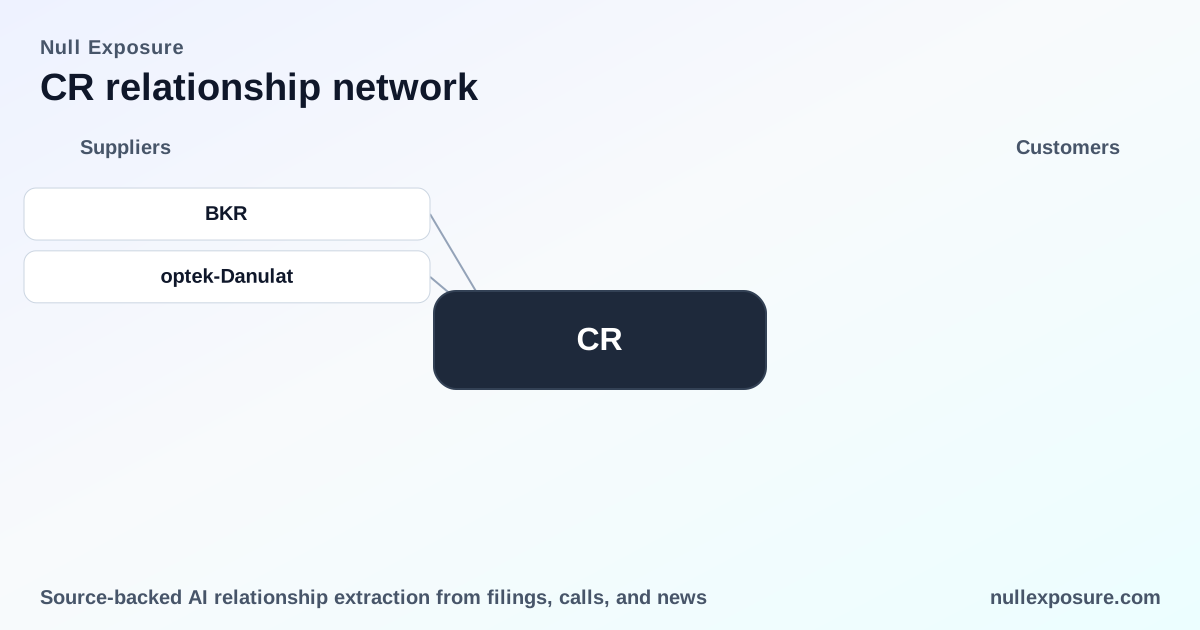
The dataset for CR’s supplier/partner relationships highlights two connected transaction threads: the completed purchase of Baker Hughes’ Precision Sensors & Instrumentation businesses and the announced purchase of German sensor leader optek‑Danulat. Below are plain-English summaries for each relationship pulled from the contemporaneous press coverage.
Baker Hughes — Precision Sensors & Instrumentation (Druck, Panametrics, Reuter‑Stokes)
Crane closed the acquisition of Baker Hughes’ Precision Sensors & Instrumentation (PSI) product line, integrating Druck, Panametrics, and Reuter‑Stokes into its instrumentation footprint; Alphastreet and related press coverage detail the transaction and cite a purchase consideration figure of roughly $1.06 billion. According to a GlobeNewswire release on January 5, 2026, Baker Hughes announced the successful closing of the sale of PSI to Crane, confirming the transfer of those businesses into Crane’s portfolio. (GlobeNewswire, Jan 5, 2026; Alphastreet coverage, Q4 2026 commentary)
Sources: GlobeNewswire press release (Jan 5, 2026); Alphastreet Q4 recap and transaction note; BIC Magazine transaction coverage.
optek‑Danulat — German sensor leader (newly announced purchase)
Crane announced the purchase of optek‑Danulat, a German sensor specialist, to strengthen its European instrumentation capability and product breadth; the acquisition was noted in Crane’s quarter commentary as a strategic add to its sensors business. Alphastreet referenced the newly announced purchase as part of Crane’s 2026 transaction activity that expands its sensing technology capabilities in key industrial end markets.
Source: Alphastreet reporting on Crane’s Q4 results and transaction announcements (FY2026).
How Crane operates as a buyer and what that implies for supply risk
Company disclosures indicate a clear contracting posture: Crane purchases raw materials from a large number of independent sources around the world. That single-line disclosure is a meaningful company-level signal about procurement strategy and supplier concentration.
- Contracting posture: Decentralized buyer — Crane’s procurement language indicates it operates with a broad supplier base rather than relying on single large vendors, which reduces counterparty concentration risk.
- Concentration and criticality: Diversified sourcing implies lower vendor concentration, but raw materials remain operationally critical; disruptions still translate into manufacturing and delivery risk even if no single supplier controls access.
- Maturity and sophistication: An established industrial firm with global sourcing suggests procurement maturity, enabling rapid supplier substitution and volume leverage in negotiations.
These operating model characteristics reduce single‑counterparty supply shocks but keep Crane exposed to commodity cycles and logistics constraints that affect industrial manufacturers broadly. Management’s buy strategy for sensors reduces input exposure by shifting value up the stack—toward more engineered, higher-margin products.
Explore supplier intelligence at NullExposure
Investment implications — what investors and operators should watch
- Strategic upside: The Baker Hughes PSI assets and optek‑Danulat expand Crane’s instrumentation total addressable market and accelerate cross‑sell into installed base and aftermarket service, supporting margin improvement over time.
- Deal finance and valuation: The reported $1.06 billion consideration for the Baker Hughes assets is sizable relative to Crane’s EBITDA; investors should monitor integration synergies, goodwill, and leverage metrics as the company absorbs these businesses. (Alphastreet reporting; corporate press.)
- Operational risk: Even with diversified suppliers, industrial OEMs remain exposed to input cost inflation and supply-chain disruptions; Crane’s acquisitions reduce some commodity sensitivity but do not eliminate operational execution risk.
- Execution checklist for operators: integration of engineering teams, cross-border service networks, and product roadmaps will determine how quickly acquired instruments convert into recurring revenue and margin expansion.
Practical risk checklist for supplier relationships
- Integration readiness: Are sales/service teams and aftermarket operations harmonized to capture cross-sell?
- Supply redundancy: Does the newly acquired instrumentation business retain diversified sources consistent with Crane’s procurement posture?
- Financial discipline: Will the deals be accretive on a cash‑EPS or free‑cash‑flow basis after integration costs?
Final read: acquisition-driven evolution, not a pivot
Crane’s recent transactions are deliberate portfolio construction rather than a wholesale strategic pivot. The company is converting exposure from lower‑margin, cyclical industrial hardware to higher‑value instrumentation and services, which supports revenue quality and long-term return on capital. Investors should evaluate integration execution, deal financing, and the pace at which new instrumentation revenue migrates to recurring service streams.
Before you model the next quarter, use a focused supplier intelligence view to validate counterparties, counterparty concentration, and integration timelines — start with a supplier-first lens.