CRAQ supplier relationships: what the underwriter lineup signals for investors
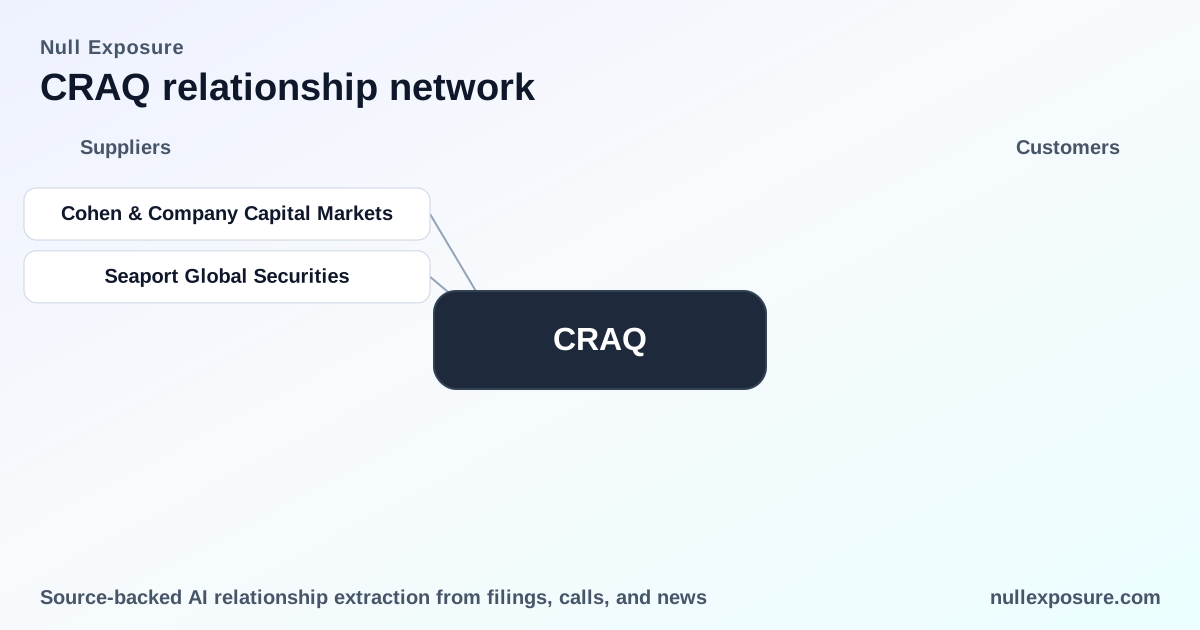
Cal Redwood Acquisition Corp (CRAQ) operates as a capital-raising vehicle that monetizes through public equity offerings and execution of de-SPAC transactions, collecting sponsor economics and underwriting fees tied to deal flow and liquidity events. The March 2026 $200 million priced offering — led by Cohen & Company Capital Markets with Seaport Global Securities as joint book-runner — is a clear example of CRAQ using established retail and institutional distribution partners to access primary capital markets. Investors should treat these underwriter relationships as core execution channels that determine the company’s access to capital, timing of transactions, and cost of capital. For more context on counterparty relationships and supplier risk, visit https://nullexposure.com/.
Why the March 2026 underwriting lineup matters to holders
Underwriters do more than distribute shares; they shape timing, pricing, and investor mix. A book-running manager with a capable syndicate reduces placement risk and compresses execution timelines — critical attributes for a sponsor-centric vehicle that relies on clean capital raises to preserve sponsor optionality and runway. The two named firms in the March 2026 press release point to a compact but defensible underwriting syndicate: one lead and one joint book-runner, suggesting an emphasis on streamlined distribution rather than a wide, multi-bank syndicate.
- Concentration: A two-firm syndicate concentrates distribution and negotiation power, which can speed decisions but increases dependency on those counterparties for future raises.
- Criticality: Underwriter selection is a high-impact choice — execution failures or reputational issues at either firm would directly constrain CRAQ’s ability to raise primary capital.
- Contracting posture and maturity: The structure described is consistent with standard underwritten offerings where firms lead and co-lead; this indicates mature capital markets behavior rather than bespoke or non-traditional financing.
If you want a broader view of CRAQ’s counterparty exposures and third-party risk profiles, start here: https://nullexposure.com/.
Relationship lineup — concise roll call (every relationship captured)
Cohen & Company Capital Markets — Listed as the book‑running manager on the priced $200 million offering, Cohen & Company leads the placement and bears primary distribution responsibility for the deal. According to the StockTitan press release covering the pricing (March 9, 2026), Cohen & Company is the lead book-runner for the transaction (https://www.stocktitan.net/news/CRA/cal-redwood-acquisition-corp-announces-pricing-of-200-million-ecs10czqzsbf.html).
Seaport Global Securities — Identified as joint book-runner alongside Cohen & Company, Seaport Global provides complementary distribution capacity and joint execution support for the $200 million offering. The same StockTitan item from March 9, 2026 cites Seaport Global Securities as the joint book-runner for the offering (https://www.stocktitan.net/news/CRA/cal-redwood-acquisition-corp-announces-pricing-of-200-million-ecs10czqzsbf.html).
Operational constraints and company-level signals
There are no explicit supplier-level contractual constraints captured in the available relationship data for CRAQ. That absence of recorded constraints is itself a signal: public disclosures on supplier-side contractual limitations are limited, so investors must infer counterparty risk from observable deal activity rather than contract excerpts.
From a business-model perspective this implies:
- Transaction-focused supplier posture: CRAQ engages underwriters on a deal-by-deal basis rather than through long-term exclusive procurement contracts. That reduces fixed supplier costs but raises variability in execution quality.
- Concentration risk: With a compact underwriting pair, CRAQ’s short-term access to primary capital is concentrated in a small set of firms; future fundraising will depend on these or similar partners accepting new mandates.
- Maturity and market norms: The underwriting structure mirrors established capital markets practices for sponsored offerings, indicating predictable contract terms and fee structures consistent with market standards.
What investors should watch next
- Underwriter relationships are leading indicators of a sponsor’s ability to execute future raises. Watch for repeat engagements with the same firms or expansion to a broader syndicate as signs of improving market confidence.
- Distribution mix and price performance post-offering will reveal whether the syndicate secured a balanced investor base or concentrated risk into narrow channels.
- Any emergence of public constraints or amendments — particularly fee arrangements, lockups, or mandated escrow conditions — will materially affect CRAQ’s cost of capital and timing for merger activity.
Risk vs. optionality — a brief verdict
Risk: dependency on a compact syndicate and limited public disclosure of supplier contracts increases execution risk. If either underwriting partner faces reputational or capacity issues, CRAQ’s next capital raise could be delayed or priced less favorably.
Optionality: streamlined syndicates can accelerate execution and reduce underwriting friction when the partners perform well. For a transaction-focused issuer, that tradeoff is central to strategy: faster execution at the cost of concentrated counterparty exposure.
If you track sponsor and underwriter pairings across multiple issuers to assess systemic risk, explore more detailed third-party relationship analytics at https://nullexposure.com/.
Final takeaways for analysts and operators
- Underwriting relationships drive execution for CRAQ — the Cohen & Company / Seaport Global pairing is the primary supplier story in the available records for the March 2026 offering.
- Concentration and transactional contracting are the dominant operational characteristics; absence of captured constraints increases the importance of monitoring public deal announcements and underwriter behavior.
- Active surveillance of subsequent financings and any disclosed contractual terms will be critical to assessing forward funding risk and the cost of capital for CRAQ.
For ongoing monitoring of CRAQ’s counterparty landscape and supplier risk signals, start at https://nullexposure.com/.