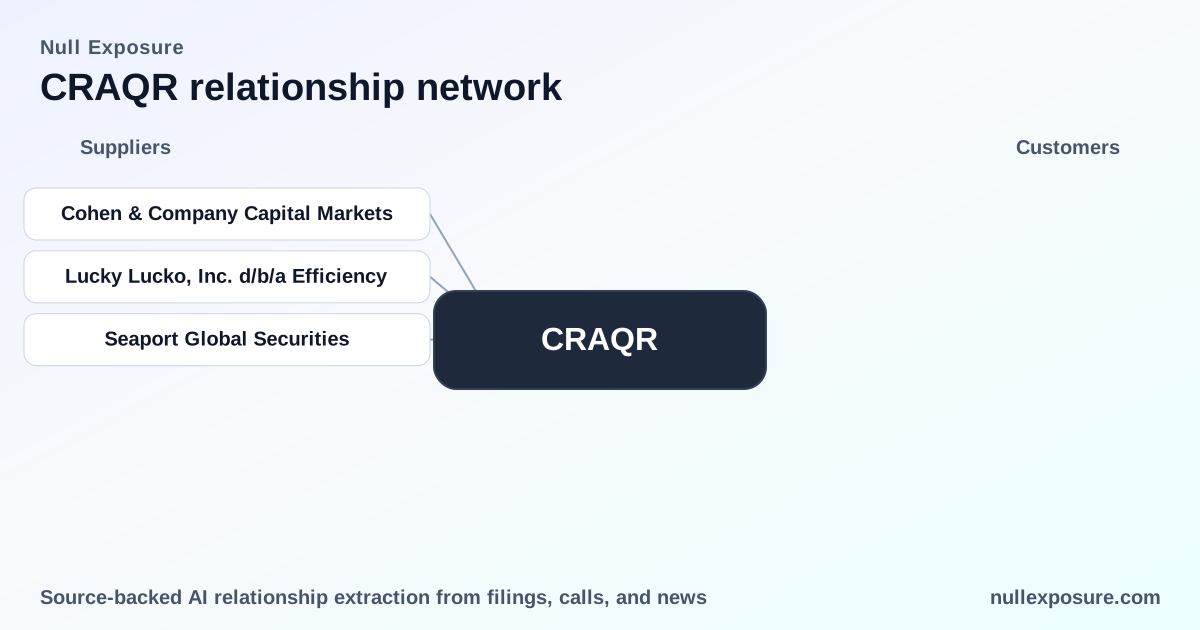
CRAQR supplier map: what the recent unit-separation filing reveals about capital-market partners
CR AQR (CRAQR) operates as a capital-markets vehicle that issues units and ordinary shares and relies on outside brokers and a transfer agent to deliver equity mechanics to investors; it monetizes principally through SPAC-like transaction economics—broker underwriting fees, sponsor promote structures and the operational execution of unit separations that enable tradability and liquidity. The March 2026 filing that announced the separate trading of units exposes a compact, high‑criticality supplier set that underpins CRAQR’s public-equity functioning and execution timetable. For deal teams and investors evaluating supplier counterparty risk, this is a concentrated, execution‑focused model worth tracking. Visit the Null Exposure homepage for supplier due-diligence tools and profiles: https://nullexposure.com/.
What the recent filing changes about how CRAQR operates
The company’s announcement that holders will separate Units into Ordinary Shares and Rights is a classic capital‑markets operational step that transfers administrative burden to third‑party providers. Execution of that step is not optional—transfer agents and underwriters are mission‑critical suppliers whose timing and accuracy determine when investors can trade or exercise rights. The March 9, 2026 notice frames CRAQR as an issuer that outsources core market plumbing rather than internalizing it, which reduces fixed costs but creates single‑point dependencies on service partners.
A technical note embedded in the public feed signals a separate company-level constraint: an external data provider flagged a rate‑limit ("Burst pattern detected") while returning CRAQR-related data, indicating limited or rate‑constrained visibility into CRAQR’s public disclosures via that channel; investors should supplement with primary SEC filings and issuer notices when possible (company data feed notice, March 2026).
Explore supplier relationships and supplier-risk scoring on the Null Exposure homepage: https://nullexposure.com/.
Contracting posture, concentration and maturity — what to assume about CRAQR’s supplier model
- Contracting posture: CRAQR demonstrates an outsourced, market-partner posture — it engages book‑runners and a transfer agent to carry out discrete capital‑markets actions rather than operating those functions in‑house. That posture accelerates go‑to‑market speed but places contractual reliance on external counterparties for regulatory and operational compliance.
- Concentration: The public filing lists a small number of named providers, indicating high supplier concentration for capital‑markets execution. Concentration raises operational risk if any single provider experiences capacity or reputational stress during a time‑sensitive corporate action.
- Criticality: These suppliers are operationally critical; failure to separate units correctly or to support trading-ready securities would directly impair liquidity for holders and could trigger governance or regulatory follow‑ups.
- Maturity: The use of established capital markets firms suggests mature, market‑standard relationships rather than ad hoc vendors, reducing execution risk but not eliminating it.
Visit Null Exposure for deeper supplier risk profiles and contract posture insights: https://nullexposure.com/.
The supplier roster documented in public reporting
The following section covers every supplier relationship cited in the March 9, 2026 announcement. Each entry is a concise plain‑English summary with source context.
Cohen & Company Capital Markets
Cohen & Company Capital Markets acted as the lead book‑running manager on CRAQR’s equity separation notice, positioning it as the primary underwriter responsible for coordinating the market execution of the unit split and related investor communications. (StockTitan news post, March 9, 2026: https://www.stocktitan.net/news/CRA/cal-redwood-acquisition-corp-announces-the-separate-trading-of-its-rili1bmy3dp1.html)
Seaport Global Securities
Seaport Global Securities served as a joint book runner alongside Cohen & Company, providing secondary underwriting capacity and distribution support for the transaction mechanics that enable unit separation and trading. (StockTitan news post, March 9, 2026: https://www.stocktitan.net/news/CRA/cal-redwood-acquisition-corp-announces-the-separate-trading-of-its-rili1bmy3dp1.html)
Lucky Lucko, Inc. d/b/a Efficiency (transfer agent)
Lucky Lucko, Inc., doing business as Efficiency, is listed as the company’s transfer agent and is the operational counterparty brokers must contact to separate Units into Ordinary Shares and Rights—making it the administrative hub for investor recordkeeping related to the corporate action. (StockTitan news post, March 9, 2026: https://www.stocktitan.net/news/CRA/cal-redwood-acquisition-corp-announces-the-separate-trading-of-its-rili1bmy3dp1.html)
What these relationships mean for investor due diligence
The supplier mix is small and concentrated around three proven capital‑markets roles: lead underwriter, joint underwriter, and transfer agent. That configuration is common for SPACs and issuance vehicles, and it delivers clear operational benefits: market access, distribution capability and a regulated transfer mechanism. The downside is single‑event exposure—a failure or delay at any one supplier during a unit separation or listing transition would directly affect liquidity and the timing of investor rights.
Key investment considerations:
- Operational dependency: Underwriters and the transfer agent are core to the issuer’s public trading mechanics; contract performance and reputational standing of these firms matter as immediately tradable outcomes for holders.
- Concentration risk: A compact supplier list increases counterparty risk; verify fallback procedures and escalation pathways in transaction documentation where possible.
- Disclosure completeness: The external data feed that flagged a rate‑limit suggests limited visibility through that channel; cross‑check issuer notices and SEC filings to confirm supplier roles and timelines.
Risk factors that should be monitored closely
- Timing risk from underwriter or transfer‑agent processing delays that could compress trading windows or delay listing changes.
- Documentation gaps: confirm that service agreements contain SLA/penalty language for missed deadlines, especially around transfer‑agent processing of unit splits.
- Single‑source dependency on named partners without publicized alternatives increases operational leverage for those suppliers.
Final takeaways and action steps
- CRAQR relies on a small, mission‑critical supplier set to deliver unit separation and tradability, elevating supplier counterparty risk relative to issuers that internalize more market plumbing.
- Underwriters (Cohen & Company, Seaport Global) and the transfer agent (Lucky Lucko/ Efficiency) are the immediate operational vectors for any investor liquidity impact arising from the announced unit separation (StockTitan, March 9, 2026).
- Verify timelines and fallback procedures in primary issuer filings and contractual materials; supplement third‑party feeds with direct issuer communications to avoid the visibility gaps signaled by external rate‑limit notices.
For a structured supplier-risk scorecard and deeper counterparty intelligence on CRAQR’s partners, go to https://nullexposure.com/. If you are evaluating operational counterparties for a capital‑markets engagement, begin with the supplier‑screening tools at https://nullexposure.com/ to convert public notices into actionable diligence.