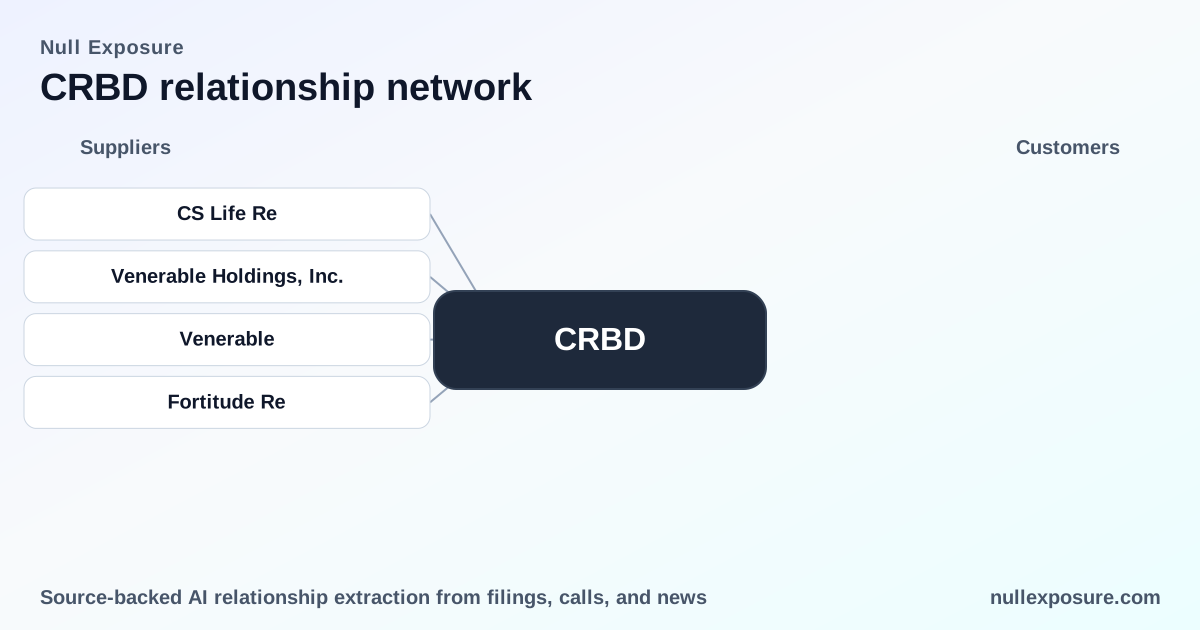
Corebridge Financial (CRBD): supplier and reinsurance relationships that shape risk and distribution
Corebridge Financial monetizes its insurance and retirement franchise by originating life and annuity products and then managing the economic and capital profile of those liabilities through a mix of reinsurance, asset management partnerships, and capital markets financing. Revenue flows come from underwriting margins and investment income, while risk is actively transferred or hedged through reinsurers and third‑party managers. For investors and vendor managers evaluating supplier exposure, Corebridge’s playbook is distribution-driven origination combined with deliberate counterparty outsourcing to control capital and operational leverage.
Explore more supplier intelligence at https://nullexposure.com/.
How Corebridge actually runs the business — a practical investor view
Corebridge sells individual retirement and life products and then uses reinsurance and outsourced asset management to scale without bearing all of the capital or operational burden in-house. The company routinely cedes blocks of liabilities to reinsurance partners and contracts large asset managers to run material portions of its investment book, creating supplier dependencies that are both strategic and capital‑sensitive.
Key operating features you should include in any relationship review:
- Capital and liquidity arrangements are multi‑tenor. Corebridge has a five‑year, $3.0 billion revolving credit agreement maturing in 2030 alongside shorter credit facilities tied to real‑estate investments with maturities under roughly 18 months. These funding structures influence how the company allocates counterparty exposure and timing of liability transfers.
- Material outsourced asset management. Since April 2022, BlackRock and affiliates have managed roughly $91.9 billion of Corebridge’s investment portfolio (liquid fixed income and certain private placements), establishing a large single‑partner operational footprint.
- Large medium‑to‑long term contractual commitments. Lease liabilities and right‑of‑use assets sit meaningfully on the balance sheet (about $80 million of lease liabilities with $16 million cash lease payments in 2025), while private investment commitments totaled roughly $4.8 billion at year‑end 2025 — underlining sizable future cash and counterparty exposure.
Constraints that frame supplier risk
Corebridge’s documented operating constraints translate directly into how you should structure supplier relationships and diligence.
- Contract maturities are mixed: Corebridge uses long‑term instruments (the five‑year 2025 credit facility) for corporate liquidity while also relying on short‑dated credit lines for consolidated real‑estate entities. This implies suppliers will face both stable, long‑running contracts and pockets of near‑term refinancing or roll risk.
- Supplier role is operational and strategic. Corebridge engages third parties for program operations, cyber risk evaluation, and asset management — a posture that elevates the criticality of vendor governance and operational resilience.
- Spend scale is material. Company‑level commitments — letters of credit totaling $276 million, drawn real estate facilities of $173 million within $319 million limits, and the $4.8 billion of private commitments — indicate supplier spend and counterparty concentration in the $100m+ band.
- Active reinsurance flows to Fortitude Re. Company filings state that as of December 31, 2025, approximately $24.1 billion of liabilities had been ceded to Fortitude Re, signaling an active, large‑scale reinsurance relationship that is operationally core to Corebridge’s balance‑sheet strategy.
If you want structured supplier risk scoring and counterparties mapped against these constraints, visit https://nullexposure.com/ for tailored intelligence.
Supplier and reinsurance relationships to know now
CS Life Re
Corebridge entered into an agreement with CS Life Re (a Venerable subsidiary) to reinsure all variable annuities of its Individual Retirement business — account value totaled $51 billion as of March 31, 2025 — moving significant in‑force exposure off Corebridge’s statutory balance sheet. Source: 401kSpecialistMag report on the transaction (March 9, 2026).
Venerable Holdings, Inc.
Corebridge described the Venerable partnership as a deliberate selection for reinsurance expertise, highlighting Venerable’s leadership in variable annuity reinsurance as a driver of the transaction. This characterizes Venerable as a strategic reinsurer for Corebridge’s product flow. Source: 401kSpecialistMag coverage of the partnership (March 9, 2026).
Venerable (flow reinsurance arrangement)
New variable annuity contracts written through Corebridge’s individual retirement business are being reinsured to Venerable under a flow structure, which makes Venerable central to both new production and the in‑force block — a structural shift in distribution economics and counterparty reliance. Source: Insurance Business Magazine report on the flow reinsurance (March 9, 2026).
Fortitude Re
Corebridge attributed part of a recent net‑loss movement to realized losses tied to the Fortitude Re funds‑withheld embedded derivative, and filings show roughly $24.1 billion of liabilities ceded to Fortitude Re as of year‑end 2025, underscoring a large, active reinsurance and derivative linkage. Source: Insurance Business and Corebridge reporting on financial results and reinsurance ceded (March 2026).
What this means for investors and procurement leaders
- Counterparty concentration is real and measurable. Large ceded blocks and outsized asset management relationships create single‑point dependencies that translate to liquidity and service risk if a supplier’s capital position or operational model changes.
- Contract mix creates timing risk. Long‑dated financing (the five‑year credit facility) coexists with short‑term draw facilities for real‑estate subsidiaries, generating windows where refinancing or market stress could force rapid adjustments to supplier terms.
- Derivative and funds‑withheld structures can transmit volatility. The Fortitude Re linkage is not a peripheral contract — it’s a source of realized loss exposure and therefore a prime focus for counterparty credit review and scenario analysis.
Key takeaway: vendor diligence must be both capital‑sensitive and operationally granular. Your vendor playbook should include covenant monitoring, stress testing of reinsurance effectiveness, and operational audits for large outsourced managers.
If you want a deeper read on how supplier exposures translate to credit and operational risk at Corebridge, find more vendor analysis at https://nullexposure.com/.
Actionable next steps for deal teams and investors
- Validate reinsurance credit and structural mechanics for each ceded block, focusing first on Fortitude Re and the Venerable flow arrangement.
- Stress asset management outsourcing to BlackRock under downside market scenarios to understand operational concentration and liquidity implications.
- Tie contract maturity calendars (credit facilities, lease obligations, private investment commitments) into a supplier continuity and contingency plan.
For procurement teams building negotiated terms and investors setting monitoring triggers, Corebridge’s model is a template of high‑value originations combined with large externalized counterparty exposure — manage both the capital and the service side of each relationship. Learn more about supplier risk mapping and monitoring at https://nullexposure.com/.