Corebridge Financial (CRBG): Supplier relationships that move capital and risk
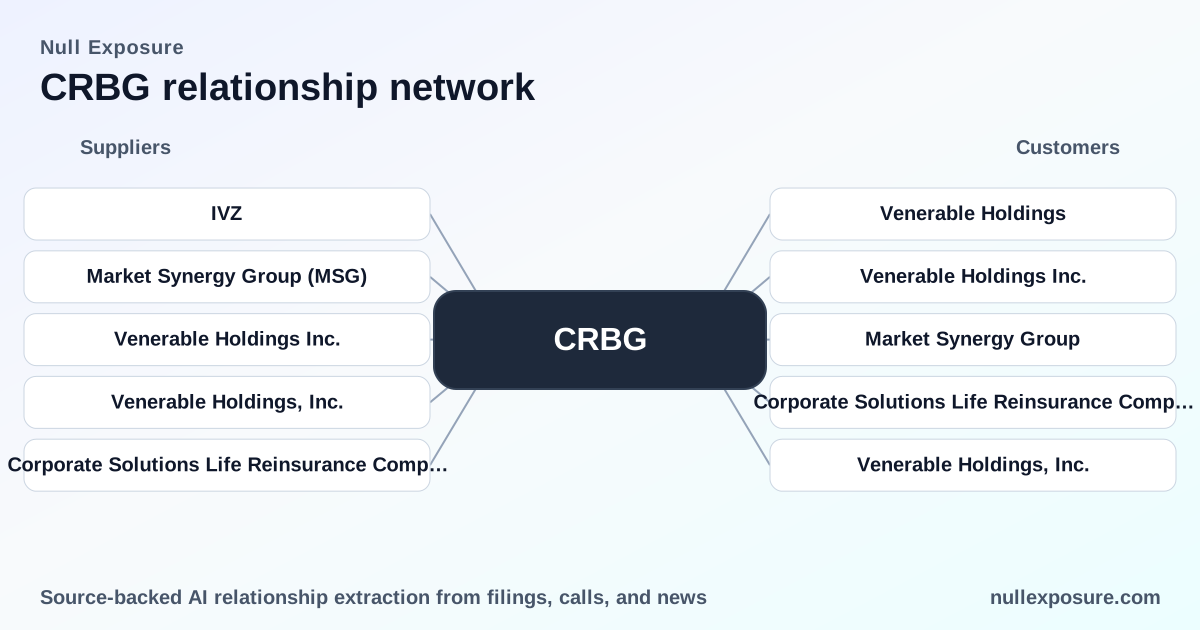
Corebridge Financial operates as a retirement and insurance franchise that monetizes through insurance underwriting margins, fee-based asset management and product distribution—particularly indexed and variable annuities—and by actively reshaping balance-sheet risk through reinsurance and asset-management partnerships. For investors and operators, the supplier map is business-critical: asset managers supply investible exposures for annuity guarantees, reinsurers transfer capital and volatility, and distribution/index partners drive product innovation and growth. Learn more or benchmark these relationship signals at https://nullexposure.com/.
What the headline relationships look like in plain English
Invesco — index provider for crypto-enabled annuities
Corebridge is using the Invesco New Economy Index as the underlying reference for a new annuity wrapper that allocates dynamically to Invesco QQQ and the Invesco Galaxy Bitcoin ETF (BTCO), effectively bringing a bitcoin exposure into indexed annuities sold by Corebridge. According to 401kSpecialist (March 9, 2026) and coverage in LifeHealth (March 2026), Invesco framed this as a tailored solution for Corebridge’s product line.
Market Synergy Group (MSG) — distribution channel for Power Select Index Annuities
The new Invesco-backed index is being offered exclusively in Power Select Index Annuities, which are part of Corebridge’s indexed annuity suite and distributed by Market Synergy Group (MSG). A March 2026 article in 401kSpecialist identifies MSG as the distribution partner for that product launch.
Venerable Holdings, Inc. — reinsurance and portfolio carve-outs
Venerable has completed multiple elements of a multi-part agreement with Corebridge, including acquisition activity (SunAmerica Asset Management LLC) and flow reinsurance of variable annuities written by Corebridge’s subsidiary American General Life Insurance Company. InsuranceBusinessMag and Reinsurance News reported in March 2026 that Venerable both closed the acquisition pieces and has begun flow reinsurance with Corebridge units.
Corporate Solutions Life Reinsurance Company — large reinsurance counterparty
Corebridge announced the closure of the largest portion of a previously disclosed variable annuity reinsurance arrangement with Corporate Solutions Life Reinsurance Company, an insurance subsidiary of Venerable Holdings. Reinsurance News (March 2026) documented the transaction closure and its significance for variable annuity risk transfer.
Constraints and operating-model signals investors should read as strategic choices
Corebridge’s supplier posture is intentional and capital-focused rather than transactional. From public filings and transaction disclosures, several clear operating characteristics emerge:
-
Contracting posture — active use of reinsurance and funds-withheld modco structures. Corebridge uses coinsurance and modco reinsurance (for example, arrangements described with Corporate Solutions Life Reinsurance Company and Fortitude Re) that transfer liabilities while often keeping investments “funds withheld” on the ceding balance sheet; Corebridge’s filings document the mechanics of these arrangements as of December 31, 2025. This structure is a deliberate capital-management tool that shifts economic risk without an immediate asset sale.
-
Concentration in outsourced asset management. According to the company’s disclosures, BlackRock and its affiliates managed approximately $91.9 billion in book value of Corebridge assets as of December 31, 2025, indicating material operational dependence on a single asset manager for large portions of liquid fixed income and some private placements.
-
Criticality and size of ceded liabilities. Corebridge reported roughly $24.1 billion (2025) and $24.9 billion (2024) of liabilities ceded under reinsurance transactions as of year-end, a scale that makes reinsurance counterparties and contract terms critical to solvency and earnings volatility.
-
Maturity and consolidation of services. The company has internalized certain capital markets services previously bought from AIG Markets, Inc.; those services are now provided through Corebridge Markets, LLC, indicating a move from third-party buy to in-house provision and a reduction in external vendor operational exposure.
-
Spend profile is lumpy. Public expense disclosures show service expenses tied to these agreements at $7 million (2025), $43 million (2024) and $161 million (2023), reflecting variability tied to transaction timing and the episodic nature of reinsurance and transformation costs. At the same time, the magnitude of ceded liabilities supports a 100m+ counterparty spend-band signal at the company level.
Taken together, these constraints reveal a firm that uses suppliers to sculpt capital and product economics: reinsurers to offload tail and capital risk, large asset managers for scale and execution, and distribution/index partners to expand addressable markets.
How these relationships translate into investment and operational risks
-
Counterparty and capital-transfer risk are front and center. Large ceded balances to reinsurers such as Venerable and Corporate Solutions directly affect Corebridge’s capital and earnings profile. Investors should watch credit quality, collateral structures (funds withheld), and reinsurance counterparty ratings.
-
Concentration risk in asset management could compress execution flexibility. BlackRock’s management of nearly $92 billion is an operational dependency that influences liquidity, hedging, and cost of running annuity hedges; that concentration magnifies vendor negotiation leverage and transition risk.
-
Product innovation introduces distribution and regulatory risk. The Invesco New Economy Index that allocates to QQQ and BTCO introduces crypto exposure into annuities, expanding addressable demand but also raising suitability, regulatory and hedging complexity for Corebridge and its distributors; coverage in LifeHealth and 401kSpecialist in March 2026 highlights this strategic product pivot.
-
Operational transition risk from internalization. Moving services from AIG Markets to Corebridge Markets shifts control to the parent but places the burden of execution, compliance and liquidity management squarely on Corebridge.
If you need a structured supplier-risk dashboard for CRBG or comparable issuers, review our tools at https://nullexposure.com/.
Practical next steps for investors and operators
- Monitor reinsurer counterparty strength and the terms of funds-withheld/modco arrangements, focusing on collateral triggers and ultimate loss-sharing.
- Track asset management concentration metrics and ask management about contingency plans to replace or diversify large mandates with BlackRock.
- Evaluate product-level hedging effectiveness and regulatory disclosures for the new Invesco-backed crypto exposures; request stress-test outputs where available.
- Review distribution contracts with MSG and similar partners to understand exclusivity, pricing, and termination terms.
Explore research and relationship analytics for CRBG and peer comparisons at https://nullexposure.com/.
Conclusion: Corebridge’s supplier portfolio is a deliberate toolkit used to reshape balance-sheet risk, accelerate product innovation, and scale distribution. Investors should treat these supplier links—particularly reinsurers and large asset managers—as strategic levers that materially affect capital, earnings volatility and product risk profiles.