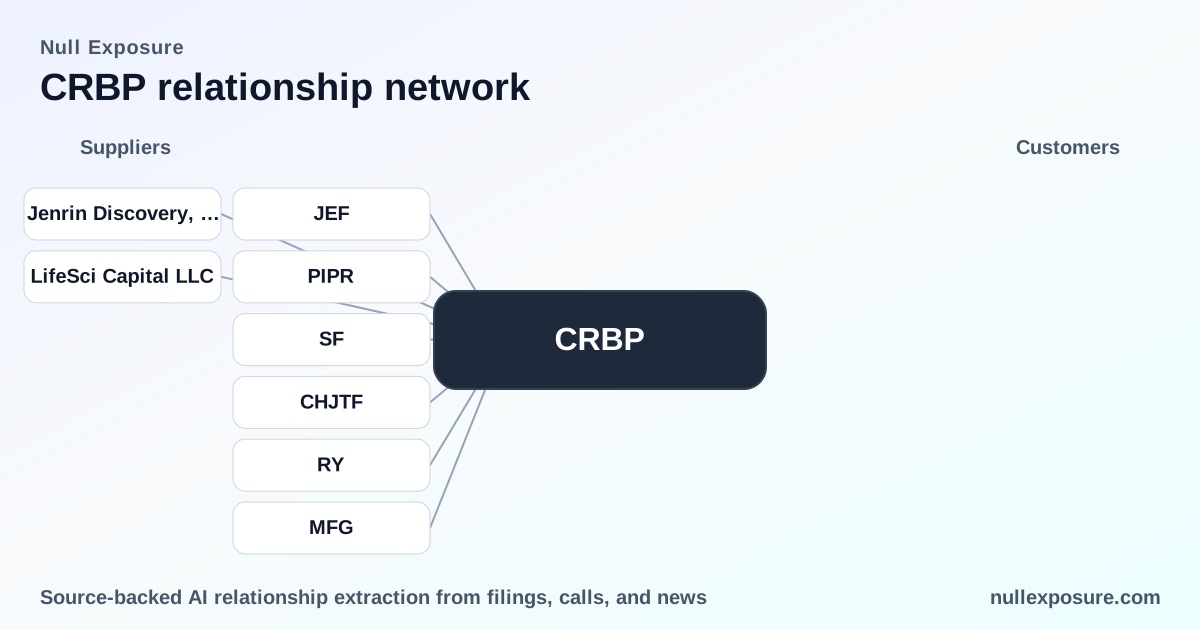
Corbus Pharmaceuticals (CRBP): Supplier map and what the capital markets relationships reveal
Corbus Pharmaceuticals is a clinical-stage biotech that monetizes through licensing, development-stage assets and capital markets activity rather than product sales—holding exclusive licenses to cannabinoid and ADC programs, outsourcing manufacturing and trial execution, and funding operations through equity offerings and placements. For investors evaluating supplier exposure, the company’s model is license-heavy, outsourcing-dependent and capital markets-driven, with third parties providing critical IP, clinical supplies and underwriting for financing. Learn more about supplier risk and relationship signals at https://nullexposure.com/.
How Corbus operates in plain investor language
Corbus does not sell marketed drugs; its value derives from licensed intellectual property (Jenrin, UCSF, CSPC) and advancing clinical candidates (for example CRB-701 and CRB-601) toward regulatory value inflection points. The company outsources manufacturing, CRO services and IT to third parties, and uses equity markets to fund R&D. Corbus’s balance sheet and runway therefore depend on continued access to capital and reliable supplier execution rather than on recurring revenue.
Key operating attributes: high supplier criticality (third-party manufacturers and CROs supply drug substance and run trials), licensing concentration (several exclusive licenses underpin the pipeline), and financing dependence (multiple underwriters and book-runners in recent offerings).
Capital markets partners and underwriting — the financing ecosystem
- Jefferies LLC — Jefferies acted as a joint book-running manager in Corbus’s proposed public offering announced Oct. 30, 2025, and as book-running manager in the subsequent pricing announcement Oct. 31, 2025; these filings show Jefferies as a primary execution partner for equity raises (GlobeNewswire Oct. 30–31, 2025: https://www.globenewswire.com/news-release/2025/10/30/3177983/0/en/Corbus-Pharmaceuticals-Announces-Proposed-Public-Offering.html and https://www.globenewswire.com/news-release/2025/10/31/3178107/0/en/Corbus-Pharmaceuticals-Announces-Pricing-of-Public-Offering.html).
- Piper Sandler & Co. — Named alongside Jefferies as a joint book-running manager for the Oct. 30, 2025 offering, indicating a role in syndicate execution for Corbus capital raises (GlobeNewswire Oct. 30, 2025: https://www.globenewswire.com/news-release/2025/10/30/3177983/0/en/Corbus-Pharmaceuticals-Announces-Proposed-Public-Offering.html).
- RBC Capital Markets — Listed as a lead manager on the Oct. 31, 2025 pricing release, signaling participation in the distribution and institutional placement effort for the offering (GlobeNewswire Oct. 31, 2025: https://www.globenewswire.com/news-release/2025/10/31/3178107/0/en/Corbus-Pharmaceuticals-Announces-Pricing-of-Public-Offering.html).
- Mizuho Securities USA LLC — Identified as a lead manager on the Oct. 31, 2025 pricing release, contributing to syndicate depth for equity execution (GlobeNewswire Oct. 31, 2025: https://www.globenewswire.com/news-release/2025/10/31/3178107/0/en/Corbus-Pharmaceuticals-Announces-Pricing-of-Public-Offering.html).
- LifeSci Capital LLC — Named as a lead manager for the offering on Oct. 31, 2025; its involvement suggests targeted investor outreach to life sciences specialists (GlobeNewswire Oct. 31, 2025: https://www.globenewswire.com/news-release/2025/10/31/3178107/0/en/Corbus-Pharmaceuticals-Announces-Pricing-of-Public-Offering.html).
- Stifel Nicolaus & Company Inc. — Named as the broker in a Form 144 filing observed in 2026, indicating Stifel’s role in handling insider or secondary sales activity tied to Corbus securities (StockTitan SEC filing summary, 2026: https://www.stocktitan.net/sec-filings/CRBP/144-corbus-pharmaceuticals-holdings-inc-sec-filing-21a38d986242.html).
Strategic supply and IP partners — where the science comes from
- CSPC Pharmaceutical Group — Corbus obtained an exclusive license from CSPC Megalith (a CSPC subsidiary) for CRB-701, covering the U.S., Canada, EU (including EFTA), the U.K. and Australia, and CSPC supplies clinical drug substance/product under a clinical supply agreement (PR Newswire/press release via Corbus FY2023 corporate update and license disclosures: https://www.prnewswire.com/news-releases/corbus-pharmaceuticals-reports-fourth-quarter-2022-and-year-end-financial-results-and-provides-corporate-update-301763955.html).
- This relationship supplies both IP/rights and clinical material under contract and extends Corbus’s geographic commercialization footprint to NA, EMEA and APAC as specified in the license.
- Jenrin Discovery, LLC — Corbus holds an exclusive worldwide license to the Jenrin library (approximately 600 compounds) and related patents, making Jenrin a core IP licensor that underpins cannabinoid-focused assets (company licensing disclosures summarized on investor pages and third-party coverage, FY2025: https://simplywall.st/stocks/us/pharmaceuticals-biotech/nasdaq-crbp/corbus-pharmaceuticals-holdings).
- Jenrin’s license is a foundational intellectual property source for Corbus’s cannabinoid pipeline.
(If you’re mapping counterparty concentration or contract terms across portfolios, see our supplier risk toolkit at https://nullexposure.com/.)
What the constraints tell an investor about operational posture
- Contracting posture: licensing-led and outsourced. Corbus shows a licensing-first model: it acquires exclusive rights (Jenrin, CSPC, UCSF) and relies on third parties for manufacturing and clinical operations rather than internalizing those functions. The licensing constraint is explicit in company disclosures describing the CSPC and Jenrin agreements.
- Supplier criticality and role mix. The company depends on service providers (CROs, consultants, vendors) for trial execution and on contract manufacturers for drug substance and product—Corbus does not operate its own manufacturing footprint, which increases criticality of supplier continuity and quality control.
- Geographic commercialization scope. License language assigns regional and global rights: specific licenses cover NA (U.S., Canada), EMEA (EU, U.K.), APAC (Australia), and other agreements convey worldwide rights for certain assets, signaling a strategy to prioritize global development and multi-jurisdictional commercialization.
- Contract maturity and stage. Several relationships are active with ongoing clinical supply agreements and underwriting mandates in FY2025–FY2026, showing both near-term execution (clinical and financing) and multi-year IP arrangements.
- Operational trade-offs. Outsourcing IT and HR functions to subscription services reduces in-house cyber exposure but increases dependency on third-party platforms; company disclosures describe a strategic move to limit sensitive data in its enterprise by using third-party SaaS.
Risk implications for investors
- Execution and supply risk are high because Corbus’s R&D progress and regulatory milestones depend on external manufacturers and CROs; any supplier failure directly delays value creation.
- Financing risk is persistent. Recent syndicated offerings and the active role of multiple underwriters demonstrate ongoing reliance on capital markets to fund development.
- Concentration in licensed IP creates binary outcomes. Major value rests on a handful of licensed programs; successful transfer to commercialization contracts and robust manufacturing agreements are decisive.
Final read: portfolio considerations and next steps
Corbus is a classic clinical-stage, license-driven biopharma: its upside is tied to catalyst delivery on a small set of licensed programs, while downside is driven by supplier execution and capital access. For investors and operators assessing counterparty exposure, prioritize diligence on contract terms with CSPC and contract manufacturers, underwriting execution history with the listed banks, and the enforceability/territorial scope of the Jenrin license.
Explore deeper supplier scoring and counterparty concentration analysis at https://nullexposure.com/ to convert relationship signals into actionable portfolio decisions.
If you want a custom supplier risk brief for Corbus (CRBP) — highlighting contract durations, manufacturing redundancy and underwriter track records — request a tailored report at https://nullexposure.com/ and we will map the exposure against your investment criteria.