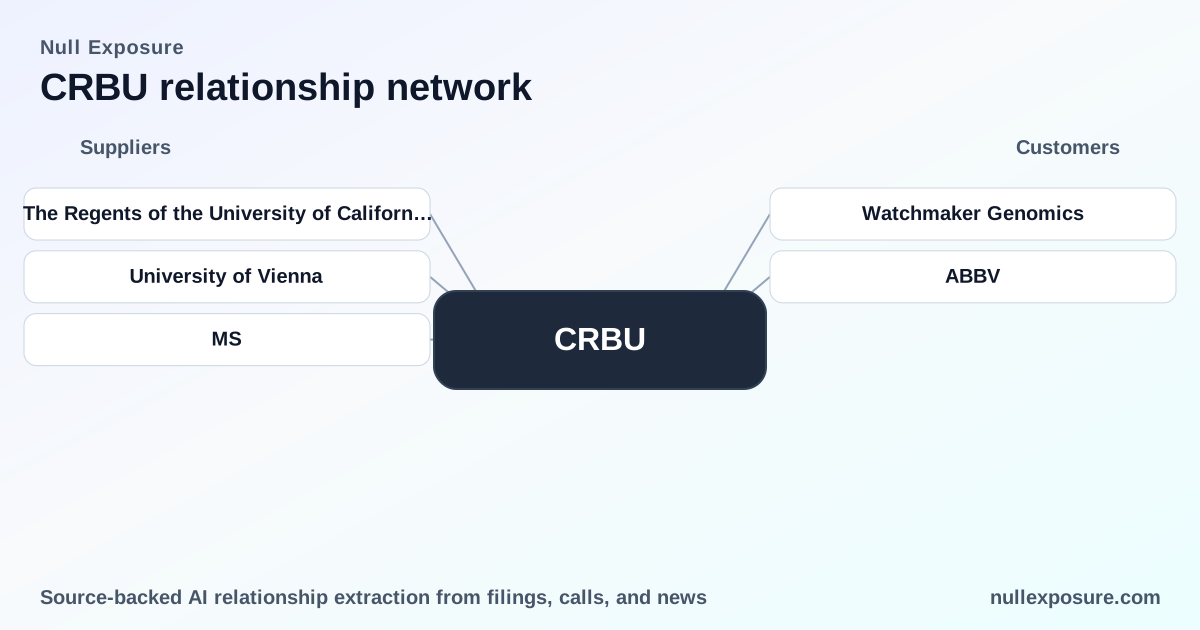
Caribou Biosciences (CRBU): Supplier relationships that shape execution risk and optionality
Caribou Biosciences operates as a clinical-stage CRISPR-focused biotechnology company that monetizes through exclusive intellectual-property licenses, strategic sublicensing and collaboration agreements, and the clinical development of therapeutic candidates that convert into downstream partnership and product revenue. The company currently lacks internal clinical-scale manufacturing and therefore relies on third-party CMOs, CROs and licensor relationships to progress its pipeline; those supplier dynamics are a central driver of commercial timing and execution risk. For deeper commercial diligence and supplier mapping, visit https://nullexposure.com/.
Foundational IP partners: university licensors that anchor the platform
-
The Regents of the University of California Caribou holds an exclusive worldwide license from The Regents of the University of California to foundational CRISPR-Cas9 inventions, with the right to sublicense across fields, a cornerstone for its technology stack and value proposition. According to Caribou’s FY2024 Form 10‑K, the company’s April 16, 2013 Exclusive License with UC (as amended) underpins its CVC IP position (FY2024 10‑K).
-
University of Vienna Caribou’s exclusive licensing arrangement extends to the University of Vienna, which co‑owns the foundational patent family and participates in the same UC/Vienna Agreement that grants Caribou broad rights to CRISPR‑Cas9 methods and compositions. This relationship is documented in the company’s FY2024 10‑K filing.
Key takeaway: These exclusive academic licenses are highly strategic and binary—they are critical assets that define Caribou’s freedom to operate and its ability to commercialize CRISPR therapies.
Broker activity and share disposition: market-level relationship observed
- Morgan Stanley Smith Barney LLC A public filing for FY2026 lists Morgan Stanley Smith Barney LLC as the broker associated with a reported disposition of common shares on 02/24/2026 (listing number of shares and aggregate market value), indicating capital markets activity and third‑party broker engagement for equity transactions. This is reflected in a stock filing posted on StockTitan that references the SEC submission (FY2026, StockTitan / SEC filing).
Key takeaway: Brokered share sales and transfer activity are visible; investors should monitor these events for insider or executive liquidity patterns that influence float and short-term trading dynamics.
Operational constraints and what they imply about execution risk
The company’s public disclosures and supplier‑role evidence create a clear portrait of Caribou’s operating posture:
-
Contracting posture: Caribou relies on exclusive inbound IP licenses from academic institutions and reciprocal licensing arrangements with industry peers (the company documents an Intellia license relationship in its filings), while outsourcing manufacturing and trial delivery to third parties. The FY2024 10‑K explicitly describes the UC/Vienna license and an Intellia license arrangement, establishing a licensing-centric business model.
-
Concentration and single-sourcing: The company acknowledges single-source suppliers and reliance on a small set of CMOs, including smaller vendors with limited scale or experience, which increases supply fragility and scheduling risk.
-
Geographic distribution and regulatory footprint: Manufacturing and supply chain partners are spread across North America, EMEA and APAC—the 10‑K identifies U.S.-based CMOs subject to cGMP, an EU-certified viral‑vector CMO outside the U.S., and at least one CMO with ties to China—creating multi-jurisdictional regulatory dependencies.
-
Criticality and maturity: Caribou does not operate clinical-scale manufacturing and currently has no immediate plans to build that capability, making third-party CMOs and CROs functionally critical to clinical progress; the company reports active contracts with multiple CMOs and clinical service providers for Phase 1 supplies and trial support.
-
Service provider dependency: The company depends on CROs, clinical sites and principal investigators to run trials, and on CMOs to supply the biologics and viral vectors necessary for its product candidates, amplifying operational exposure to third‑party compliance and capacity issues.
For quick reference, the operating model signals are:
- Licensor-centric IP model anchored by UC and University of Vienna (and contractual cross‑licenses with Intellia).
- Outsourced manufacturing with multiple CMOs active for Phase 1 supplies.
- Supplier concentration and single-source exposures to small businesses.
- Geographic regulatory complexity (U.S., EMEA, APAC CMOs).
A practical next step for procurement and investor teams is to map each critical CMO and CRO to regulatory history, scale metrics and contingency plans; for a vendor‑level intelligence platform that supports that mapping, see https://nullexposure.com/.
What investors and operator-managers should prioritize
-
Supply continuity and audit trail. Given that viral‑vector and CAR‑T manufacturing are essential and often single‑sourced, investors should require visibility into quality certifications and audit histories for each CMO. The 10‑K notes that one viral‑vector CMO has cGMP certification from an EU national authority but has not been FDA‑audited, which is a discrete risk for U.S. commercialization timelines.
-
Counterparty credit and scale. Caribou warns in its filings about small‑business suppliers with limited resources; procurement teams must vet the financial and operational resilience of those vendors to avoid delays at scale.
-
Regulatory and geopolitical exposure. The involvement of CMOs with ties to China and other non‑U.S. jurisdictions places the supply chain under geopolitical and export‑control scrutiny; investors should factor that into timeline and reimbursement assumptions.
-
Balance sheet context. Caribou is a clinical‑stage biotechnology company with limited revenues (TTM ~$11.2M) and negative EBITDA (approximately -$130.3M), which constrains its ability to rapidly internalize manufacturing or absorb extended delays—contractual protections and contingency clauses with suppliers are therefore value‑relevant.
Final verdict and action items
Caribou’s exclusive academic licenses provide foundational intellectual property and are a durable value anchor, while its outsourced manufacturing posture creates execution and supply concentration risk that materially affects clinical timelines and commercial optionality. For institutional investors and operator teams, the immediate priorities are deeper vendor due diligence, documentation of backup manufacturing capacity, and monitoring brokered share activity that could influence near‑term market dynamics.
For enterprise teams compiling counterparty risk matrices or investors conducting supplier-level due diligence, review Caribou’s filings and supplier audit records, and consider subscribing for supplier intelligence at https://nullexposure.com/ to translate these disclosures into actionable risk scores.
Concluding recommendation: treat the UC/Vienna license as a core strategic asset, and treat the third‑party manufacturing base as the principal operational risk to be actively monitored and mitigated. Visit https://nullexposure.com/ to begin supplier mapping and comparative diligence on CRBU’s critical partners.