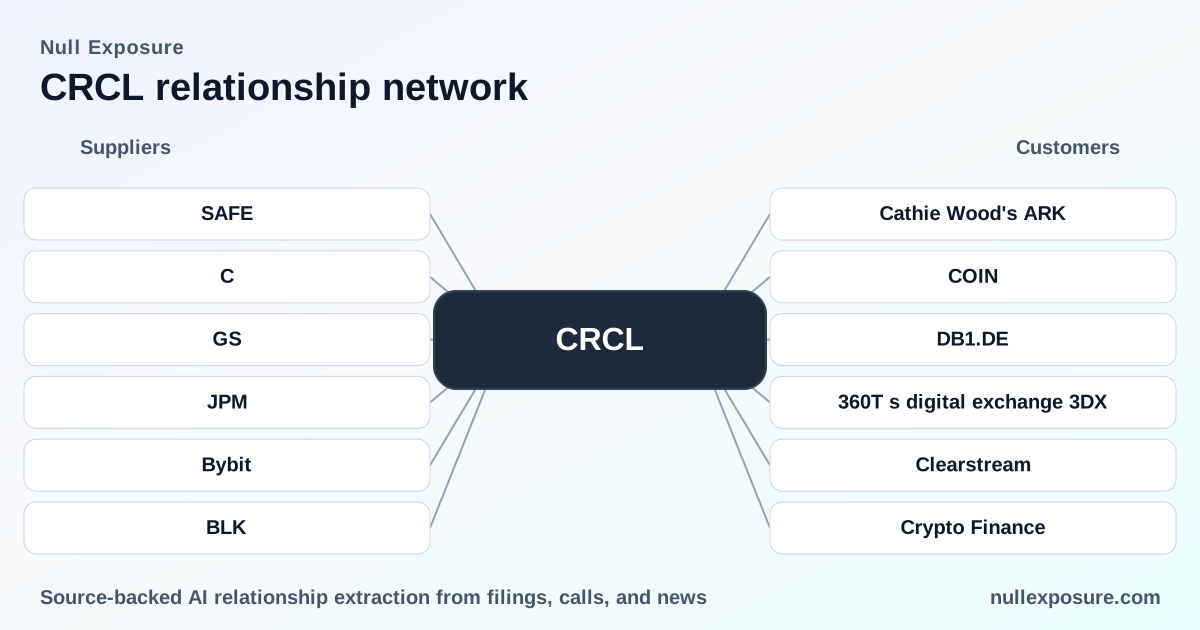
Circle Internet Group (CRCL): supplier relationships that drive USDC scale
Circle is a platform and market infrastructure company built around USDC stablecoin and blockchain-native payments. It monetizes through fees on token issuance, payments and platform services, and by operating treasury and settlement infrastructure that captures yield on reserve assets, while also selling enterprise payments and Treasury services to institutional customers. With roughly $33.4 billion market capitalization and $2.75 billion trailing revenue, these supplier relationships form part of the operating backbone that scales USDC and the company’s go-to-market for institutional products.
For a quick, supplier-focused lens on Circle and comparable coverage, visit https://nullexposure.com/.
Why supplier relationships matter for a stablecoin platform
Circle’s value depends on two linked propositions: network liquidity and trust in reserves. Suppliers that provide custody, banking rails, market distribution, and asset management services are functionally critical to both. That creates a contracting posture where counterparties are strategic rather than tactical—commercial terms and operational resilience directly affect product availability and regulatory optics. The supplier list below therefore informs business concentration, counterparty risk, and the speed with which Circle can scale USDC into new markets.
Operationally, the supplier signal set suggests the following company-level characteristics:
- High counterparty criticality: partners provide custody, on/off ramps and reserve placement that directly affect USDC liquidity and credibility.
- Institutional contracting posture: Circle negotiates with global banks, exchanges, and asset managers on complex custody and settlement protocols rather than commodity vendors.
- Diversification in distribution but concentration in financial plumbing: distribution partners expand reach, while a fewer set of financial institutions underpins reserves and book‑running.
- Maturing commercial model: public-market activity (underwriting and book-running) and named institutional partners indicate progress toward mainstream capital markets integration.
Supplier-by-supplier: the relationships investors should track
-
Safe — Circle announced a strategic partnership to position Safe as an institutional storage solution for USDC in self-custody and DeFi, expanding Circle’s institutional custody options and on‑chain settlement flows. Source: MarketScreener press report on the partnership (Mar 9, 2026) (https://www.marketscreener.com/news/safe-partners-with-circle-tsafe-and-circle-internet-group-inc-announces-a-strategic-partnership-ce7d5ad9d180f323).
-
Citigroup — Citigroup is named among joint lead active book‑runners for Circle’s offering, signaling traditional investment bank underwriting support and distribution to institutional investors. Source: Economic Times referencing Coindesk on Circle’s IPO book‑runners (Mar 2026) (https://m.economictimes.com/news/international/us/circle-internet-group-ipo-top-things-investors-need-to-know-circle-ipo-news/articleshow/121443270.cms).
-
Goldman Sachs — Goldman Sachs is participating as a joint lead active book‑runner on Circle’s offering, reinforcing access to institutional capital markets and advisory capabilities. Source: Economic Times / Coindesk coverage of underwriting syndicate (Mar 2026) (https://m.economictimes.com/news/international/us/circle-internet-group-ipo-top-things-investors-need-to-know-circle-ipo-news/articleshow/121443270.cms).
-
JP Morgan — JP Morgan is also a joint lead active book‑runner, bringing broad institutional distribution and bank plumbing that supports Circle’s transition toward public-market finance. Source: Economic Times / Coindesk note on underwriting roles (Mar 2026) (https://m.economictimes.com/news/international/us/circle-internet-group-ipo-top-things-investors-need-to-know-circle-ipo-news/articleshow/121443270.cms).
-
Bybit — Circle and Bybit formed a strategic partnership to advance global USDC adoption, including fiat on‑ and off‑ramp solutions that combine Circle’s infrastructure with Bybit’s market reach to simplify deposits and withdrawals in key markets. Source: Circle press release on the Bybit partnership (Mar 2026) (https://www.circle.com/pressroom/bybit-and-circle-forge-strategic-partnership-to-advance-global-usdc-adoption).
-
BlackRock — Circle discloses that part of USDC reserves are held in Treasuries and overnight repo, including via a BlackRock‑managed money market fund structure, linking its reserve placement to a major institutional asset manager. Source: coverage noting Circle’s reserve reporting and BlackRock money market fund exposure (Mar 2026) (https://www.bez-kabli.pl/circle-internet-group-stock-jumps-again-as-rates-drive-the-usdc-story/).
Each of the relationships above connects to either distribution (book-runners and exchanges), custody and settlement (Safe, Bybit), or reserve management (BlackRock), and each therefore translates quickly into revenue or risk exposure for Circle.
What investors should read into these partnerships
-
Underwriting and institutional distribution (JP Morgan, Citigroup, Goldman Sachs) accelerate access to balance-sheet capital and sophisticated investors; that reduces financing friction and strengthens price discovery for public securities or tokenized products. Watch underwriting fees and allocation patterns for indications of demand and pricing power.
-
Custody and on‑ramp partners (Safe, Bybit) increase USDC availability and reduce friction for institutional users; operational uptime, SLAs, and custody insurance terms are direct inputs to platform risk. Performance and remediation clauses in custody contracts will be material in stress scenarios.
-
Reserve placement with major asset managers (BlackRock) signals conservative reserve hygiene and institutionalized cash-management practices; because USDC credibility depends on reserve transparency, the choice of money‑market structures and counterparties is a reputational as well as yield decision.
For more supplier risk intelligence and contract-level signals, see https://nullexposure.com/.
Practical risk checklist for underwriting exposure to CRCL
- Concentration risk: quantify revenue and transaction routing dependence on named partners; underwriting banks and a limited set of reserve vehicles create concentrated operational touchpoints.
- Counterparty credit and custody terms: evaluate custody SLAs, insurance coverage, and the legal interoperability between on‑chain settlement and off‑chain custodial claims.
- Regulatory and disclosure posture: track reserve reporting cadence and third‑party assurance timing; those disclosures determine market trust and legal resilience.
- Integration and market access speed: partnerships with exchanges and payments providers are execution leverage—monitor product rollouts, fiat rails, and regional licensing developments.
What to watch next and how to act
Monitor Circle’s upcoming filings and press releases for contract-level details—fee schedules with book‑runners, custody terms with Safe and Bybit, and the exact structure of reserve placements with BlackRock or equivalent funds. Operationally critical contracts will show up quickly in disclosures or commercial announcements, and changes in those relationships will move valuation and risk assumptions faster than product-level metrics.
For continuing coverage and supplier-level intelligence on Circle and comparable market infrastructure companies, visit https://nullexposure.com/.
In summary: Circle’s supplier map shows a deliberate mix of institutional capital markets partners, exchange distribution deals, and conservative reserve managers—each tradeable into distinct investment conclusions. Book‑running banks improve capital-market access, custody partners lower operational friction, and reserve managers support credibility; together these relationships materially influence Circle’s ability to scale USDC and monetize at enterprise margins.
If you want ongoing supplier risk signals and contract-level analysis to inform underwriting or operating decisions, start here: https://nullexposure.com/.