Cricut (CRCT) — supplier relationships and operational constraints investors should price in
Cricut designs and sells a creativity platform centered on connected machines, accessories and consumables, monetizing through hardware sales and recurring purchases of materials and accessories; its economics are shaped by outsourced manufacturing, distributor/retailer channels, and periodic capital-market activity. With TTM revenue of $708.8M, a market cap near $864M, and a gross margin above 50%, supply-side relationships directly influence near-term margins, inventory turns, and capital efficiency. For a practical view of counterparty exposure and operational leverage, visit the project homepage for structured supplier intelligence at https://nullexposure.com/.
The supplier architecture that drives margins and operational risk
Cricut’s operating model is built on outsourced manufacturing and outsourced logistics, which compresses fixed-cost manufacturing investment but transfers execution risk to third parties. Public filings and disclosures show that Cricut outsources the manufacture of connected machines, accessories and materials to contract manufacturers primarily in Malaysia, China, Thailand and South Korea, while logistics and last-mile distribution are handled by a small number of third-party logistics partners across the United States, Europe and Australia. Those statements establish a clear contracting posture: purchase-order relationships with a handful of external manufacturers and logistics providers rather than vertically integrated production.
This posture creates four practical characteristics investors should price:
- High concentration: top-two vendors comprised approximately 69% of finished goods purchases in 2024, a structural concentration that elevates supplier bargaining power and single-point failure risk.
- Materiality: the company defines its supply chain as material to results; supplier disruptions are described in filings as capable of materially affecting operations.
- Geographic concentration in APAC: manufacturing is largely Asia-based, exposing the company to regional capacity, labor and geopolitical risks.
- Contract flexibility, not guarantees: contracts with manufacturers do not obligate suppliers to deliver fixed quantities or prices, meaning Cricut relies on purchase orders and supplier cooperation to scale production.
These characteristics produce both operating leverage in good times and downside exposure in supply disruptions. For a consolidated view and monitoring tools, explore https://nullexposure.com/ for supplier mapping and alerts.
The manufacturing and logistics picture, in plain English
Cricut’s core hardware and consumables business depends on third-party contract manufacturers and third-party logistics providers; inventories are composed of finished goods and raw materials purchased from contract manufacturers. This structure reduces capital intensity but translates supply interruptions and vendor price moves directly into cost of goods sold volatility and potential inventory write-downs.
Every named counterparty investors should track
Below I cover each relationship listed in public results and explain why it matters.
-
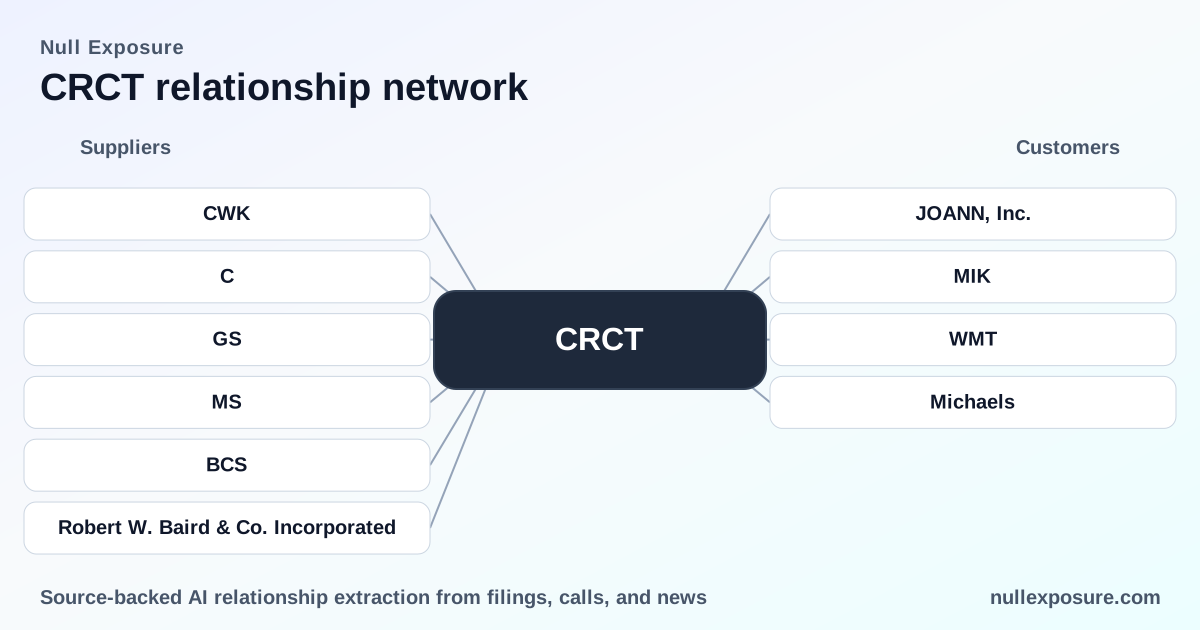
Cushman & Wakefield — Cushman represented Cricut in a lease-extension for its 128,000-square-foot corporate headquarters in South Jordan, Utah, formalizing longer-term occupancy of its U.S. HQ. This stabilizes real-estate cost exposure and anchors management’s physical operations in Salt Lake City (Cushman & Wakefield press release, April 28, 2025: https://www.utahbusiness.com/press-releases/2025/04/28/cushman-wakefield-represents-cricut-longer-term-lease-corporate-headquarters-south-jordan/).
-
Citigroup Global Markets Inc. — Citigroup served as a joint-bookrunning manager on Cricut’s initial public offering, positioning it as a primary capital markets counterparty during Cricut’s listing process (Cricut IPO press release, March 25, 2021: https://www.globenewswire.com/news-release/2021/03/25/2198971/0/en/Cricut-Announces-Pricing-of-Initial-Public-Offering.html).
-
Goldman Sachs & Co. LLC — Goldman Sachs acted as a lead bookrunning manager on the 2021 IPO, indicating the firm’s role in pricing and distribution of Cricut equity during the public offering (Cricut IPO press release, March 25, 2021: https://www.globenewswire.com/news-release/2021/03/25/2198971/0/en/Cricut-Announces-Pricing-of-Initial-Public-Offering.html).
-
Morgan Stanley & Co. LLC — Morgan Stanley was a co-lead bookrunning manager on the 2021 IPO, sharing underwriting and distribution responsibilities that supported company access to public equity capital (Cricut IPO press release, March 25, 2021: https://www.globenewswire.com/news-release/2021/03/25/2198971/0/en/Cricut-Announces-Pricing-of-Initial-Public-Offering.html).
-
Barclays Capital Inc. — Barclays served as a joint-bookrunning manager on the IPO, participating in underwriting and market placement during Cricut’s transition to a public company (Cricut IPO press release, March 25, 2021: https://www.globenewswire.com/news-release/2021/03/25/2198971/0/en/Cricut-Announces-Pricing-of-Initial-Public-Offering.html).
-
Robert W. Baird & Co. Incorporated — Baird acted as a co-manager on the IPO, a role that supported distribution to certain institutional and regional investor channels during the offering (Cricut IPO press release, March 25, 2021: https://www.globenewswire.com/news-release/2021/03/25/2198971/0/en/Cricut-Announces-Pricing-of-Initial-Public-Offering.html).
Each of these relationships is transactional by nature — real estate advisory and capital markets counterparties versus operational manufacturers and logistics providers — but they all factor into corporate stability: the lease extension secures HQ continuity while the investment banks shaped Cricut’s access to public capital.
What the constraints say about operational fragility and runway
Company-level disclosures surface clear constraints that govern how Cricut operates with suppliers:
- APAC manufacturing focus: the firm states that substantially all products are manufactured by overseas outsourcing partners in Malaysia, China, Thailand and South Korea, a structural supply concentration that demands active supplier management.
- Material reliance on a small number of suppliers: top-two vendors accounted for about 69% of finished goods purchases in 2024, reinforcing concentrated counterparty risk.
- Contractor role, not capacity guarantees: contracts do not obligate manufacturers to supply specific quantities or prices; Cricut issues purchase orders and relies on supplier capacity and cooperation.
- Service-provider logistics footprint across NA and EMEA: third-party logistics partners fulfill a substantial percentage of deliveries in key markets, which spreads operational dependency across geography but keeps control external.
These constraints mean supply-side shocks directly affect COGS, inventory, and gross margin — metrics investors should monitor alongside sales growth and working capital. Given Cricut’s operating margin of ~7.16% and profit margin of ~10.8%, supplier cost pressure or inventory disruption would have immediate earnings impact.
Mid-report action: for deeper supplier and counterparty intelligence, see https://nullexposure.com/ to map concentration and vendor profiles.
Bottom line — what investors and operators should do next
- Investors: price a premium for supplier concentration risk and APAC exposure; monitor vendor concentration metrics and inventory days closely. Use the lease-extension news to reduce near-term real-estate uncertainty in valuation models.
- Operators: prioritize multi-sourcing of critical components, negotiate minimum supply commitments where possible, and stress-test logistics routes in the event of APAC disruptions.
Cricut’s outsourced manufacturing model provides capital efficiency but concentrates operational risk; the firm’s counterparty mix — from APAC contract manufacturers to U.S.-based real estate advisors and global bookrunners — defines where execution can break or be defended. For ongoing monitoring and structured supplier intelligence, check the project home page at https://nullexposure.com/.
Final recommendation: incorporate supplier concentration scenarios into your financial model and maintain real-time visibility on top vendors and logistics partners to protect margins and avoid surprise stock-price downside. For tailored supplier reports and alerts, visit https://nullexposure.com/.