Crawford & Company (CRD-B): Supplier relationships that move claims operations and investor signals
Crawford & Company monetizes by selling outsourced claims management and related professional services to insurers, brokers, and corporations worldwide; the firm bills clients for managed services, third‑party administration, and technical claims work, producing roughly $1.27 billion in trailing revenue and an EBITDA base that supports net margins but leaves operating leverage sensitive to claims cycles. For investors, the value proposition is recurring contract revenue tied to operational scale and vendor execution—and supplier relationships are a direct lever on cost, continuity, and reputation.
Discover more supplier intelligence at https://nullexposure.com/.
How Crawford’s operating model uses suppliers to scale claims delivery
Crawford runs a global outsourcing model: it keeps core claims expertise in‑house while contracting third parties for technology, communications, and complementary services. This structure converts fixed cost into a variable‑cost delivery platform that lets the company expand into new geographies and product lines with lower incremental capital requirements. Financially, the company reports $1.265bn revenue TTM, $79.7m EBITDA, and limited profitability headroom (profit margin ~1.55%), which makes supplier cost control and service continuity highly consequential for margins and client retention.
A company‑level constraint in Crawford’s filings explicitly notes that payments to outsourced service providers are one of the most significant expenses in the Broadspire segment, indicating a contracting posture that leans on external partners to augment internal teams. That excerpt signals several operating characteristics:
- Contracting posture: outsourcing is a deliberate, embedded strategy rather than an ad hoc arrangement.
- Criticality: third‑party suppliers handle material functions that influence cost of delivery and client satisfaction.
- Maturity: the practice is established within the business model and disclosed as an ongoing expense category.
- Concentration: not specified by the constraint, so vendor concentration should be assessed case‑by‑case (see relationships below).
The supplier relationships you need to know
Below I cover every supplier relationship flagged in the source material and what each means for operational risk and investor assessment.
-
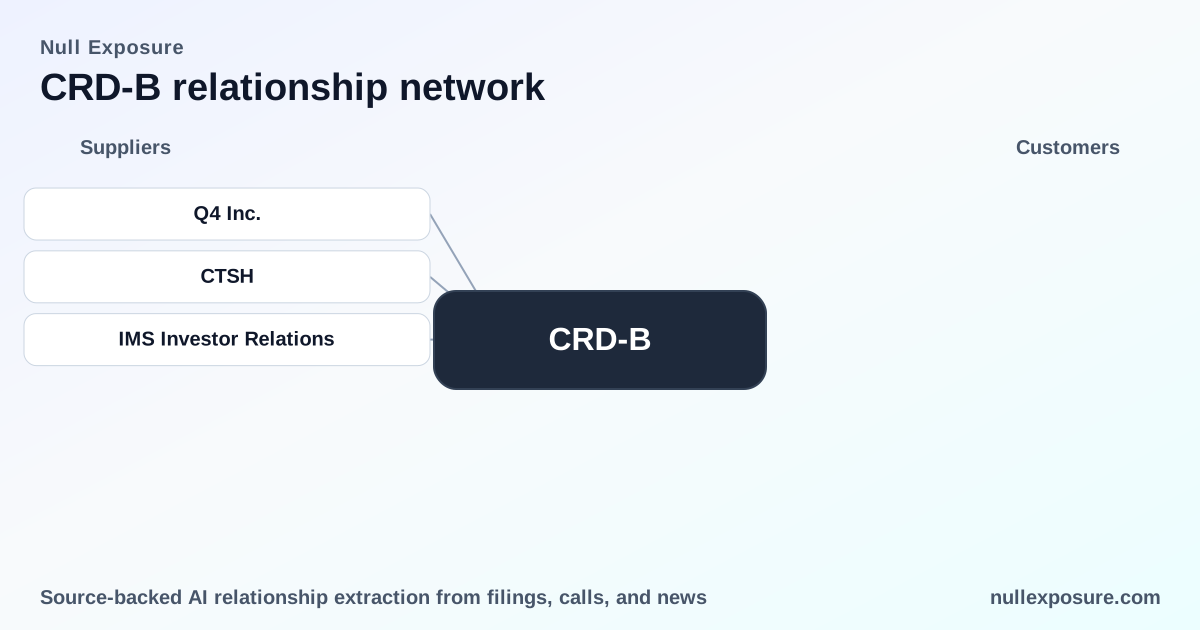
Q4 Inc. — Crawford uses Q4’s webcasting services to host earnings calls and investor presentations during FY2025; multiple FY2025 press releases reference call webcasts facilitated by Q4 Inc. This is a communications vendor for investor relations and public disclosures, important for transparent market access but low operational risk to claims delivery (source: Crawford FY2025 earnings press releases hosted on Yahoo Finance and FinancialContent/BizWire, FY2025).
-
IMS Investor Relations — Crawford lists IMS Investor Relations as investor contacts for earnings announcements in FY2025, indicating an outsourced IR support relationship that coordinates media and investor outreach; this supports market communications and the equity story rather than back‑office operations (source: Crawford FY2025 press release on Yahoo Finance, FY2025).
-
Cognizant (CTSH) — Historical reporting shows Crawford mandated Cognizant to implement PeopleSoft Financials as part of an ERP project (Project Atlas) that was described as critical to Crawford’s operations in FY2019, and Cognizant was subsequently involved in litigation related to that engagement. This relationship illustrates strategic, high‑impact outsourcing for core financial systems and the operational risk that accompanies large ERP implementations (source: Times of India report on the Cognizant–Crawford Project Atlas matter, FY2019).
What these supplier ties imply for investors and operators
The three relationships above fall into two clear categories: communications / investor‑facing vendors (Q4, IMS) and core systems integrator / IT vendor (Cognizant). Each carries different risk and value implications.
-
Communications vendors (Q4, IMS): These relationships underpin regulatory disclosure and investor relations. They are low operational risk but high reputational value—poor execution degrades investor confidence and can amplify volatility around earnings. Contracts are typically short to medium term and commoditized, so switching costs are low, but reliability is non‑negotiable during earnings cycles.
-
ERP and systems integrators (Cognizant): The Cognizant engagement for PeopleSoft shows CFO‑level dependence on outsourced ERP delivery. Large ERP projects are single points of failure for finance, billing, and reporting; history of dispute highlights the potential for contract friction, implementation delay, and remediation costs. For operators, this elevates vendor selection, SLAs, and governance as primary risk controls.
Across the business, the constraint that outsourced service providers are a significant expense in Broadspire signals material vendor dependency for a segment that contributes meaningfully to revenue. That raises three investment‑relevant points:
- Operational leverage is vendor‑sensitive. With thin profit margins, vendor price creep or service failure directly compresses profitability.
- Governance matters. High insider ownership (~68.6%) and modest institutional ownership implies decisions about vendor strategy are concentrated among insiders, increasing the importance of transparent external oversight.
- Maturity of outsourcing lowers execution risk but not legal risk. Outsourcing is an established model for Crawford, reducing likelihood of ad hoc failures, but legal disputes (as with the ERP project) remain possible and can be costly.
Near‑term financial context for supplier risk
Crawford’s valuation and operating metrics frame how supplier outcomes translate into investor returns: EV/EBITDA ~7.3 and forward P/E ~10.2 suggest the market prices a moderate recovery and operational improvement; conversely, a sustained vendor problem that inflates costs or damages client relationships would rapidly reverse that thesis. Monitor vendor contract disclosures, SLA penalties, and project‑specific litigation as direct leading indicators of margin pressure and execution risk.
Explore joint supplier signals and vendor risk profiles at https://nullexposure.com/.
Practical takeaways for relationship managers and investors
- Treat ERP and finance systems vendors as strategic partners with executive‑level oversight because failures impact core financial controls.
- Benchmark communications/IR vendors on reliability and continuity planning—they are low risk but have outsized PR impact.
- Watch procurement disclosures and vendor concentration language in filings to detect single‑vendor dependencies that would be hard to unwind quickly.
For a deeper view of supplier relationships and concentrated vendor risk across your portfolio, visit https://nullexposure.com/ to see how vendor signals map to operational and investment outcomes.
Bottom line: Crawford’s business model is deliberately outsourced in execution, and that delivers scale while transferring discrete operational risks to suppliers. Investors should value the flexibility that outsourcing provides but insist on visibility into vendor contracts, SLAs, and litigation exposure—especially for ERP and other systems that feed billing and financial reporting.