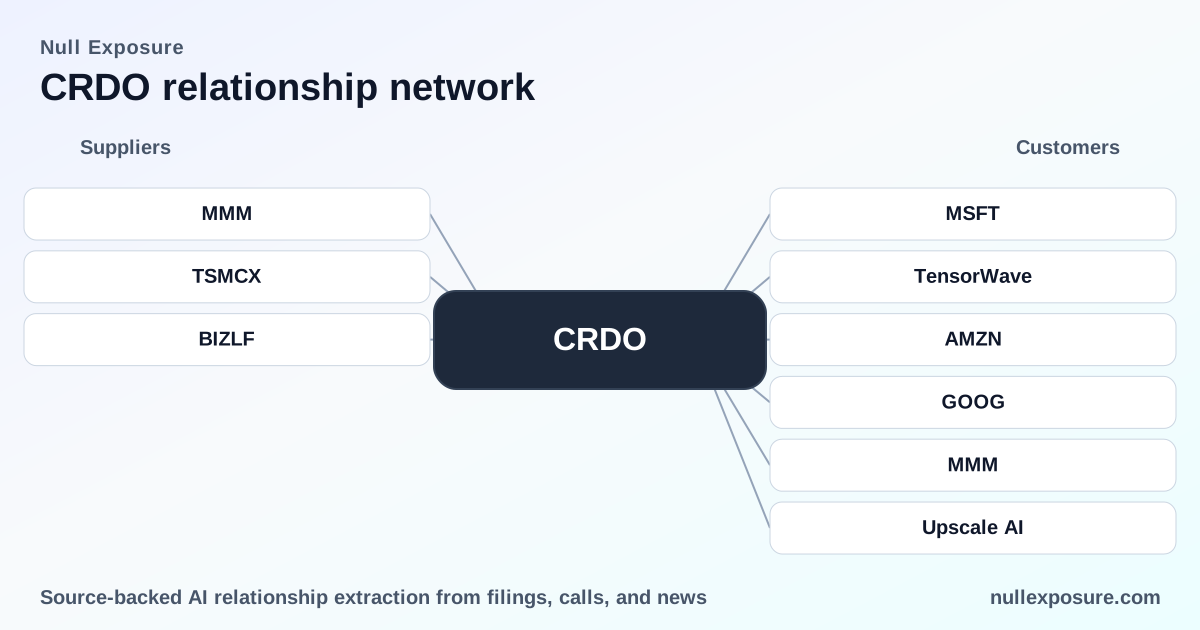
Credo Technology Group (CRDO): supplier relationships and what they mean for investors
Credo is a fabless semiconductor supplier that monetizes high‑speed electrical and optical connectivity ICs through product sales and selective IP licensing to systems and module makers. The company drives margins from design differentiation and node‑shrink performance while outsourcing wafer fabrication and assembly; its commercial model mixes chip sales with strategic IP/license deals. For a rapid supplier-risk view tied to portfolio decisions, visit https://nullexposure.com/.
How Credo runs its supply chain and why that matters to valuation
Credo operates a classic fabless model: it focuses on IP, design and system integration while outsourcing wafer production, assembly and test. Revenue is product‑driven ($1.07B TTM) with healthy gross and operating margins, but the margins rely on an outsourced manufacturing footprint that produces concentration and capacity risk. The company’s market capitalization (~$33.2B) and premium multiples (trailing P/E ~99, EV/Revenue ~30.6) reflect forecasted growth in AI/data‑center interconnect and investor willingness to pay for margin leverage on design wins.
The supply posture is quantitatively and qualitatively important for operators assessing counterparty risk:
- Contracting is short‑term and purchase‑order oriented, reducing long‑tail contractual guarantees but increasing flexibility to reprice or reallocate volume.
- Manufacturing concentration is high—Credo relies on large, third‑party foundries and Asia‑based assembly/test partners, creating capacity and geopolitical exposure.
- Supplier relationships range from strategic IP licenses to volume manufacturing agreements, so financial exposure is a mix of committed spend (tens of millions) and spot purchases.
Key operating constraints investors should factor into models
Credo’s public filings and disclosures make several company‑level signals clear:
- Contracting posture: most purchases are made on purchase orders; long‑term supply contracts are limited. This limits guaranteed capacity but keeps flexibility to manage costs and forecasting.
- Concentration and criticality: wafer fabrication is exclusively outsourced to a single major foundry in FY2025, making that supplier operationally critical to Credo’s roadmap.
- Geography and supplier footprint: assembly and test are primarily in APAC, concentrating execution risk in that region.
- Spend profile: unconditional purchase commitments reported place Credo’s mid‑range supplier spend in the $10m–$100m band, indicating material but not monopoly supplier economics.
These constraints shape contracting strategy, inventory policy and the contingency premium investors should bake into growth scenarios.
Counterparty snapshot — who Credo works with and why it matters
Below are every supplier or partner relationship cited in the available results, with a concise, source‑linked take for each.
3M (symbol: MMM)
Credo entered a patent licensing agreement with 3M that expands access to intellectual property relevant to high‑speed data solutions, strengthening Credo’s IP position and enabling broader commercial coverage for certain technologies. This development was reported in industry coverage in March 2026. (Source: Simply Wall St coverage, March 9, 2026.)
TSMC (aliases: TSM, TSMCX)
Credo discloses that it exclusively used Taiwan Semiconductor Manufacturing Company Limited (TSMC) for wafer production in FY2025, and it has announced product IP availability on advanced TSMC nodes (5nm and 3nm / N3) for next‑generation AI connectivity. TSMC is therefore both the operational bottleneck and the technological enabler for Credo’s roadmap. (Source: Credo FY2025 Form 10‑K; Credo investor press release on TSMC collaboration, May 2026.)
BizLink (symbol: BIZLF)
Credo maintains a manufacturing agreement with BizLink for the manufacture of certain AEC products, while noting that it does not have long‑term contracts broadly with other contract manufacturers. That single agreement is the primary named long‑form manufacturing commitment disclosed. (Source: Credo FY2025 Form 10‑K, filed May 2025.)
Why each relationship changes the risk/reward profile
- 3M license: IP licensing from a diversified industrial IP owner reduces the risk of patent‑blocking and supports Credo’s go‑to‑market for certain interconnect features; this is a strategic credit to Credo’s monetization of design/IP. (Simply Wall St, Mar 2026.)
- TSMC dependence: Exclusive wafer sourcing in FY2025 makes TSMC a single point of failure for volume scaling; at the same time, availability on cutting nodes (5nm/3nm) is a commercial advantage that supports margin expansion if Credo converts design wins into volume. (Credo FY2025 10‑K; Credo investor news, May 2026.)
- BizLink production agreement: The named manufacturing agreement for AEC products provides a discrete production path but underscores that most supplier relationships remain short‑term rather than contractual lock‑ins—increasing supplier negotiation leverage and supply volatility. (Credo FY2025 10‑K, May 2025.)
Investment implications — valuation, leverage and where to focus diligence
Credo’s financials show high operating leverage (operating margin ~36.8% TTM) and attractive profitability, yet the stock trades at premium multiple levels that price in continued share gains in AI/data center interconnects. Operationally, focus diligence on three areas:
- Capacity assurances and contractual coverage: absence of long‑term guarantees with TSMC and others means growth forecasts need explicit capacity scenarios; stress models for wafer scarcity or node allocation constraints.
- Supplier concentration and regional execution risk: assembly/test primarily in APAC raises supply‑chain and geopolitical exposure that impacts time‑to‑market and gross margin variability.
- IP and licensing strategy: the 3M patent license improves defensibility, but investors should track whether licensing translates into higher realized ASPs or improved win rates.
Key market signals: elevated beta (~3.18) and a wide 52‑week trading range suggest sentiment‑driven moves; analysts are bullish overall (majority Buy/Strong Buy consensus), so operational slippage would be priced harshly given rich multiples.
Practical next steps for investors and operators
- For operators negotiating supplier contracts, prioritize capacity commitments and dual‑sourcing where feasible; quantify the revenue at risk if wafer allocations tighten.
- For investors, stress‑test models for wafer capacity constraints and APAC execution shocks; treat IP licenses (e.g., 3M) as positive but not a substitute for supply security.
- For a structured supplier risk view aligned with portfolio needs, see the supplier intelligence tools at https://nullexposure.com/.
Final takeaway: Credo’s business is high‑margin and technically differentiated, but its upside is materially conditioned on outsourced manufacturing capacity and execution in APAC; both the 3M IP arrangement and TSMC node availability are pivotal to turning premium multiples into realized growth.