CRE (Cre8 Enterprise) Supplier Network: What investors and operators need to know
Cre8 Enterprise Limited builds digital platforms and monetizes through software solutions and services that drive client engagement and operational efficiency; the company converted to a public company via an IPO in early March 2026 and relies on a compact set of external providers for capital markets, legal counsel, and press distribution. For investors and operators evaluating supplier relationships, the IPO-era roster signals a boutique capital markets pathway, concentrated post-listing support, and immediate compliance sensitivity tied to market pricing. Explore supplier detail and implications below, and for a deeper supplier-risk view visit https://nullexposure.com/.
How the supplier list defines operational posture after IPO
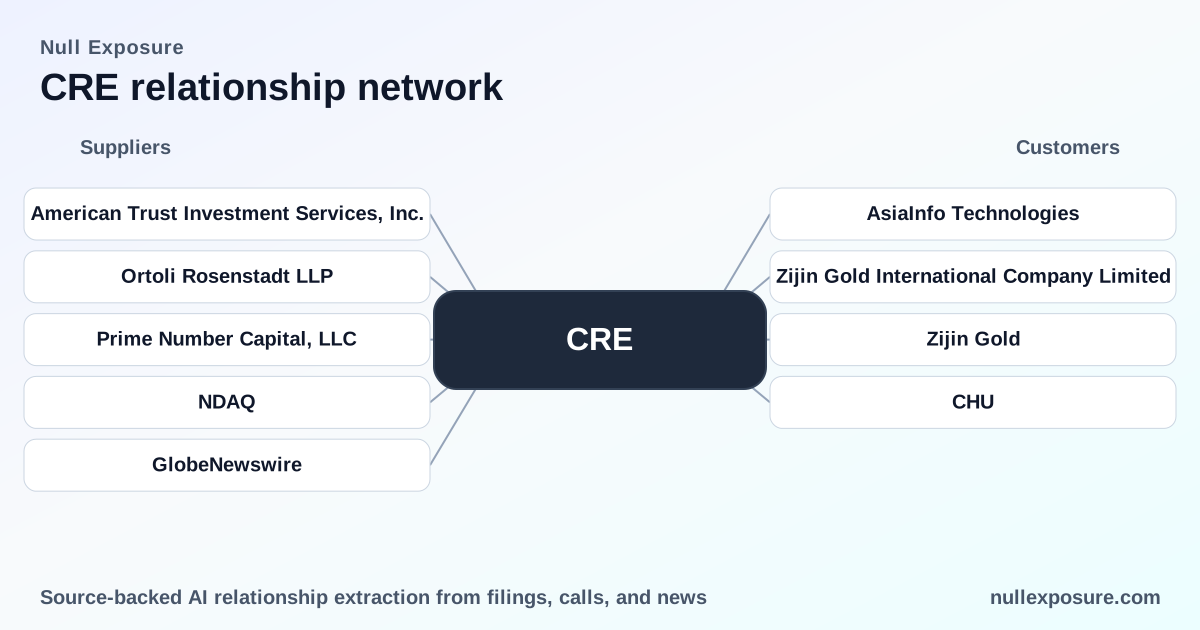
Cre8’s supplier roster around the IPO is small and highly transactional: a lead underwriter, a co-underwriter, U.S. securities counsel, the Nasdaq listing venue, and press-distribution channels. That configuration reflects a common post-IPO operating pattern where external providers are critical for market access and disclosure compliance but limited in number — increasing single-point-of-failure risk for market-facing functions. Company-reported metrics to the latest quarter (2025-03-31) show TTM revenue of $104.6 million against a market capitalization of roughly $6.2 million, underlining an asymmetric public valuation that intensifies the importance of trading liquidity and compliance suppliers.
American Trust Investment Services, Inc.
American Trust acted as the lead underwriter for Cre8’s IPO, serving as the representative of the underwriting syndicate and steering the execution of the offering. This places American Trust at the center of Cre8’s capital-market access during and immediately after the IPO. Source: PR Newswire press release announcing the underwriting role (Mar 9, 2026).
Prime Number Capital, LLC
Prime Number Capital served as a co-underwriter alongside American Trust, providing supplemental placement and distribution capacity for the offering. Co-underwriter involvement indicates Cre8 relied on a small syndicate rather than a large institutional bookrunner group. Source: StockTitan reporting on the IPO pricing and underwriter roles (Mar 9, 2026).
Ortoli Rosenstadt LLP
Ortoli Rosenstadt LLP acted as U.S. securities counsel to Cre8 for the offering, providing the legal framework and securities-law opinions necessary for the IPO. Retention of a dedicated U.S. securities counsel is a standard control for cross-border issuers and is material to disclosure and compliance quality. Source: StockTitan coverage announcing the IPO pricing (Mar 9, 2026).
Nasdaq Capital Market
Cre8’s shares began trading on the Nasdaq Capital Market under the ticker CRE, establishing the primary trading venue and regulatory framework for ongoing public reporting. The Nasdaq listing makes exchange compliance and market-microstructure dynamics immediately critical to the company’s public performance and investor liquidity. Source: StockTitan notice of trading commencement on Nasdaq (Mar 9, 2026).
GlobeNewswire (press distribution as captured by QuiverQuant)
A GlobeNewswire release (captured in secondary distribution channels) provided press distribution for a Nasdaq notice regarding non-compliance with Nasdaq’s minimum bid price rule; secondary services summarized that release. Press distribution amplified a compliance event that directly affects listing status and investor perception. Source: QuiverQuant summary of a GlobeNewswire press release (Mar 9, 2026).
Operational constraints and what the absence of explicit constraints signals
No constraint excerpts were supplied with the relationship data, which itself is a company-level signal: the public-facing supplier footprint for the IPO is narrow and there are no recorded contractual constraints or long-term supplier commitments in the provided material. From that absence, derive these operating-model characteristics with confidence:
- Contracting posture: Short-term, transaction-focused engagements dominate — underwriting, counsel, and listing services were engaged for IPO execution rather than long-duration outsourcing. This contracting posture prioritizes speed to market over multi-year vendor lock-ins.
- Concentration: The supplier mix is concentrated across a few providers, increasing operational leverage and single-vendor risk for market access and compliance functions.
- Criticality: Underwriting, U.S. securities counsel, and the Nasdaq listing are mission-critical for liquidity, capital access, and regulatory continuity; any disruption to these suppliers would have an immediate market impact.
- Maturity: The supplier relationships reflect an early-stage public-company maturity profile: transactional, compliance-driven, and dependent on a small adviser set rather than an institutional ecosystem.
What this means for investors and operators: risk and opportunity checklist
Cre8’s supplier choices and public metrics produce a compact set of investment implications operators and researchers should weigh.
- Liquidity and market structure risk is elevated. A small underwriting syndicate and a market cap materially below TTM revenue create a fragile trading environment where post-IPO price dynamics can trigger exchange compliance actions, as reflected in a Nasdaq minimum-bid-price notification distributed via GlobeNewswire. Source: QuiverQuant/GlobeNewswire summary (Mar 9, 2026).
- Legal and disclosure controls are in-place but concentrated. Having U.S. securities counsel (Ortoli Rosenstadt) is a positive control for cross-border disclosure, but reliance on a single legal firm increases execution risk for complex future transactions. Source: StockTitan IPO pricing announcement (Mar 9, 2026).
- Capital access is established but not broad-based. Lead and co-underwriters (American Trust and Prime Number Capital) secured the offering, but the syndicate’s boutique profile implies limited distribution depth and potential secondary-market illiquidity. Source: PR Newswire and StockTitan underwriter notices (Mar 9, 2026).
- Information flow and investor perception are sensitive to press channels. The company’s compliance notice propagated through GlobeNewswire and financial aggregators, demonstrating the outsized market effect of single press releases for small-cap issuers. Source: QuiverQuant/GlobeNewswire (Mar 9, 2026).
- Shareholder base signals follow-through risk. Company data show low institutional ownership (about 2%) and meaningful insider ownership (~33%), indicating that market-making and institutional support are limited and insider positions dominate liquidity dynamics.
For a consolidated supplier-risk profile and to monitor future supplier disclosures, use our platform: https://nullexposure.com/.
Final read: how to act on this supplier map
For investors, the combination of small-syndicate underwriting, concentrated legal reliance, an active Nasdaq compliance notice, and low institutional ownership defines a high-structural-risk, high-information-sensitivity investment case. For operators, prioritize diversifying capital-market advisors, implementing robust disclosure controls with backup counsel, and managing market communications proactively to reduce listing-compliance and liquidity shocks.
Actionable next steps: verify the company’s exchange correspondence and updated trading status, confirm whether Cre8 has engaged additional market makers or institutional placement agents since the IPO, and track any further legal or regulatory notices. Revisit supplier relationships periodically because, for a newly public firm of this profile, supplier changes materially alter execution risk and valuation.
For ongoing supplier intelligence and alerts on Cre8 and comparable small-cap issuers, visit https://nullexposure.com/.