Cresud (CRESY): Supplier relationships that matter to cash flow and credit posture
Cresud operates as a Latin American agricultural and real estate conglomerate that monetizes through commodity production and sales, land and property assets, and dividends from related real estate holdings; the company funds operations and investor returns via periodic coupon payments on issued notes and steady dividend receipts. For investors and operators, the critical dynamics are cash-flow concentration from related-party dividends, a public debt servicing pattern executed through Argentina’s securities infrastructure, and a domestic credit profile supported by local ratings. Learn more about supplier and counterparty intelligence at https://nullexposure.com/.
How Cresud’s operating model shapes supplier risk and contracting posture
Cresud’s business model combines commodity cycles with real estate cash flows and capital markets funding. Contracting posture reflects two distinct vectors: commercial procurement for agricultural operations and creditor relationships for issued notes. Concentration is material because dividend inflows from related real estate businesses form a meaningful portion of corporate liquidity. Criticality sits highest on payments that preserve market access — servicing bond interest and principal through paying agents is operationally non‑negotiable. Maturity of the company’s capital markets profile is evident from recurring note issuances and scheduled coupon distributions, demonstrating an institutionalized funding cadence.
These company-level signals frame supplier diligence: prioritize counterparties that enable debt service and liquidity (paying agents, custodians, major related-party cash generators) and monitor any single counterparty that provides outsized cash inflows.
The supplier and counterparty footprint — what every investor should record
-
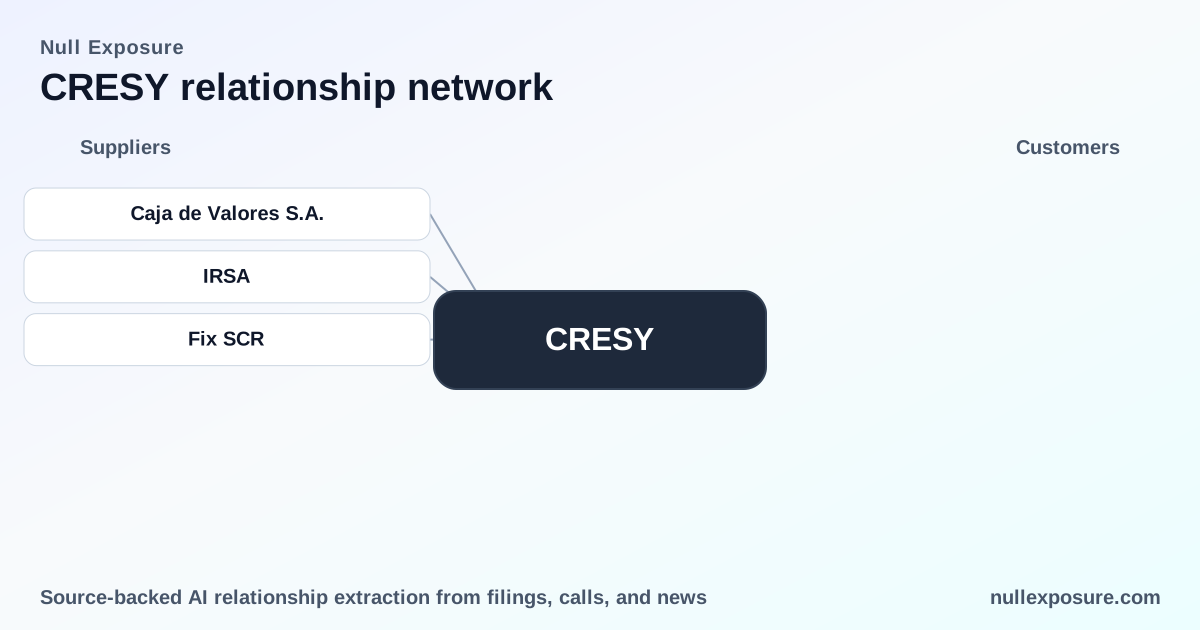
Caja de Valores S.A. — Cresud used Caja de Valores to process a peso-denominated interest installment for its Series XLVI notes covering July 18, 2025 to January 18, 2026 at a 1.50% nominal rate, with a payment equivalent to USD 215,911.53 to noteholders of record as of January 16, 2026. According to a company press release carried by The Globe and Mail (March 2026), this transaction underlines the firm’s ongoing fulfillment of scheduled interest obligations through Argentina’s central securities depository.
-
Caja de Valores S.A. — For a separate issuance, Cresud initiated the first interest payment on Series XLIX notes on March 2, 2026, with the disbursement processed in U.S. dollars via Caja de Valores to holders registered as of February 27, 2026. A subsequent press release published via The Globe and Mail (March 2026) confirms Cresud’s operational use of the same paying‑agent infrastructure for U.S. dollar‑denominated coupon flows.
-
Inversiones y Representaciones S.A. (IRSA) — Cresud receives material dividend flows from IRSA that constitute a relevant portion of its funds, making IRSA a cash‑flow critical related party. InvertirOnline’s coverage of Cresud’s negotiable obligations (June 28, 2025) highlights dividend receipts from IRSA as a significant input to Cresud’s liquidity profile.
-
Fix SCR — The local rating agency Fix SCR reaffirmed Cresud’s long‑term issuer rating at AAA(arg) with a Stable outlook, which directly supports investor confidence in the company’s access to domestic capital markets. That rating confirmation was reported by InvertirOnline in mid‑2025 (June 28, 2025), signaling continued domestic credit support metrics.
Each of these relationships is simple and operationally focused: paying agents and registries manage coupon flows, a related real estate entity supplies recurring dividends, and a local rating agency anchors market perceptions.
What these relationships mean for credit, operations and downside scenarios
-
Debt servicing is a critical operational priority. The two independent notices processed via Caja de Valores demonstrate that Cresud routes coupon payments through formal registry infrastructure, which reduces operational counterparty risk for creditors and implies predictable cash‑transfer mechanics for bondholders.
-
Cash-flow concentration is a direct risk factor. The company’s reliance on IRSA dividends for a meaningful share of funds increases exposure to related‑party distribution policy and real estate cycle volatility; changes in IRSA dividend policy would have an immediate impact on Cresud’s liquidity available for operations and debt service.
-
Local rating stability underpins market access. Fix SCR’s AAA(arg) assessment supports lower domestic funding friction and suggests local creditors view Cresud’s issuer profile as robust; however, an Argentine sovereign or sectoral shock could compress that buffer and alter funding costs rapidly.
-
Currency and settlement variation matters. Cresud executes payments in both Argentine pesos and U.S. dollars depending on issuance terms, so foreign‑exchange exposure and the mechanics of local payment agents are central to modeling recoveries and timing risk.
If you require consolidated counterparty profiles or ongoing monitoring of these critical relationships, consider a targeted supplier risk review at https://nullexposure.com/ — faster diligence reduces exposure windows.
Tactical recommendations for investors and operators
- Treat dividends from IRSA as a first‑order liquidity input: stress‑test cash flows under scenarios where dividends are reduced or delayed.
- Prioritize contract and operational confirmation with paying agents such as Caja de Valores: validate payment mechanics, settlement windows, and fallback procedures.
- Monitor local rating agency commentary and sovereign indicators since domestic ratings materially affect Cresud’s funding cost and market access.
Conclusion — concise risk/reward posture and next steps
Cresud runs a hybrid operating model where related‑party dividends and structured note issuances together determine near‑term liquidity and creditor confidence. The relationships documented — Caja de Valores as paying agent, IRSA as a significant cash contributor, and Fix SCR as a local ratings provider — form the backbone of Cresud’s supplier and funding ecosystem. Investors should treat dividend concentration and currency settlement mechanics as the principal operational risks, while viewing the local AAA(arg) rating as supportive but sensitive to macro changes.
For a deeper, consolidated view of Cresud’s counterparty exposures and to integrate these supplier signals into your investment workflow, visit https://nullexposure.com/. For bespoke monitoring or portfolio-level supplier analysis, start at https://nullexposure.com/ and set up tailored alerts.