Creative Realities (CREX): Strategic supplier moves and what counterparties tell investors
Creative Realities monetizes a three-legged digital marketing platform: hardware resale (digital signage), professional services (design, deployment, support), and recurring SaaS/subscription revenues for ad-tech platforms. The company is executing a growth-through-acquisition playbook to scale its out-of-home (OOH) footprint and improve margin mix by adding advertising inventory and recurring revenue from operator relationships. For investors and operators evaluating supplier exposure, the recent Cineplex transaction and its financing partners materially change counterparty concentration, leverage profile, and revenue optionality. Learn more at https://nullexposure.com/.
The headline acquisition: Cineplex Digital Media adds scale and ad inventory
Creative Realities agreed to acquire Cineplex Digital Media (CDM) from Cineplex Inc. for CAD 70 million, a transaction that instantaneously expands CRI’s installed base, ad inventory, and service contracts across Canada. The purchase includes a long-term commercial arrangement where Cineplex remains CDM’s exclusive advertising sales agent for CDM-operated digital-out-of-home networks across Canada, preserving a critical distribution and monetization channel for the acquired assets (The Globe and Mail, Mar 9, 2026; SaskToday, Mar 9, 2026).
Financing for the deal combines a $36 million three-year senior term loan from First Merchants Bank and $30 million of convertible preferred equity provided by affiliates of North Run Capital LP; Craig-Hallum served as placement agent for the financing (MartechCube, Mar 9, 2026). This capital mix materially increases CREX’s near-term leverage while adding investor-aligned convertible capital that can convert at $3.00 per share (MartechCube, Mar 9, 2026).
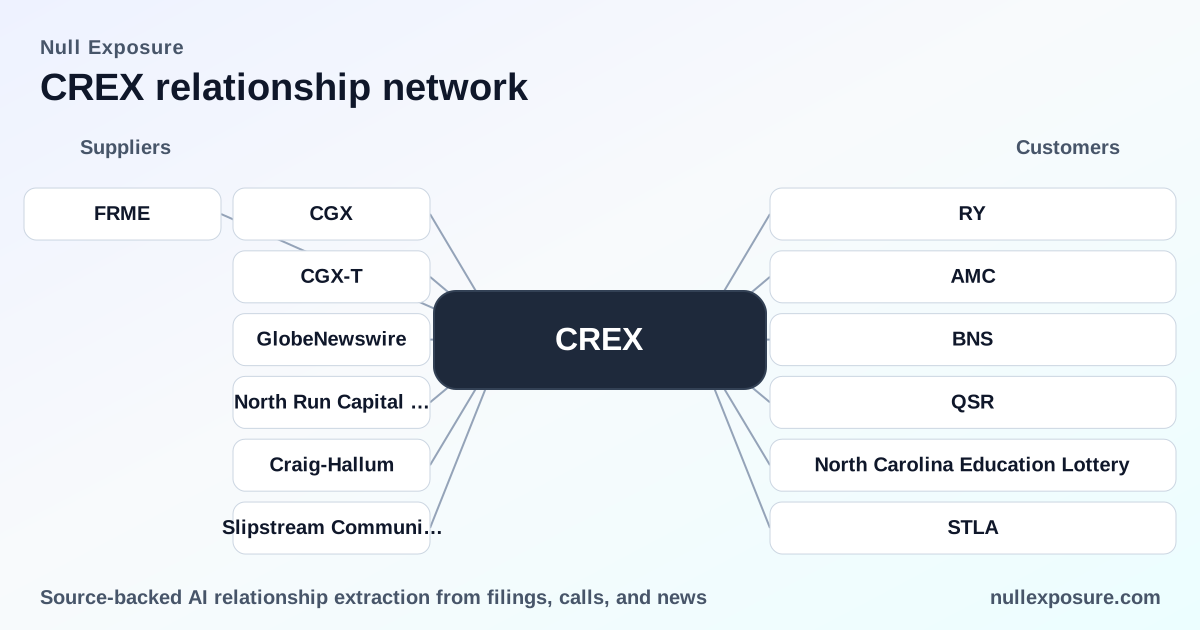
Counterparty map: every relationship in the results and what it means
Cineplex Inc.
Multiple news outlets reported that Cineplex will transfer Cineplex Digital Media to Creative Realities for CAD 70 million and will continue as CDM’s exclusive advertising sales agent for CDM-operated networks in Canada—preserving go-to-market continuity while handing operational control to CREX (The Globe and Mail, Mar 9, 2026; SaskToday, Mar 9, 2026; Barchart, Mar 9, 2026; Delta-Optimist, Mar 9, 2026; PRPeak, Mar 9, 2026). These reports confirm the transaction and the ongoing commercial tie that preserves ad-sales monetization under Cineplex’s Canadian relationships (see The Globe and Mail and allied coverage).
GlobeNewswire / press release distribution
A press release about product updates and solutions—summarized via a third-party service—was distributed through GlobeNewswire and summarized by Quiver Quant; the material referenced product launches such as Digital Drive-Thru 2.0 to expand modular menu board solutions for QSR and convenience operators (QuiverQuant/GlobeNewswire, Mar 9, 2026). This underscores Creative Realities’ continued focus on hardware-enabled vertical solutions for retail and quick-service restaurants.
North Run Capital LP
North Run provided the $30 million of convertible preferred equity backing the Cineplex acquisition, which converts at $3.00 per share; that capital is a strategic partner injection that reduces upfront cash strain but creates potential equity dilution if converted (MartechCube, Mar 9, 2026). North Run’s role is both financier and potential long-term shareholder given conversion economics.
First Merchants Bank
First Merchants Bank provided a three-year, $36 million senior term loan to finance the acquisition; this facility materially increases CREX’s senior secured obligations and sets a near-term maturity and amortization schedule that management must service against newly acquired revenues (MartechCube, Mar 9, 2026). The bank’s involvement signals traditional credit support for the transaction structure.
Craig-Hallum
Craig-Hallum acted as exclusive placement agent for the North Run financing, indicating the deal required sell-side placement expertise to align convertible preferred capital with CREX’s transaction timetable (MartechCube, Mar 9, 2026). Its role is transactional—facilitating private capital that underpins the acquisition.
Slipstream Communications, LLC
Creative Realities repurchased warrants originally issued to Slipstream in 2022 in connection with a credit facility; the warrant issuance and subsequent amendments indicate prior bespoke credit arrangements that the company has since unwound or refinanced (Globe and Mail press release, Mar 9, 2026). This activity is a sign of the company tidying legacy capital structures ahead of new financing.
Operating model constraints and what they signal about business risk
Creative Realities’ operating model is a blended manufacturer/reseller plus services and SaaS provider. Company disclosures describe three primary revenue streams: hardware resale of OEM signage (e.g., Samsung, BrightSign), design/deployment/support services, and recurring subscription licensing/support for digital signage and ad-tech software. That structure creates specific strategic constraints and attributes:
- Contracting posture: The business mixes one-off hardware sale contracts with recurring SaaS/license agreements and multi-year service contracts, producing variable cash flow profiles and different negotiation dynamics with enterprise retail customers.
- Concentration and criticality: Large platform acquisitions like CDM concentrate operational risk (Canada-heavy OOH inventory) while raising criticality: customers renting screens or ad placements depend on CREX for uptime and monetization via partner sales agents.
- Maturity and margin trajectory: The acquisition is designed to accelerate scale and margin convergence—management projects pro-forma revenue north of USD $100 million and adjusted EBITDA margins moving into the high teens, then above 20% once synergies are realized (MartechCube, Mar 9, 2026). Those targets hinge on integration execution and ad-sales performance under the retained Cineplex sales arrangement.
- Capital structure sensitivity: The mix of senior term debt and convertible preferred equity increases leverage but staggers dilution; investors should treat near-term cash flow as the primary lever for deleveraging.
These constraints are company-level signals derived from the financing and revenue model disclosures and should inform counterparty stress tests for downstream operators and investors alike.
Investment implications and risk posture
Creative Realities is executing a consolidation strategy in OOH and retail digital signage that materially expands addressable inventory and recurring revenue, but the transaction increases leverage and ties short-term outcomes to integration success and the operational efficacy of Cineplex’s retained ad-sales role. Key risks include integration execution, sales-agent alignment in Canada, and servicing higher interest and amortization burdens from the new First Merchants facility.
If you evaluate supplier relationships or market exposure tied to digital signage and retail media, prioritize operational KPIs (screens delivered and live, ad fill rates, contracted ad revenue per screen) and monitor conversion triggers on North Run’s preferred equity. For deeper coverage mapping and counterparty intelligence visit https://nullexposure.com/.
Final takeaways and next steps
- The Cineplex acquisition is transformational for CREX’s scale and ad inventory, but it materially changes the capital structure via term debt and convertible preferred equity (MartechCube; Globe and Mail, Mar 9, 2026).
- Operational continuity is preserved by Cineplex’s long-term ad-sales role in Canada, reducing GTM execution risk while leaving CREX responsible for systems and delivery (The Globe and Mail, Mar 9, 2026).
- Investors should watch debt covenants, integration timetables, and ad-sales monetization metrics as the primary drivers of near-term equity returns.
For comparative supplier analysis, counterparty risk modeling, and premium exposure reports, explore our research hub at https://nullexposure.com/.