Crescent Energy (CRGY): Advisor roster and contract anatomy every investor should know
Crescent Energy operates as a domestic onshore oil and gas E&P operator that monetizes through production, disciplined capital development of PUDs, and strategic M&A; the company also uses fixed-fee and management structures to outsource executive management and support services, while carrying material take-or-pay and pipeline commitments that lock in cash flow and downside liabilities. With a market capitalization near $3.9 billion and TTM revenue of roughly $3.58 billion, Crescent’s financial profile reflects a mid‑cap E&P with high institutional ownership and active advisory relationships that both enable deal execution and concentrate counterparty risk. For an investor evaluating supplier and advisor exposures, the company’s public advisory roster and contract excerpts disclose long-term service relationships, >$100m committed spend, and an active management outsourcing arrangement. Learn more at https://nullexposure.com/.
The deal team — who is advising Crescent on strategy and transactions
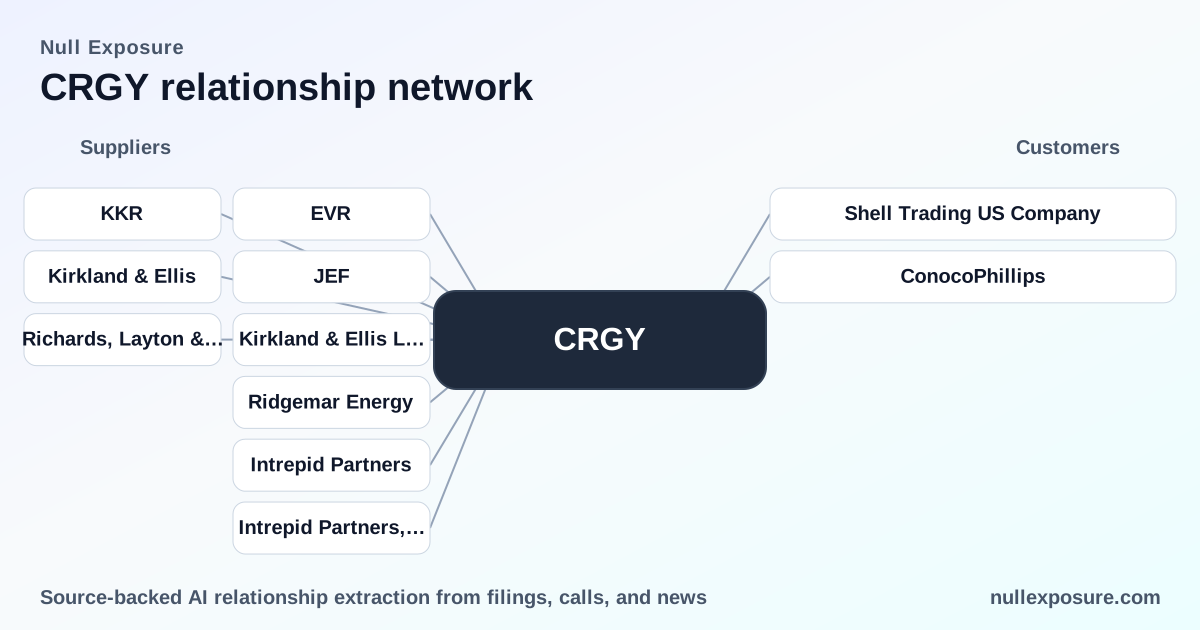
The recent public reporting around Crescent’s announced acquisition of Vital Energy illuminates a core advisory and legal network that investors should parse for alignment, fees, and control dynamics. Below are every supplier/partner referenced in the assembled reporting, with a concise investor‑grade take and source.
- Jefferies LLC (JEF) — Jefferies is named as the lead financial advisor to Crescent on the Vital Energy acquisition, positioning it as the primary investment bank executing deal strategy and valuation work. According to Euro-Petrole and Offshore-Technology coverage of the transaction (March 2026), Jefferies serves as lead financial advisor to Crescent.
- Evercore (EVR) — Evercore is engaged as an additional financial advisor to Crescent on the same transaction, offering a second boutique advisor perspective on transaction structuring and process. Euro-Petrole and Offshore-Technology list Evercore among Crescent’s financial advisors (March 2026).
- Kirkland & Ellis LLP — Kirkland & Ellis is Crescent’s legal counsel for the Vital Energy deal, handling transaction documentation and regulatory risk management. Offshore-Technology and Euro-Petrole identify Kirkland & Ellis as legal counsel to Crescent (March 2026).
- Richards, Layton & Finger, P.A. — Richards, Layton & Finger is counsel to the Special Committee overseeing the transaction, indicating an independent legal review layer for governance and fiduciary processes. Euro-Petrole reports Richards, Layton & Finger acting for the Special Committee (March 2026).
- Intrepid Partners / Intrepid Partners, LLC — Intrepid Partners is serving as financial advisor to the Special Committee, providing an independent valuation and process oversight role for Crescent’s board review. Both Euro-Petrole and Offshore-Technology cite Intrepid Partners advising the Special Committee (March 2026).
- Ridgemar Energy — Ridgemar is a counterparty from which Crescent previously acquired Eagle Ford assets for $905 million (closed January 2025), indicating a recent history of asset purchases and integration activity. Offshore-Technology references Crescent’s prior Ridgemar asset purchase (reporting March 2026).
- KKR Energy Assets Manager LLC (KKR) — KKR is identified in a company filing as the Manager under a management agreement and is entitled to management compensation under that agreement, signaling outsourced senior management and fee arrangements. This is documented in an 8‑K reproduced on StockTitan (SEC filing reflected in FY2026 reporting).
Each relationship above is documented in public reports or filings tied to the Vital Energy acquisition or to formal company disclosures (March 2026 reporting and the referenced SEC material).
What the contractual constraints tell you about operational risk and capital posture
Crescent’s public disclosures and contract excerpts paint a clear operating model: long-term contractual commitments, framework master agreements for services, active third‑party service dependence, and multi‑hundred‑million dollar development spend.
- Long-term take-or-pay and pipeline commitments are structural. The company discloses oil and gas transportation and gathering agreements with minimum daily shipping obligations and associated deficiency charges; a take‑or‑pay CO2 purchase agreement included minimum daily volumes through May 2026. These are long‑dated obligations that create downside cash flow exposure when volumes fall.
- Management functions are outsourced under an evergreen management agreement. The Management Agreement had an initial three‑year term (starting 2021), was renewed in December 2024 for three years to 2027 and includes automatic renewals thereafter, creating a recurring fee and governance dependency centered on the designated Manager. The Manager is contractually compensated, per the company 8‑K noting payments to KKR Energy Assets Manager LLC.
- Service delivery is organized under framework/master agreements. Audit and operations support are governed by letter agreements and master services agreements, which standardize scope but leave the company exposed to market price swings in oilfield services. The firm admits oilfield service costs fluctuate materially with market conditions, implying input cost sensitivity.
- Active relationships with measurable spend obligations. Crescent reported total minimum future commitments (related to transportation and gathering) of $905,904 as of December 31, 2024, and assumes $2.8 billion to develop estimated PUDs — both signals that future investment and contracted spend are material and concentrated. These figures place multiple vendor relationships into the 100m+ spend band and drive supplier criticality.
Collectively, these constraints indicate a company that outsources management, locks in transport and CO2 volumes via long-term contracts, and runs concentrated development spend, which translates into predictable operational capacity but also fixed-cost rigidity in downside scenarios.
Why the advisor and supplier map matters for investors
- Governance and control: Outsourced management increases reliance on the Manager’s incentives and alignment; KKR’s compensation under a management agreement is a governance lever that investors must monitor through vectoring of performance targets and termination provisions (SEC 8‑K, FY2026).
- Deal execution capacity: Having both Jefferies and Evercore on the deal team plus top-tier legal counsel (Kirkland) demonstrates capacity to execute complex M&A, but it also concentrates advisory fees and potential conflicts when insiders or special committees evaluate outcomes (Euro-Petrole; Offshore-Technology, March 2026).
- Counterparty concentration: Large minimum commitments to pipelines, CO2 suppliers, and the $905k+ minimum future commitments indicate concentrated supplier risk that is operationally critical — when market volumes or commodity prices shift, these fixed obligations create cash‑flow pressure.
For a buyer or partner evaluating exposure to Crescent, the combination of long-term commercial contracts, active outsourced management, and repeated M&A behavior defines both the opportunity (scale, predictable capacity) and the risk (fixed-cost inflexibility, counterparty concentration).
Learn more about assessing supplier and advisor concentration at https://nullexposure.com/.
Practical takeaways for investors and operators
- Treat the management agreement and KKR compensation as first‑order governance items. The management arrangement is active and renewable and therefore central to executive control and recurring fees (8‑K/StockTitan, FY2026).
- Stress-test cash flow for minimum transport and CO2 obligations. Take‑or‑pay and pipeline deficiency charges create downside stretch in lower production scenarios.
- Factor advisory and legal fees into M&A IRR assumptions. Multiple high‑quality advisors confirm deal capability but increase transaction friction and cost.
If you require a deeper counterparty map or want a tailored supplier‑risk brief for Crescent Energy, request a research package at https://nullexposure.com/—we provide structured exposure analysis for investors and operators.
Crescent’s public filings and the reported advisor roster show a company building scale through deals while leaning on long‑term contracted services and outsourced management; that combination supports disciplined growth when commodity and volume assumptions hold, and it constrains flexibility when markets retrench. For investors, the key is monitoring the Manager relationship, the magnitude of committed transport/CO2 obligations, and how advisory costs affect transaction economics.