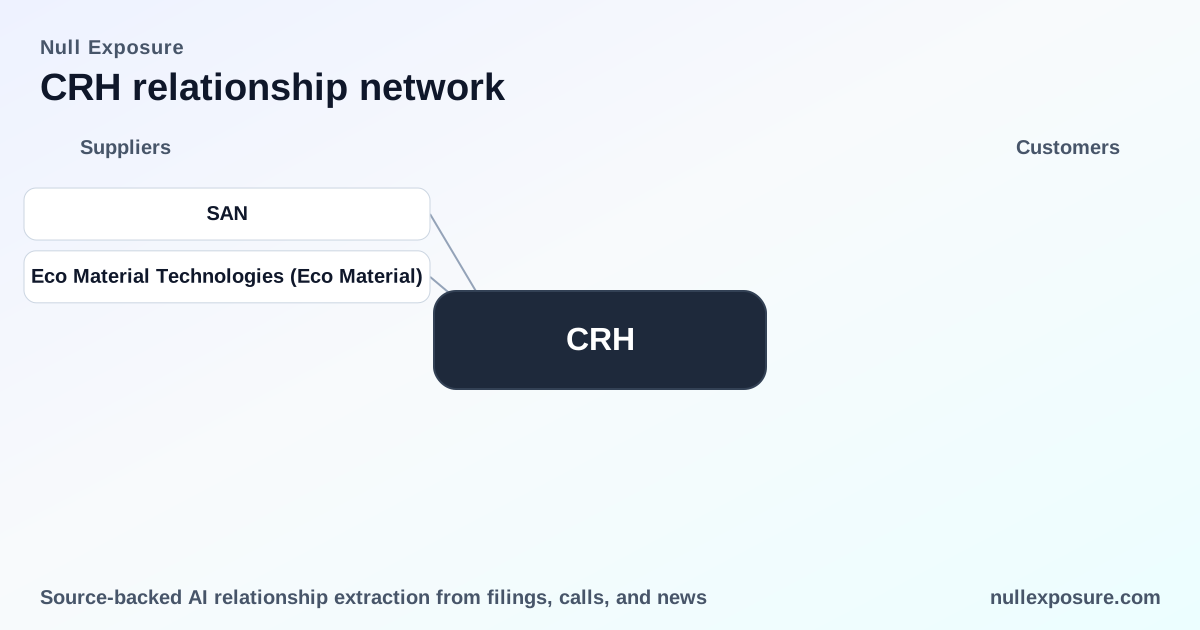
CRH plc (CRH) — supplier relationships, recent transactions, and what investors should price in
CRH plc manufactures and distributes construction materials globally and monetizes through product sales, strategic acquisitions, and capital returns. Revenue is generated across building-materials product lines and geographies, while growth and margin expansion come from targeted bolt‑ons and operational leverage in materials segments. Investors should focus on CRH’s capital allocation choices and supplier/partner network because those determine input cost stability and the company’s ability to scale specialty materials. For more structured supplier intelligence, visit https://nullexposure.com/.
How CRH makes money and why suppliers matter
CRH converts raw and processed inputs into aggregates, cement, asphalt and related products that are sold to construction firms, contractors, and distribution channels worldwide. According to the latest company figures (latest quarter 2025-12-31), CRH reported trailing twelve‑month revenue of $37.45 billion and EBITDA of $7.5 billion, reflecting a business that is large, capital‑intensive, and sensitive to raw‑material and logistic inputs. The company expands via M&A—particularly into higher‑value or specialty materials—and returns excess cash through share repurchases and dividends, which directly ties capital allocation to transaction counterparties and execution partners.
Suppliers and service providers therefore influence both cost structure and strategic execution: the consolidated purchasing posture and the mix of vertical integration versus external sourcing are central to margin stability and M&A synergies. If you want a concise supplier risk view tailored to institutional diligence, check https://nullexposure.com/.
Recent named relationships and what they mean for investors
Santander US Capital Markets — executing CRH’s NYSE share repurchases (Globe and Mail, March 2026)
CRH executed a tranche of NYSE share repurchases through Santander US Capital Markets, repurchasing 29,100 ordinary shares at a VWAP of $126.8005 as part of a previously disclosed $300 million buyback program, with the shares to be cancelled. According to a Globe and Mail press release dated March 9, 2026, Santander acted as the execution agent for these transactions: https://www.theglobeandmail.com/investing/markets/stocks/CRH-N/pressreleases/150544/crh-extends-300-million-buyback-with-latest-nyse-share-repurchase/.
Santander US Capital Markets — confirmation of buyback plan execution and cancellation policy (Tikr blog, March 2026)
A follow‑up report summarized the same buyback activity and reiterated that these transactions were executed under CRH’s plan to repurchase up to $300 million of ordinary shares by February 17, 2026, with all acquired shares to be cancelled, highlighting continued active capital return execution through Santander: Tikr (March 2026) — https://www.tikr.com/blog/crh-is-up-9-in-the-last-6-months-heres-where-shares-could-go-in-2026.
Eco Material Technologies — strategic acquisition to expand supplementary cementitious materials (Futunn, March 2026)
CRH’s Americas Materials Solutions segment completed the acquisition of Eco Material Technologies for $2.1 billion in 2025, adding a leading supplementary cementitious materials (SCM) capability in North America and strengthening CRH’s exposure to higher‑value cement additives. The transaction was cited in a Q4 revenue note and described as the largest acquisition in 2025 (Futunn news, March 2026): https://news.futunn.com/en/post/69016839/crh-plc-s-q4-revenue-reached-9-4-billion-usd.
What the relationships imply for supply and capital posture
The three items together reveal two distinct dimensions of CRH’s external relationships:
- Capital markets execution and buybacks are outsourced to institutional brokers. The Santander transactions show CRH uses external capital markets intermediaries to execute share repurchases, which is standard for large multinationals that prefer execution expertise and liquidity management off‑balance‑sheet.
- Strategic capability is being built via M&A rather than pure organic sourcing. The Eco Material acquisition signals that CRH is willing to invest meaningful capital into specialty inputs that can differentiate its product mix and improve margin resilience in cement‑related businesses.
These points reflect broader operating characteristics. The company’s procurement posture combines vertical integration and external sourcing, supported by a dedicated global purchasing team and a mix of internal and third‑party service providers, which creates a structured but flexible supply model (company supply‑chain disclosure; company filing evidence).
Constraints and company‑level supply signals
Company‑level evidence shows CRH runs a hybrid sourcing model: dedicated centralized purchasing, vertical integration where it makes sense, and reliance on external service providers as needed. This produces several investor‑relevant constraints and signals:
- Contracting posture: Centralized procurement with strategic use of external service providers implies formal supplier management, standardized contracting, and scale leverage on cost. This reduces idiosyncratic vendor risk but increases exposure to a smaller set of strategic suppliers for specialized inputs.
- Concentration and criticality: Acquisition of specialty suppliers (Eco Material) reduces external dependency for SCM inputs and internalizes critical capabilities, lowering supply concentration risk for that product line while concentrating integration risk.
- Maturity and execution: Using established capital markets partners for buybacks shows mature capital allocation processes and an active balance‑sheet management posture; it also signals CRH’s preference for execution via reputable intermediaries rather than in‑house trading.
- Operational implications: The mix of integration and third‑party sourcing creates predictable scale benefits but requires disciplined supplier governance to protect margins in cyclical construction markets.
(Excerpt support: company supply‑chain statement referencing a dedicated global purchasing team and a blend of vertical integration and external suppliers/service providers.)
If you need a targeted supplier exposure report with counterparty scoring and contract‑level signals, explore our platform at https://nullexposure.com/.
Investment implications and how to think about risk
CRH’s strategy balances scale and vertical capability with active capital returns. The $2.1 billion Eco Material acquisition strengthens upstream control over a material that directly affects cement performance and margin, while the $300 million buyback program executed through Santander signals confidence in free‑cash‑flow conversion and a shareholder‑friendly bias.
Key investor takeaways:
- Positive: Acquisition of specialty input suppliers reduces procurement volatility and supports premium pricing for higher‑performance materials.
- Watchlist risks: Integration execution for large bolt‑ons and persistent commodity price cycles remain primary operational risks; supplier contracting discipline must be maintained to realize synergies.
- Capital allocation lens: Continued repurchases executed via external brokers are a predictable use of cash but should be weighed against further strategic M&A opportunities.
For institutional-grade supplier diligence and to map CRH’s counterparty network in depth, start a review at https://nullexposure.com/.
— End of analysis.