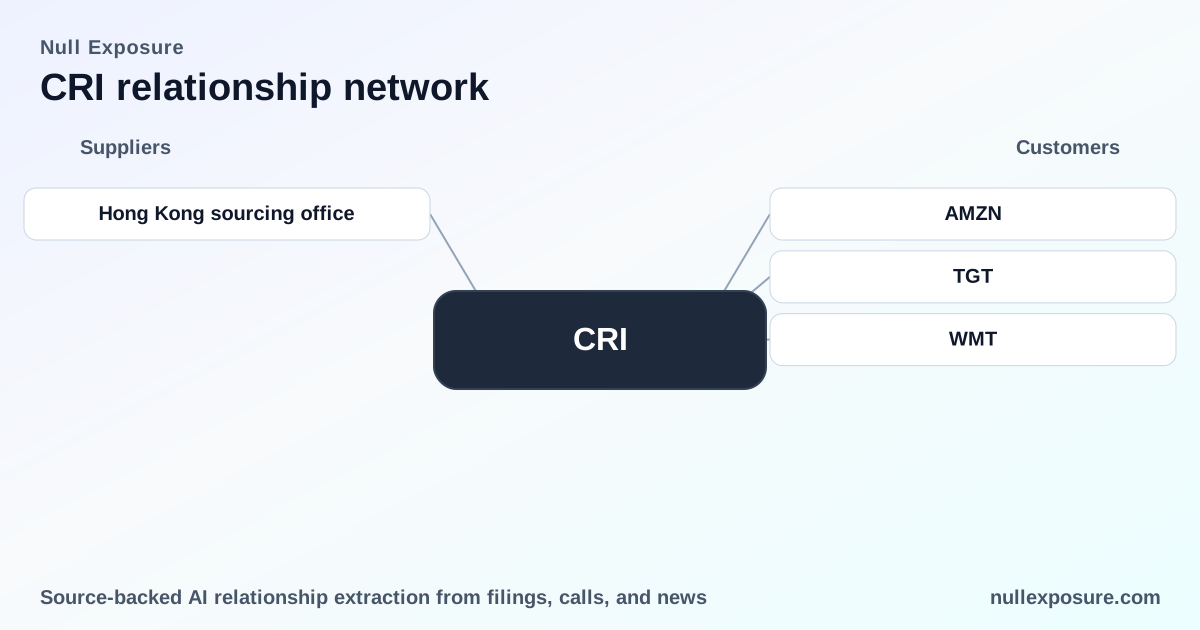
Carter’s (CRI) supplier profile: concentrated Asian sourcing, short-term contracts, and material inventory commitments
Carter’s designs and markets branded children’s apparel and accessories and monetizes through wholesale, retail and e‑commerce sales of owned and licensed brands; the company sources most of its finished goods from third‑party manufacturers and captures margins through brand pricing, scale distribution and private‑label manufacturing direction. For investors and operators evaluating supplier relationships, the key dynamics are high vendor concentration, substantial near‑term purchase commitments, and sourcing coordination centralized through a Hong Kong office. Learn how these supplier dynamics translate into operational and financing exposures at https://nullexposure.com/.
Quick read for investors: the operating facts that matter
Carter’s is not a vertically integrated manufacturer — it is a branded merchant that directs manufacturing but relies on third‑party producers. The supply posture produces several actionable signals for investors and commercial underwriters:
- Primary sourcing in Asia. The company coordinates the vendor network through a Hong Kong sourcing office and sources substantially all products from vendors primarily in Asia (FY2024 filing).
- Short‑term contracting posture. Purchase commitments are cancellable and span one year or less; Carter’s states it has not entered long‑term manufacturing contracts.
- High concentration with material vendors. In FY2024 roughly 62% of purchases came from ten vendors, with three vendors representing about half of purchases from the top ten — a concentrated supplier base that is critical to continuity.
- Large working‑capital commitments. Estimated purchase commitments stood between $450 million and $550 million as of December 28, 2024, indicating meaningful inventory funding needs relative to $2.898B in trailing revenue.
What the public record lists as a supplier relationship
Hong Kong sourcing office
Carter’s FY2024 10‑K states: “We source substantially all of our products through a network of vendors primarily in Asia, principally coordinated by our Hong Kong sourcing office.” This confirms that the company centralizes sourcing coordination in Hong Kong and routes vendor management, quality oversight and commercial negotiations through that office (Carter’s 2024 Form 10‑K).
How the constraints translate into a sourcing and financing profile
The company‑level constraints drawn from public filings form a coherent operating model for procurement and supplier risk:
- Contracting posture — short‑term, cancellable commitments. Carter’s describes purchase commitments that are cancellable within a year and explicitly notes it has not entered long‑term manufacturing agreements. That short‑term posture creates commercial flexibility to shift volumes and renegotiate pricing, but it also means inventory and cashflow volatility when seasonal orders must be recontracted each cycle.
- Geographic concentration — APAC primary, global reach. The firm sources primarily in Asia but maintains global manufacturing relationships for certain channels. That makes Asia‑specific risks (tariffs, port disruptions, labor constraints, regional policy changes) the primary operational concern, while still exposing Carter’s to broader manufacturing dispersion where used.
- Materiality and concentration — critical suppliers. With 62% of purchases from ten vendors and three vendors accounting for roughly one‑half of those top‑ten purchases, supplier loss or disruption at a single partner would have outsized operational and margin consequences.
- Role of suppliers — manufacturers operating at Carter’s direction. Public language indicates manufacturers buy raw inputs at Carter’s direction and produce to company specifications, so Carter’s exerts product and materials direction but remains operationally dependent on third‑party factories for capacity and compliance.
- Spend scale — meaningfully large commitments. The stated $450–$550M in purchase commitments signals material working‑capital and contingent payment exposure that affects inventory financing, letters of credit, and premium calculations for marine/transit and trade credit insurance.
Why these supplier signals matter to premium finance and risk managers
For investors focused on supplier risk and for insurers evaluating coverage layers, the mix of high concentration, short contract terms, and Asia‑centric sourcing translates into concrete risk levers:
- Financing demand and timing: Large cancellable commitments tied to seasonal production create predictable peaks in short‑term financing needs (inventory financing, letters of credit, and trade receivable securitization).
- Underwriting concentration: Insurers and reinsurers must price for event concentration (factory fire, port blockade, geopolitical escalation) because a small number of vendors account for a large share of procurement.
- Operational mitigation options: Carter’s central sourcing office provides a single locus for supplier consolidation, quality control and alternative sourcing strategy — a positive for coordinated response — but alternative capacity outside the top vendors will require lead time.
- Regulatory and compliance exposure: Manufacturers buy raw materials at Carter’s direction, increasing the company's exposure to supplier compliance risk (labor, environmental, traceability), which in turn affects reputational and litigation risks.
For a practical next step on supplier concentration analytics and tailored risk scoring, see how NullExposure maps supplier footprints and exposure: https://nullexposure.com/.
Investment and operational takeaways
- Concentration is the single largest supplier risk: 62% from ten vendors, and three vendors representing half of that pool, creates a low‑diversification profile that elevates event‑driven downside.
- Short‑term contracts increase flexibility but amplify volatility: Cancellable, sub‑one‑year commitments reduce long‑term lock‑in, enabling pricing leverage, but they require active sourcing oversight and working‑capital elasticity.
- Asia exposure defines the risk vector: Sourcing coordinated in Hong Kong concentrates operational risk in APAC trade lanes and factory clusters.
- Large near‑term purchase commitments drive financing needs: $450–$550M in commitments translates to meaningful inventory financing and contingent liabilities for insurers.
If you are underwriting Carter’s supply risk or structuring inventory financing, prioritize scenario modeling for a top‑vendor outage and review the company’s contingency sourcing plans and lead times. For a deeper, supplier‑level risk map and tailored exposure scoring, explore NullExposure’s analysis tools at https://nullexposure.com/.
Carter’s supplier disclosures provide a clear, actionable picture: a brand that directs manufacturing at scale, concentrates production in a few partners in Asia, and manages sizable short‑term purchase commitments — a profile that delivers margin efficiency but demands active supply‑chain and financing discipline.