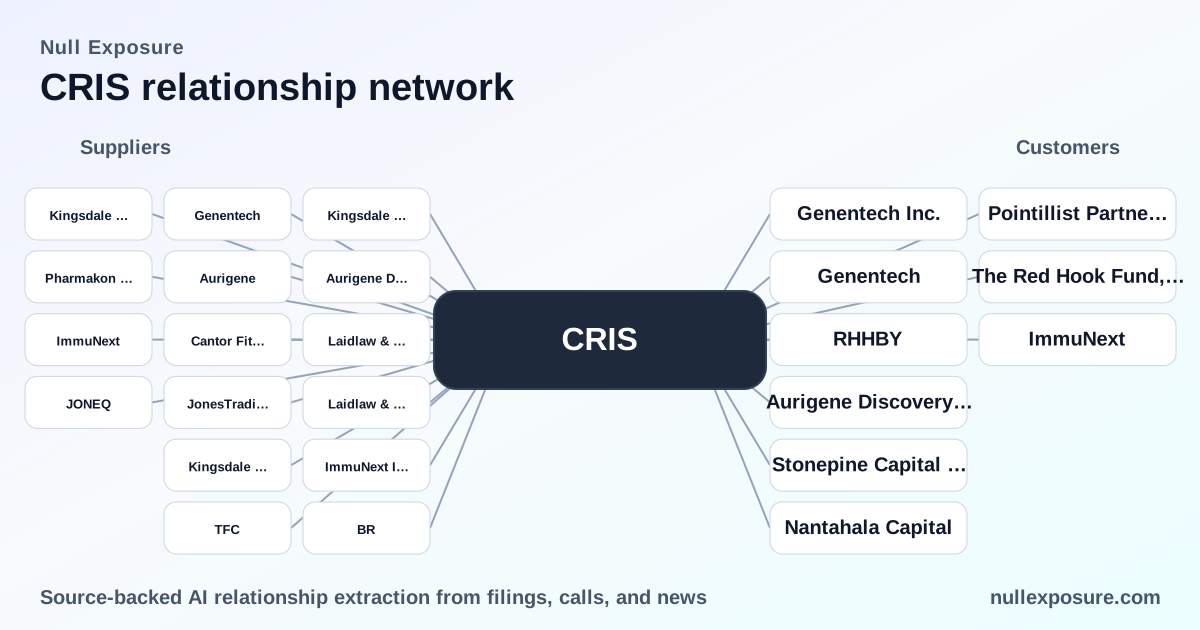
Curis (CRIS): supplier and advisor relationships that drive financing, development and commercialization
Curis is a research-stage oncology company that monetizes by licensing discovery-stage assets, advancing drug candidates through partnered clinical programs, and raising capital through equity and private placements while outsourcing manufacturing, development and commercialization functions. For investors evaluating supplier risk and counterparty exposure, the company’s supplier map is heavy on CMO/CRO partnerships, placement agents for recurring financings, and proxy/meeting services—all signals of a capital-intensive small-cap biotech that outsources operational execution. Learn more or benchmark your counterparty diligence at https://nullexposure.com/.
How to read Curis’ counterparty footprint
Curis operates with no internal manufacturing capacity, relying on third parties for clinical supply, drug product and regulatory starting materials, while using placement agents and proxy firms to manage capital raises and shareholder governance. That model produces distinct risk characteristics: concentration of critical manufacturing off‑balance-sheet, operational dependency on service providers, and recurring capital markets activity that drives relationships with boutique placement agents and proxy specialists. For upstream risk, note geographic dispersion of suppliers; for financing risk, note repeated use of placement agents and at‑the‑market programs.
If you want a consolidated supplier intelligence briefing, visit https://nullexposure.com/ to request a tailored counterparty report.
Line-by-line supplier and advisor map (each source in the public record)
Below I cover every relationship flagged in the available results. Each entry is a concise, plain-English takeaway with a direct source reference.
Kingsdale Shareholder Services US LLC (Kingsdale Advisors) — FY2026
Curis engaged Kingsdale to provide strategic proxy solicitation and advisory services in connection with a Special Meeting, demonstrating reliance on third-party governance communications support. Source: preliminary and definitive proxy statements filed in 2026 (StockTitan).
Aurigene Discovery Technologies Limited — FY2025 / FY2026 / FY2021
Curis holds the exclusive license for emavusertib (CA‑4948) from a 2015 collaboration with Aurigene and cites the collaboration repeatedly in press releases and clinical updates. Source: PR Newswire and BioSpace press releases (2021–2026) and Yahoo Finance commentary.
Laidlaw & Company (U.K.) Ltd. / Laidlaw & Company (UK) Ltd. — FY2024 / FY2026
Laidlaw acted as placement agent—at times as sole placement agent—for multiple financings including PIPE and registered direct offerings; Curis pays customary placement fees and expense reimbursements. Source: PR Newswire, BioSpace and StockTitan filings (2024–2026).
ImmuNext Inc. / ImmuNext — FY2020 / FY2021
Curis entered an option and license agreement with ImmuNext to acquire exclusive worldwide rights to anti‑VISTA antibodies, including CI‑8993, incorporating this program into its oncology pipeline. Source: PR Newswire release announcing the option and license (2020) and subsequent clinical program updates (2021).
Broadridge Financial Solutions, Inc. (BR) — FY2026
Broadridge is contracted to count, tabulate and certify shareholder votes for the Special Meeting, reflecting standard outsourced corporate meeting services. Source: preliminary proxy statement (StockTitan, FY2026).
Genentech — FY2012
Curis licensed GDC‑0917 from Genentech, securing exclusive worldwide development and commercialization rights to an IAP inhibitor as part of historical licensing activity. Source: RTTNews coverage of the 2012 licensing transaction.
Pharmakon Advisors — FY2012
Curis entered a $30 million financing secured by future Erivedge royalties, provided by a fund managed by Pharmakon Advisors, showing historical use of royalty‑backed financing. Source: RTTNews report discussing the 2012 debt transaction.
Cantor Fitzgerald Co. — FY2026
Cantor serves as a sales agent under Curis’ 2024 ATM agreement, positioning Curis to access incremental capital through at‑the‑market sales of common stock (up to $100 million capacity). Source: definitive proxy disclosures referencing the 2024 ATM Agreement (StockTitan, FY2026).
JonesTrading Institutional Services LLC / Jones (JONEQ) — FY2026 / FY2025
JonesTrading participates as a sales agent in the 2024 ATM program and served as a placement agent alongside Laidlaw in certain financings, indicating recurring capital markets intermediation. Source: 2024 ATM agreement language and placement-agent statements in PR Newswire (FY2024–FY2025).
Truist Securities (TFC) — FY2024
Truist acted as a placement agent for a registered direct and concurrent private placement, underscoring Curis’ periodic reliance on established investment banks to raise equity. Source: PR Newswire release for the FY2024 registered direct offering.
Laidlaw & Company entries (multiple FY2026 entries)
Repeated filings and press coverage confirm Laidlaw’s role as sole placement agent for a PIPE financing and as placement agent on other registered direct transactions—this is a primary channel for Curis’ near‑term capital raises. Source: PR Newswire, BioSpace and FINVIZ coverage (FY2026).
Aurigene (alternate mentions across FY2021–FY2026)
Multiple press releases and clinical updates reiterate the Aurigene collaboration and the emavusertib license as a core asset relationship supporting Curis’ clinical development programs. Source: PR Newswire, BioSpace and Yahoo Finance (2021–2026).
Operational constraints that shape supplier risk
Curis’ public disclosures and relationship map surface several company-level constraints that define its supplier posture:
- Outsourced manufacturing posture and criticality: Curis explicitly relies on CMOs for production and lacks internal manufacturing capabilities; this makes third‑party manufacturers critical single‑point suppliers for clinical and commercial supply continuity.
- Geographic supply dispersion: Recorded evidence points to North American operations (headquarters in Lexington, MA, and a Canadian CMO producing drug product) and at least one subcontractor in China supplying regulatory starting materials, creating multi‑jurisdictional sourcing complexity and potential regulatory or logistics concentration risks.
- Service provider dependence and maturity: Frequent use of CROs, CMOs, proxy solicitation firms and placement agents reflects an operating model that is outsourced by design, with limited internal commercialization capacity and repeated reliance on capital markets partners.
- Capital-market orientation: Recurring registered directs, PIPEs and an ATM program indicate a financing-dependent structure where placement agents are central to execution of funding strategies.
These constraints are company-level signals drawn from Curis’ disclosures and press reports; they frame the likely vendor governance, audit and contingency priorities investors should demand in due diligence.
Investment implications and final takeaways
- Operational risk is concentrated: reliance on third‑party CMOs/CROs and offshore subcontractors makes manufacturing continuity and regulatory traceability primary operational risks.
- Financing relationships are mission-critical: Laidlaw, Cantor, JonesTrading and Truist are not peripheral—these firms enable Curis’ recurring capital raises, which are essential for funding trials and operations.
- Governance and shareholder services are outsourced: Kingsdale and Broadridge manage proxy solicitation and vote tabulation functions, indicating externalized governance support during contested or special meetings.
For a deeper, investor-ready analysis of Curis counterparty exposure and to request a supplier diligence package, visit https://nullexposure.com/. If you want a focused review of Curis’ manufacturing chain or capital markets counterparties, request a tailored briefing at https://nullexposure.com/ and get a prioritized checklist for operational and financing risk.