Comstock Resources (CRK): Supplier relationships and what they mean for investors
Comstock Resources operates as an independent oil & gas E&P focused on the Haynesville/Bossier plays and nearby basins, monetizing through upstream production sales and contractual access to midstream transportation and gathering services that convert produced volumes into marketable commodity revenue. The company's economics depend on capturing differential value through reliable takeaway capacity and long-term midstream arrangements that lock in delivery options and fixed commitments. For investors and supplier counterparts, the central read is that Comstock is a production-first operator that underwrites midstream capacity to preserve realized prices and optionality. Learn more at https://nullexposure.com/.
One sentence on how CRK makes money — and why suppliers matter
Comstock drills, produces and sells natural gas and oil primarily in North America and secures long-haul and gathering capacity via multi-year contracts so its produced volumes reach optimal markets; those midstream contracts are a direct driver of realization and working-capital commitments. According to the company's disclosures, its operations are concentrated in the Haynesville and Bossier shales and rely on contracted transportation to capture market access.
The NextEra tie: a strategic supply relationship with implications
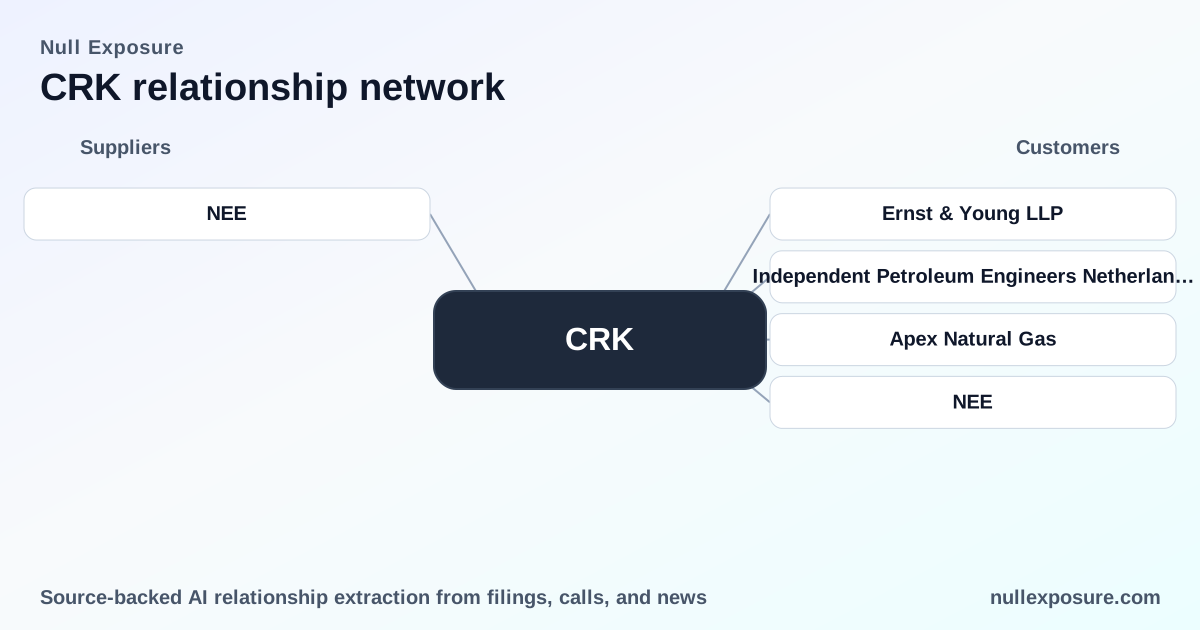
Comstock disclosed a partnership with NextEra on a data center project in the Western Haynesville during its 2025 Q4 earnings call. This cooperation signals an industrial demand pathway for gas-produced value beyond traditional pipeline markets and positions CRK as a supplier for localized power or fuel use, potentially increasing offtake certainty in that sub-basin (earnings call, 2025 Q4, March 2026).
All of CRK’s reported supplier/partner relationships
- NextEra: Comstock announced a partnership on a data center project in the Western Haynesville in its 2025 Q4 earnings call. This places Comstock in a direct commercial relationship with a large energy developer where gas produced in CRK-controlled acreage could support an on-site or near-site power/demand customer (earnings call, 2025 Q4, March 2026).
What the contractual evidence says about how the company runs supplier relationships
Company-level disclosures describe a long-term contracting posture for transportation and gathering. Comstock reports transportation and gathering contracts extending to 2031 and firm long-haul capacity averaging approximately 1.7 Bcf per day in 2025, which underwrites the company’s ability to deliver volumes to market. The firm also reports multi-year committed transport costs totaling $84.4 million in 2025 and continuing commitments into 2026–2027, indicating mid-single-digit-to-low-double-digit millions in annual committed spend that suppliers and counterparties can expect (company disclosures covering 2025 commitments).
- Contracting maturity and criticality: Contracts run to 2031, which locks in midstream access but also creates fixed commitments against production profiles for the next half-decade.
- Role and stage: Comstock treats midstream firms as service providers — gathering, treating and long-haul transport are core vendor relationships that operate on an active, ongoing basis.
- Geographic concentration: Operations are focused in North America, specifically the Haynesville/Bossier shales; that regional concentration amplifies the importance of basin-level infrastructure deals rather than diversified cross-basin suppliers.
- Spend band signal: The company's disclosed committed transport obligations align with a $10M–$100M annual spend band, making these supplier relationships material to both operating budgets and cash-flow planning.
These constraints are company-level operational signals derived from the firm’s own disclosures and they define the tone of supplier negotiations: longer-term, materially sized commitments in a single geography.
Why the NextEra partnership matters to operators and investors
The partnership with NextEra crystallizes a commercial pathway beyond commodity spot sales. For operators, a utility/enterprise-sized counterparty reduces offtake and basis risk by creating localized demand or contracted offtake that can be structurally advantaged versus open-market sales. For investors, the tie to a strong energy developer translates into potential upside to realized pricing or reduced takeaway congestion if gas can be routed into dedicated, high-utilization loads (earnings call, 2025 Q4).
Financial context that governs supplier leverage
Comstock has scale: a market capitalization in the low single-digit billions and trailing EBITDA north of $1.3B, which gives the company negotiating heft with midstream providers. Conversely, concentrated geography and long-term fixed transport commitments create supplier-side predictability and lock-in risk—if volumes fall, Comstock would still service contracted obligations. These dynamics are central to evaluating counterparty credit and the economics of any supplier extending multi-year equipment or capacity financing.
For more granular supplier and relationship analysis, visit https://nullexposure.com/.
Practical takeaways for operators contemplating CRK as a counterparty
- Expect multi-year contracting terms and material annual commitments; structure pricing and escalation clauses accordingly.
- Evaluate credit protections or partial-volume guarantees: Comstock’s firm transport commitments make it a predictable buyer of capacity, but operators should account for production volatility in contract design.
- Treat the NextEra link as a signal that CRK pursues industrial offtake pathways; suppliers whose products or services enable localized power, compression, or treatment infrastructure gain strategic advantage.
Quick relationship summary (one place to scan)
- NextEra — Partnership on a Western Haynesville data center project disclosed on CRK’s 2025 Q4 earnings call; positions CRK as a potential supplier into a large-scale, localized gas demand project (earnings call, 2025 Q4, March 2026).
What investors should do next
- Monitor Comstock’s quarterly disclosures for updates on the NextEra project and for capacity utilization reports tied to firm transport commitments. Supplier commitments through 2031 and disclosed annual obligations are material to cash flow and downside scenarios.
- Evaluate counterparty exposure in portfolios: Comstock’s geographic concentration in Haynesville increases both upside from basin strength and downside from regional takeaway constraints.
- To access ongoing monitoring and deeper supplier relationship intelligence, visit https://nullexposure.com/.
Comstock’s operating model blends high-volume Haynesville production with explicit midstream commitments and selective industrial partnerships; for investors and suppliers, the relevant frame is contractual durability plus basin concentration — a combination that defines both opportunity and structural risk.