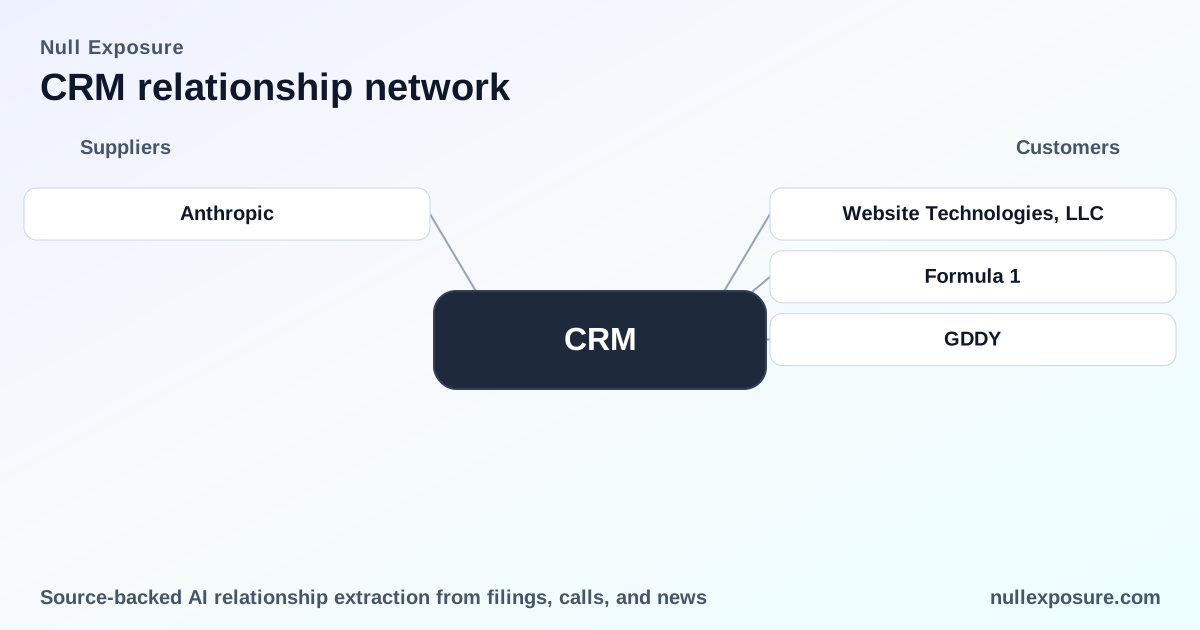
Salesforce (CRM) as a Supplier: Strategic footprint, supplier posture, and a mapped partner to watch
Salesforce is a global SaaS platform that monetizes primarily through recurring subscription revenue for CRM, marketing, service and platform tools, supplemented by professional services and strategic acquisitions. As a supplier to enterprise buyers, Salesforce’s value proposition is continuity of customer data, extensibility through partner ecosystems, and global delivery, which creates concentrated operational dependency for critical customer workflows. For investors evaluating CRM supplier relationships, the core questions are reliability, geographic redundancy, vendor governance, and the supplier’s third‑party ecosystem risk profile. Learn more about how we map these supplier relationships and constraints at https://nullexposure.com/.
How Salesforce operates as a vendor and where the money comes from
Salesforce sells cloud software on a subscription basis; enterprise contracts and platform consumables generate the bulk of revenue. Recurring ARR and platform adoption drive predictability, while acquisitions and AI investments expand addressable market and upsell pathways. The company runs data centers and leases office space globally to support customers across North America, EMEA and APAC, which underpins its delivery model and global contract coverage. Fiscal metrics — including substantial revenue (roughly $41.5B trailing twelve months) and healthy profit margins — support a supplier posture that combines scale with the leverage to dictate contractual terms.
The supplier map: partners, AI vendors and one relationship in the news
Salesforce’s ecosystem includes cloud infrastructure partners, AI vendors, consulting firms, and data center co‑locations. This network is a strategic asset: it increases switching costs for customers and concentrates operational criticality on a limited set of core services. Investors should treat Salesforce as a high‑criticality supplier for enterprise customer data and customer-facing operations.
A Finviz news item on March 9, 2026 reported that Anthropic touts work with Spotify and Salesforce, signaling public-facing AI partnerships that touch major platform vendors and content/service providers (Finviz, March 2026). This mention indicates Salesforce’s visibility inside cutting‑edge AI vendor alliances.
Read more about supplier coverage and signals at https://nullexposure.com/.
Relationship: Anthropic — a short, actionable read
Anthropic: A media report (Finviz, March 9, 2026) referenced Anthropic promoting collaborations with major customers including Spotify and Salesforce, indicating a commercial or marketing relationship between Anthropic and Salesforce. The reference is limited to press mention; investors should treat this as a signal of engagement rather than a disclosed long‑term contract (Finviz news, 2026‑03‑09).
How disclosed constraints shape the supplier risk profile
Salesforce’s public filings and disclosures provide operational constraints that define its supplier posture and the risk surface for customers:
- Global footprint and regional redundancy: Salesforce operates data centers in the U.S., Europe and Asia through co‑location leases and leases office space across North America, Europe, Asia, South America, Africa and Australia. This global footprint signals capacity to serve multinational customers and reduces single‑region outage exposure, but also increases regulatory complexity and operational overhead.
- Third‑party service provider governance: Salesforce maintains a risk‑based approach to identifying and overseeing cybersecurity threats from vendors and service providers. This denotes mature third‑party risk management and an enterprise governance posture that investors should value when assessing supplier stability and controls.
- Multi‑region operational exposure: Evidence of co‑location leases and widespread offices indicates a deliberate strategy to balance performance with compliance. Geographic diversification mitigates country‑level concentration risk but increases vendor coordination complexity.
These constraints are company‑level signals that shape contracting posture and supplier maturity rather than being tied to any single partner unless explicitly stated in disclosures.
What those constraints imply for contracting posture, concentration, criticality and maturity
- Contracting posture: Enterprise-grade, standardized SaaS contracts with service level commitments and global data residency options. Expect multi‑year enterprise agreements with volume/term discounts and robust indemnities.
- Concentration: Operational concentration is high for customers that centralize CRM and customer workflows on Salesforce, but Salesforce’s broad supplier base reduces vendor‑level single points of failure for infrastructure.
- Criticality: Salesforce is mission‑critical for customer data pipelines, sales operations and service delivery; any third‑party incident that affects Salesforce infrastructure or partners will have outsized customer impact.
- Maturity: Public risk disclosures and structured third‑party governance indicate advanced supplier risk management, although complexity increases with AI partnerships and multi‑jurisdiction data operations.
Red flags for investors and operator buyers
Investors and procurement leaders should monitor these items closely:
- Regulatory and data residency risk in high‑sensitivity geographies, driven by Salesforce’s global footprint.
- Concentration of customer dependencies on Salesforce platform services that are integral to revenue generation.
- Third‑party AI partnerships and rapid integration of external models, which accelerate capability but increase vendor governance demands.
- Contractual clarity on uptime, data portability, and incident response tied to co‑location or infrastructure partners.
Key operational indicators to watch include SLA performance trends, third‑party incident disclosures, and any expansion of AI partnerships mentioned in public filings or press.
For a deeper, structured review of supplier relationships and control signals, visit https://nullexposure.com/ to explore supplier risk intelligence.
Bottom line: positioning and next steps for investors
Salesforce operates as a dominant, subscription‑driven CRM supplier with global delivery, mature third‑party governance, and increasing AI partner exposure. The press mention of Anthropic signals an expanding AI ecosystem but does not change the core supplier risk profile without contract disclosures. Investors should treat Salesforce as a high‑criticality vendor whose operational resilience and vendor governance are central to customer retention and revenue durability.
Actionable next steps:
- Validate regional data residency commitments against your portfolio companies’ compliance needs.
- Request evidence of third‑party risk assessments for any AI partners integrated into core customer workflows.
- Monitor public disclosures and press for incremental partnership announcements that could change supplier concentration or regulatory exposure.
Final note: for portfolio teams evaluating supplier risk or for operators negotiating enterprise agreements, detailed supplier mapping and constraint analysis is essential — start here: https://nullexposure.com/.