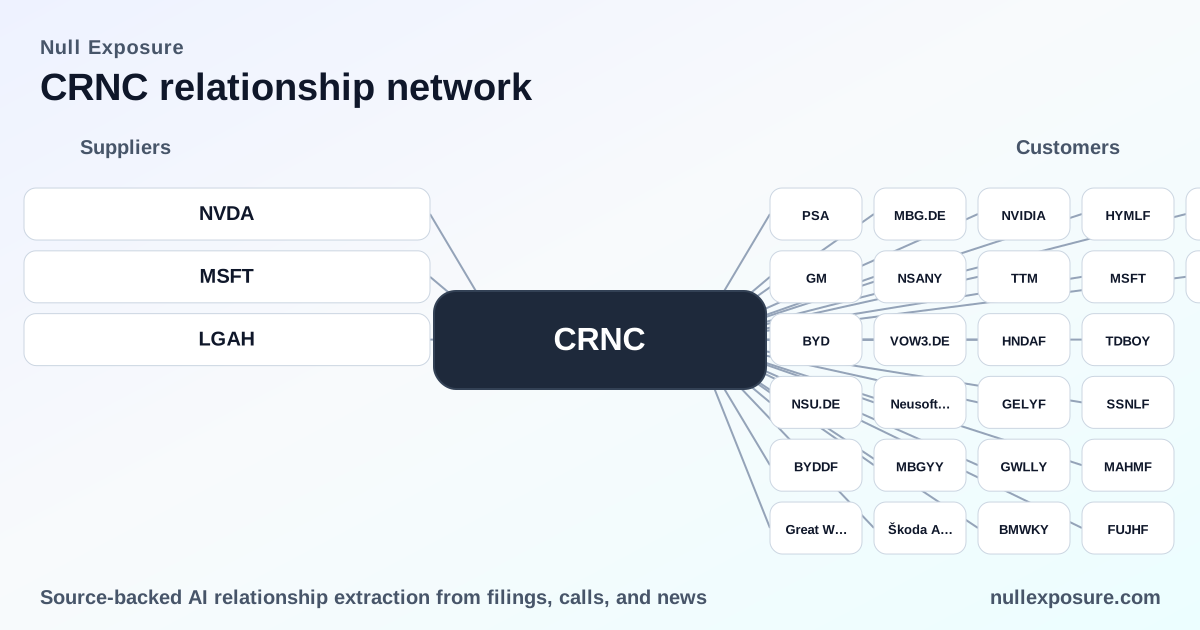
Cerence Inc (CRNC) — supplier relationships that power in-car AI and where value flows
Cerence sells AI software and voice assistants into automotive and consumer electronics channels, monetizing through software licensing, cloud-enabled deployments, and professional services tied to OEM programs. The company packages on-device components, cloud services and integration work into contracts with automakers and device makers; its commercial traction is increasingly dependent on cloud and GPU partners for production-grade generative-AI experiences while legacy licensing arrangements underpin IP flexibility. Explore deeper partner intelligence at https://nullexposure.com/.
How the partner stack shapes Cerence’s business model
Cerence’s operating model is platform + services: commercial deals bundle licensed software, ongoing cloud usage (runtime and model hosting), and implementation services. That mix produces predictable recurring revenue from licenses and cloud consumption, with episodic professional-services revenue for integration. The constraints signal a clear contracting posture:
- Licensing is a core contract type: corporate disclosures show reciprocal IP licensing arrangements governing core technology, which supports redistribution to Cerence customers and resellers.
- Dual-role commercial posture: the company acts both as a licensee of third-party technologies and as a service provider delivering integration and voice/AI implementations to OEMs and partners.
- Operational maturity is mixed: gross margins are healthy (gross profit roughly $249M on $316M revenue TTM), but quarterly revenue and earnings growth are uneven — the business is scaling AI features while still extracting value from legacy products.
These characteristics imply concentration and criticality risk around a small set of cloud/GPU suppliers and key OEM relationships: if cloud partners or platform ecosystems change commercial terms, Cerence’s cost-to-serve and product roadmap economics will shift quickly.
Relationship-by-relationship: who does what and why it matters
NVIDIA — GPU and edge/cloud platform for Cerence xUI
Cerence has publicly positioned its Cerence xUI hybrid AI platform to run on NVIDIA AI Enterprise, with deployments by multiple global automakers slated for production in 2026; NVIDIA’s blog highlights Cerence tapping NVIDIA’s cloud and edge expertise to deliver generative in-car experiences (blog post, March 9, 2026). These arrangements make NVIDIA a critical infrastructure partner for Cerence’s advanced model deployments. (Source: NVIDIA blog and company announcements, March 2026)
Microsoft / Microsoft Azure — cloud host and integration partner for productivity and trusted-device scenarios
Cerence announced collaborations linking vehicle assistants into Microsoft productivity services and leveraging Azure as a production cloud host for Cerence xUI; MotorTrend reported integration that uses Azure to make cars “trusted devices” for calendar and Office connectivity (MotorTrend, March 2026), and other reports confirm that Cerence runs NVIDIA DGX Cloud on Microsoft Azure for model training and inference (NVIDIA blog / ad-hoc-news, March 2026). Microsoft’s platforms therefore serve both service integration and cloud compute roles for Cerence. (Sources: MotorTrend, NVIDIA blog, ad-hoc-news, March 2026)
Microsoft Azure (called out separately in reporting) — co-engineered cloud/GPU environment
Reporting specifically calls out DGX Cloud on Microsoft Azure as the environment Cerence leverages for scalable AI training and inference, a configuration that combines Microsoft’s cloud services with NVIDIA’s optimized stack for vehicle-grade workloads (NVIDIA blog, March 2026). This pairing materially reduces time-to-production for large models and standardizes deployment for OEM customers. (Source: NVIDIA blog / ad-hoc-news, March 2026)
LG — voice and TTS distribution across consumer devices
Cerence disclosed a partnership with LG to power voice interaction across LG’s television lineup, supporting 65 voices and languages across tens of millions of households; that program was discussed on Cerence’s fiscal Q3 2025 earnings call as a formally announced partnership (earnings call, 2025 Q3). LG represents a non-automotive channel that scales Cerence’s text-to-speech and voice IP into consumer electronics distribution. (Source: Cerence 2025 Q3 earnings call)
Nuance (from Cerence’s intellectual property agreement) — reciprocal IP licensing that underpins distribution rights
Company filings describe an Intellectual Property Agreement with Nuance that granted reciprocal, perpetual, non‑exclusive licenses to certain patents and technology; under a final agreement Nuance licensed designated Nuance technologies to Cerence for internal use and distribution to Cerence end-users and resellers. This contractual arrangement is a structural element of Cerence’s licensing model and affects its freedom to operate and product packaging. (Source: company filing — Intellectual Property Agreement)
Why each relationship matters to investors
- NVIDIA and Azure together form the execution layer for Cerence’s generative-AI roadmap; they are operationally critical because xUI’s performance and cost profile depend on GPU/cloud economics. If GPU pricing or licensing changes, Cerence’s unit economics for next‑generation offers will be affected.
- Microsoft relationships expand functionality and OEM value by embedding productivity and identity/trusted-device capabilities that extend Cerence’s TAM beyond pure voice recognition.
- LG shows product diversification into consumer electronics distribution, demonstrating Cerence’s ability to reuse voice/TTS assets outside automotive.
- The Nuance IP agreement provides legal and commercial flexibility that allows Cerence to package third‑party technologies under its own go‑to‑market, but it also signals legacy IP complexity that investors should monitor.
Investment implications and risk checklist
- Revenue mix dependency: Cerence’s monetization combines licensing and cloud consumption; cloud-hosted generative features drive future upside but also introduce variable costs tied to partner pricing.
- Partner concentration risk is elevated: reliance on a small number of cloud/GPU providers increases bargaining leverage for suppliers and exposes Cerence to infrastructure cost shocks.
- Service delivery is material: professional services and third-party contractors have historically influenced margin swings; filings show a material reduction in contractor costs in FY2025, evidencing active management but also operational sensitivity.
- Commercial maturity vs. innovation: the company demonstrates strong gross margins and an enterprise software profile, yet growth rates are uneven as it transitions into cloud‑native generative offerings; investors should weigh execution risk on scaling xUI into production vehicles in 2026.
Mid‑stage investors and operators looking to model Cerence’s supplier exposure should track GPU/cloud pricing, OEM deal timings, and contract language around runtime licensing. For deeper partner intelligence, visit https://nullexposure.com/ to see how supplier relationships translate into commercial and operational risk.
Bottom line and recommended next steps
Cerence is a software-first vendor extracting value through licensing and cloud-enabled AI features, with NVIDIA and Microsoft/Azure as the pillars supporting its next generation of in‑car experiences and Nuance-era IP agreements shaping rights and redistribution. LG demonstrates optionality beyond automotive. Monitor partner commercial terms, cloud/GPU costs, and OEM rollout timelines as primary drivers of valuation re-rating.
For structured supplier risk profiles and ongoing monitoring of Cerence’s partner landscape, start with our home page: https://nullexposure.com/. For customized exposure analysis and alerts relevant to CRNC relationships, see https://nullexposure.com/ and contact our research team.