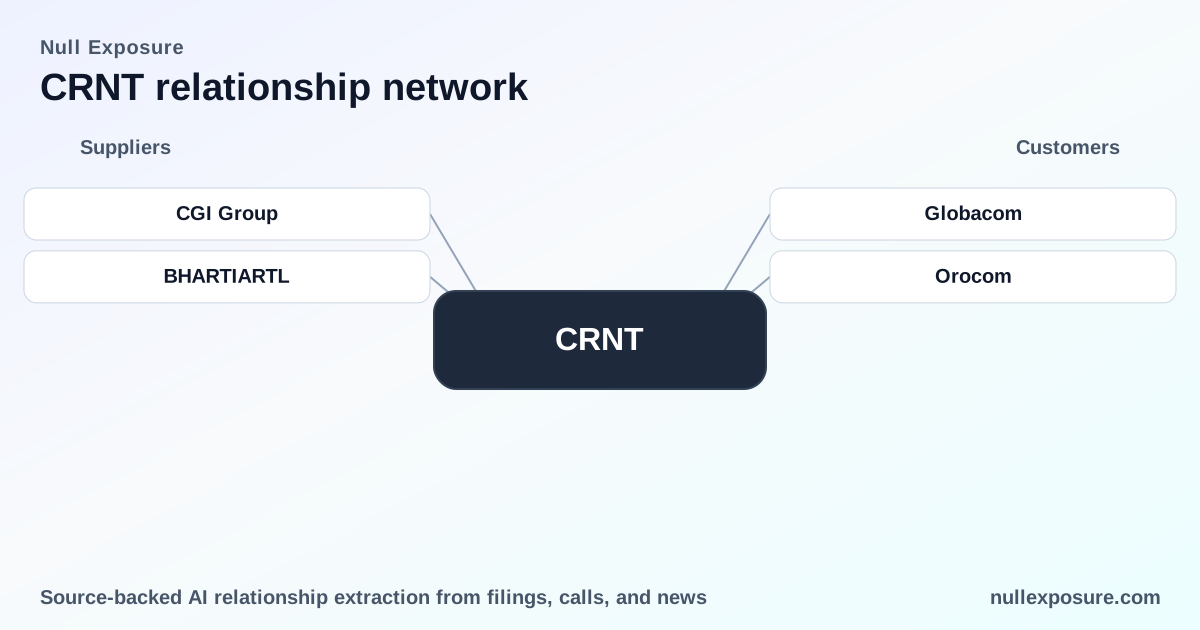
Ceragon Networks (CRNT): supplier relationships and what they signal for investors
Ceragon Networks sells wireless backhaul equipment and services to mobile carriers and wireless service providers, monetizing through hardware sales, software/firmware, and installation/maintenance contracts that support carrier network rollouts and capacity upgrades. Its revenue mix is project-driven with recurring maintenance and support, and the company extracts margin from software and managed-services attachments to hardware deployments. For investors and operators, the central investment thesis is straightforward: Ceragon is a niche infrastructure supplier exposed to large carrier capital cycles, where winning or losing a few anchor contracts materially affects near-term revenue and cash flow. Learn more about our supplier coverage at https://nullexposure.com/.
What Ceragon sells, who pays, and how the economics work
Ceragon’s product set supports cellular operators’ need to transport voice and data between radio sites and core networks; monetization is a blend of one-time equipment sales and multi-year service/maintenance contracts. The company reported $338.7 million revenue (TTM) with $114.6 million gross profit, and a modest operating margin (about 2.1% TTM), indicating a business that is profitable at the operating level but sensitive to order timing and margin compression. Market capitalization of roughly $207 million and EBITDA of $25.4 million show a small-cap supplier profile where balance-sheet management and customer concentration determine risk-adjusted returns.
Key operating characteristics to watch:
- Contracting posture: Project-driven wins with attached recurring services; success depends on multi-vendor carrier procurement cycles and integration capability.
- Concentration/criticality: Deals with tier-one carriers deliver outsized revenue and are mission-critical for customers, raising switching costs but also revenue volatility.
- Maturity/predictability: Negative reported EPS (TTM diluted EPS: -0.02) and uneven quarterly growth suggest revenue lumpyness with sensitivity to carrier capex timing.
What the record shows about Ceragon’s supplier relationships
Below are the relationships captured in the available coverage. Each relationship is summarized in plain English and tied to the original reporting.
CGI Group — vendor engagement to recover receivables
A March 2026 Globes report indicates Ceragon engaged CGI Group to assist in recovering a debt, including a reported $200,000 advance as part of the engagement for FY2023 collection efforts. This shows Ceragon uses external professional services for credit recovery when on-balance receivables require escalation, and suggests working-capital pressure in that period (Globes, March 9, 2026).
Bharti Airtel — a carrier customer in India
Previous coverage referenced Ceragon’s role expanding network capacity for Bharti Airtel, confirming Ceragon supplies equipment or services supporting one of India’s largest mobile operators; this is cited in the context of acquisition interest reported by Globes for FY2022. The mention underlines Ceragon’s exposure to large international carriers and the strategic importance of its products in dense, growth markets (Globes, March 2026).
How to interpret these relationships for supplier risk and value
The two documented relationships point to two separate dynamics that investors and operators must weigh:
-
Customer footprint includes tier-one carriers. The Bharti Airtel mention is a positive commercial signal: Ceragon competes for and wins business from large incumbent operators, which validates product-market fit in high-volume, high-demand geographies. This increases revenue upside but also binds Ceragon to capex cycles of large carriers.
-
Receivables management can be active and costly. Contracting external help like CGI Group for debt recovery and the advance payment cited for FY2023 are operational signals that Ceragon has to actively manage working capital and collections. This raises short-term liquidity and credit risk considerations for suppliers and investors.
Mid-read: if you are reviewing supplier exposure or building a sourcing strategy, see our platform for deeper relationship analytics at https://nullexposure.com/.
Company-level constraints and operating signals
There are no formal constraint entries attached to the relationship records; nevertheless, company-level financials and governance metrics provide clear operating signals:
- Liquidity and scale: Market cap near $207M with modest EBITDA implies limited scale to absorb major order delays or large receivable write-offs.
- Profitability profile: Positive gross profit and operating margin contrast with a small negative EPS, implying the business is operating profitably at the product level but still coping with non-operating costs or timing effects.
- Ownership and governance: Insider ownership (
13.9%) and institutional ownership (19.3%) indicate a mixed governance base; the stock carries a beta of 1.25, reflecting sensitivity to market and sector swings. - Analyst view: Aggregate analyst targets and ratings skew positive (a mix of Buy and a Strong Buy), with an average target price of $4.75, suggesting institutional analysts see upside relative to current pricing.
These company-level signals translate into a supplier profile that is operationally essential to carrier customers but financially exposed to cash-collection and capex timing risk.
Investment implications — what to watch and how to position
For investors assessing CRNT as a supplier-exposed holding or procurement partner, the trade-offs are clear.
Primary opportunities:
- Growth leverage to carrier capex: If large operators in growth regions like India accelerate 5G or densification projects, Ceragon benefits disproportionately from its product set.
- Service attach economics: Expansion of recurring maintenance and software services can improve margin stability and reduce lumpiness.
Primary risks:
- Working capital strain: Evidence of paid recoveries and external collection assistance indicates receivable risk that can compress free cash flow.
- Concentration and lumpy contracts: A few large deals drive revenue swings; losing an anchor customer or delayed orders will materially impact near-term results.
Actionable items for investors and operators:
- Monitor reported receivable actions and cash-flow statements quarterly to detect worsening collection dynamics.
- Track pipeline disclosures related to large carriers (for example, India rollouts) as forward indicators of revenue acceleration.
- For procurement teams, negotiate payment terms and performance milestones that mitigate concentration risk.
Before you commit capital or award supplier contracts, get the latest relationship intelligence and contract-level signals from our platform: https://nullexposure.com/.
Bottom line
Ceragon is a focused wireless-backhaul supplier selling to tier-one carriers with meaningful upside tied to carrier capex cycles and service-attach expansion. Its relationships with large operators like Bharti Airtel validate the commercial product set, while engagement of recovery specialists such as CGI Group signals working-capital pressure that investors must monitor. For supplier diligence and real-time relationship monitoring, our coverage at NullExposure centralizes the signals operators and investors need to act decisively.